

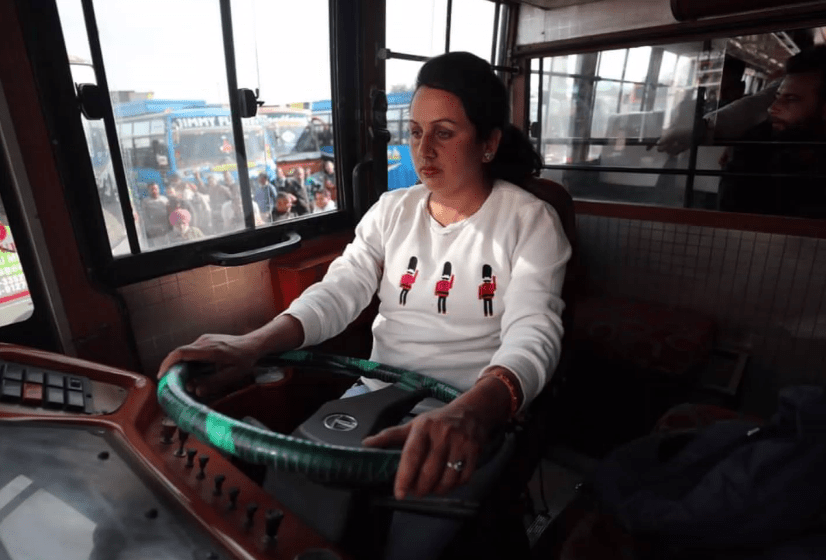
Female Drivers in Kashmir Talk About Gender Bias
In the midst of chaos, on a hot June afternoon, Tabish was drenched in sweat, her eyes oscillating from the red traffic light to the clock on her car’s android system and her hands anxiously circling the steering wheel.
Tabish’s car was stuck in a traffic jam on the busy Srinagar road for the past half an hour. Once the green signal was displayed, Tabish heaved a sigh of relief, finally ready to reach her destination. Bringing her car to life, she was all set to leave the place when out of nowhere a tempo driver came behind her car honking non-stop and shouting at her blaming her for creating a traffic jam that was in actuality because of bad traffic management and faulty traffic lights on a four-view junction.
“I was already so anxious because I had to reach my examination center but this man out of nowhere started verbally abusing me for no apparent fault of mine. I was dumbfounded and couldn’t comprehend the scenario. I started shivering and had a breakdown.”
Tabish skipped her paper that day and went straight to her home, weeping all along. The instance weekend the confidence of Tabish who is otherwise a confident driver. “People don’t understand how much effect their words can have on people; their minds, their confidence. The incident left my already disturbed mental state in complete shambles.”
The public-private dichotomy dictates much of what women are allowed to do. Things that resonate with what women are told to do in private spaces are allowed to do in public spaces as well.
Dr. Shazia Malik, Assistant Professor of Gender Studies at the University of Kashmir puts it, “The perception is that the street is a part of the public sphere that belongs to men. In the context of driving, it completely belongs to the street. Therefore, women need not own any part of it. The harassment of women drivers is an outcome of social expectations and traditional gender roles.”
The public-private dichotomy dictates much of what women are allowed to do. Things that resonate with what women are told to do in private spaces are allowed to do in public spaces as well.
“Women are encouraged to work as teachers and professors because the job involves nurturing that is an extension of the gender roles women are assigned in the private spaces. But they are rarely encouraged to ride a bike and drive a car,” says Dr. Shazia. Dr. Shazia further explained that even when they have a green signal to learn the skill, it doesn’t come from a place of trust but mostly to minimize the threat of sexual harassment that happens in public transport.
Misba, a post-graduate student also had the same reason for learning how to drive that Dr. Shazia explained, she faced rampant sexual harassment in public transport.
In Shazia’s opinion, if women make any mistake while driving it is because of her gender and she will be instantly questioned which will eventually lead to losing access to transport altogether.
When Misba joined a reputed driving school in the valley, she was enthusiastic as she would finally be free from the vultures traveling in the public buses. Still, on the very first day of her driving on the road with her driving coach, Misba could feel the stereotype in her trainer’s scolding and sighs.
“He was very harsh with me and I couldn’t fathom the possible reason for such behavior. I was bound to make mistakes, after all, it was my first time on the road. Somehow, I couldn’t help but think that it was because of my gender. He was already irritated because of the stereotype,” remembers Misba. “My confidence was shaken a lot. I was thinking maybe I am not worth learning. I had to change the trainer eventually.”
In Shazia’s opinion, if women make any mistake while driving it is because of her gender and she will be instantly questioned which will eventually lead to losing access to transport altogether. This stereotype in society has made women less courageous to face any hurdle on the road, even when they are not at fault. “The irony is that women have also become a part of this categorization of good and bad drivers based on gender.”
Multiple studies over the years have shown that women are better drivers than men and do not cause accidents that result in death or disability.
Shazia has herself bore the brunt of harassment because of being a female driver. She has seen harassment countless times and her conclusion is that men feel threatened because they feel that if women become more and more a part of the public sphere, the patriarchy may get dismantled, and subsequently so will their control over them.
“I recall an incident when a man made a derogatory comment while I was driving through a challenging situation, suggesting, Give the car to a man from your household; he knows how to drive. Interestingly, when a man asks another man for space, the response is usually a simple observation like, “Looks like he’s new on the road.” It is disgusting how generalizations about women’s capabilities are made.”
People holding powerful positions can easily inculcate women drivers in the public transportation sector and provide them with the necessary training to break stereotypes around women driving.
While most men seem to degrade women drivers with sexist criticism on the road, some have contrary opinions that women tend to feel nervous because of the confirmed societal bias associated with them.
“Not all men feel threatened, we understand that women are bound to get nervous in tricky situations. As society has anyways strengthened the notion of looking at women as weak creatures, thinking that women can’t drive has already gotten embedded in our psyche. It’s more of a psychological issue to me, said Amir, a professional photographer.”
Dr. Shazia believes that the solution to this deep-rooted problem lies with the government. The government needs to give women access to transport. People holding powerful positions can easily inculcate women drivers in the public transportation sector and provide them with the necessary training to break stereotypes around women driving. This will not only provide females with empowerment but will also create gender inclusivity. Dr. Shazia further elucidated that starting with small transports like cabs will help women to have a foot in public spaces. It will also help in changing the mindset of people and the skewed narrative about women owning such spaces. Another benefit of such initiatives would be a safer mode of transport for female commuters, especially during late hours.
In Tabish’s opinion, men also need to have an open mind and not only let women have a wide space for learning something that has traditionally not been a women-dominated space but also understand the implications of it.
“The biggest hurdle is that women fear losing access and that nervousness forces them to make more mistakes. It is not about capabilities, it is about narratives and notions otherwise no woman would have ever thought of being behind the wheel,” says Tabish.
Do you want your story to be the next published guest piece? Send us your submissions at editorial@muslimgirl.com.