

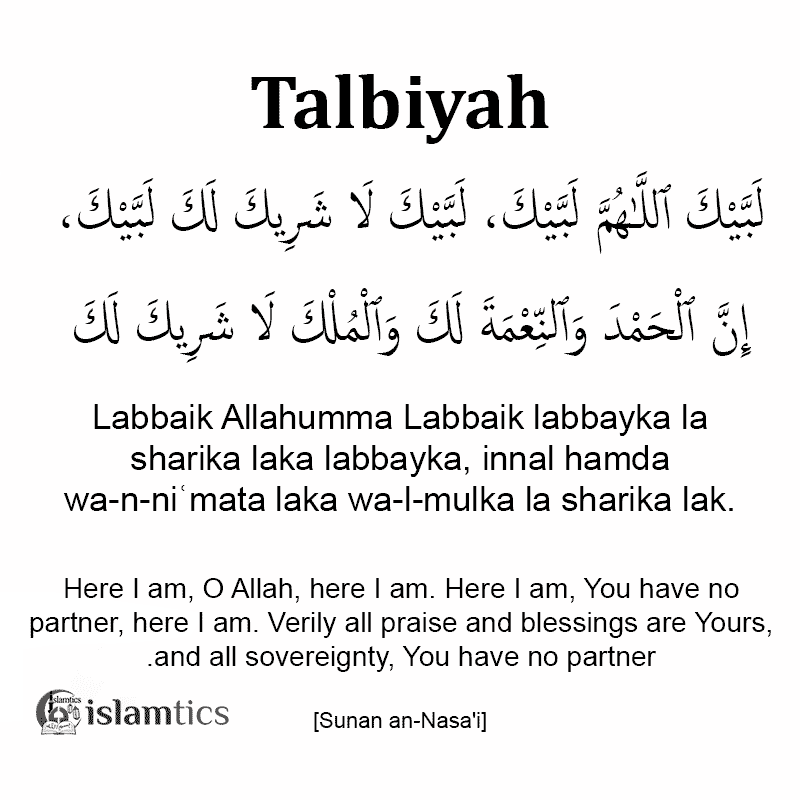
Labbaik Allahumma Labbaik -Talbiyah- in Arabic, Meaning & Benefits
Labbaik Allahumma Labbaik Dua also referred to as Talbiyah is repeatedly recited when Muslims go for Hajj, Eid prayer, a pilgrimage, or putting on the Ihram.
Labbaik Allahumma Labbaik in Arabic

The Talbiyah is written in Arabic with the Diacritical as:
لَبَّيْكَ ٱللَّٰهُمَّ لَبَّيْكَ، لَبَّيْكَ لَا شَرِيكَ لَكَ لَبَّيْكَ، إِنَّ ٱلْحَمْدَ وَٱلنِّعْمَةَ لَكَ وَٱلْمُلْكَ لَا شَرِيكَ لَكَ
and Without the Diacritical:
لبيك ٱللهم لبيك، لبيك لا شريك لك لبيك، إن ٱلحمد وٱلنعمة لك وٱلملك لا شريك لك
Transliteration
Labbaik Allahuma Labbaik labbayka la sharika laka labbayka, innal hamda wa-n-niʿmata laka wa-l-mulka la sharika lak.
Labbaik Allahumma Labbaik Meaning
The meaning of the Labbaik Allahuma Labaik in English is
“I am here at Your service, O Allah, I am here at Your service. I am here at Your service, You have no partner, I am here at Your service. Surely the praise, and blessings are Yours, and the dominion. You have no partner.“
Talbiyah Pronounciation
https://www.youtube.com/watch?v=zw_8HHMSISg
Dua Benefits
The benefits of reciting this dua are the things that this supplication is asking for which are:
- It is a form of remembrance of Allah and that He alone is the source of all blessings without any partner.
- Reciting it covers the concept of Tawhid by stating “Allah has no partners”
- By reciting it you offer complete Submission to Allah (S.W.T).
- While it humbles you as an individual but it gives you power as one Umah who speaks with one voice that they are willing to do anything for Allah’s sake.
- It is a Sunnah that we learned from our prophet Muhammed(ﷺ) and you are good deeds for following it.
Dua Source
It was narrated that ‘Abdullah bin ‘Umar said: “The Talbiyah of the Messenger of Allah was: “Labbaika Allahumma Labbaik, Labbaika la sharika laka labbaik. Innal-hamda wan-ni’mata laka wal-mulk, la sharika lak (Here I am, O Allah, here I am. Here I am, You have no partner, here I am. Verily all praise and blessings are Yours, and all sovereignty, You have no partner.”
Sunan an-Nasa’i 2749