

The Weight of Time: Measuring Time Beyond the Clock
LnRiLWNvbnRhaW5lciAudGItY29udGFpbmVyLWlubmVye3dpZHRoOjEwMCU7bWFyZ2luOjAgYXV0b30gLndwLWJsb2NrLXRvb2xzZXQtYmxvY2tzLWNvbnRhaW5lci50Yi1jb250YWluZXJbZGF0YS10b29sc2V0LWJsb2Nrcy1jb250YWluZXI9ImViOGY4Njg0MjRkZTEzYzdhZjZmZTZmOGQzOTIxNjIwIl0geyBiYWNrZ3JvdW5kOiByZ2JhKCAyMzgsIDIzOCwgMjM4LCAxICk7cGFkZGluZzogMjVweDttYXJnaW4tdG9wOiAxMHB4O21hcmdpbi1ib3R0b206IDEwcHg7IH0gQG1lZGlhIG9ubHkgc2NyZWVuIGFuZCAobWF4LXdpZHRoOiA3ODFweCkgeyAudGItY29udGFpbmVyIC50Yi1jb250YWluZXItaW5uZXJ7d2lkdGg6MTAwJTttYXJnaW46MCBhdXRvfSB9IEBtZWRpYSBvbmx5IHNjcmVlbiBhbmQgKG1heC13aWR0aDogNTk5cHgpIHsgLnRiLWNvbnRhaW5lciAudGItY29udGFpbmVyLWlubmVye3dpZHRoOjEwMCU7bWFyZ2luOjAgYXV0b30gfSA=
So as for those whose scale is heavy ˹with good deeds˺,
they will be in a life of bliss.
And as for those whose scale is light,
their home will be the abyss.
Our view of time has been hijacked by the modern world.
In my article “The Tyranny of the Mechanical Clock” I argue that measuring our time by the clock has turned time into a currency; something to be spent, saved, and maximized for economic output.
When we believed time is money, we started measuring our days by productivity and output instead of what’s meaningful.
- If you pause to pray, that’s 10 minutes you could be working.
- If you sit with your mother over tea, that’s an hour with no ROI.
- If you decide to block time to recite the Quran, you’ll question if it was ‘productive’.
Everything sacred starts to feel like a waste of time. And everything that feeds the machine (more meetings, more output, more hustle) feels like time well spent. Even at the expense of your health, your relationships, and your soul.
This explains why we’re addicted to hustle culture and never seem to be able to shift to Barakah culture.
The Scale That Matters
Islam gives us a different way to measure the value of time.
In the Quran, Allah (SWT) does not speak of time as currency to be maximized. He speaks of time as something that will be weighed. In the above verses from surat Al-Qari’ah which we opened this article with, Allah describes a Day when every soul will stand before a scale, a mizan that will weigh each person’s good deeds vs. bad deeds. Our final destination in the hereafter is determined by this mizan.
But where do deeds happen? They happen in the limited time we have on this earth.
Therefore, every moment can be heavy with remembrance or light with heedlessness,heavy with obedience in the scale of good deeds or heavy with sin in the scale of bad deeds.
The moment takes on the weight of what we place inside it. This means time has weight. Not intrinsic weight, but carried weight. the weight of the deeds, intentions, and choices we pour into it.
So how do we make our time heavy?
I want to propose seven dimensions through which we can measure and increase the weight of our time. Think of these as seven scales nested within each other, from the smallest unit of time to the largest: the moment, the hour, the day, the week, the month, the year, and the lifetime.
Let’s walk through each one.
1. The Weight of the Moment
The smallest unit of weighted time is the moment – what you do with right now.
There’s a term for this in Islamic science of spirituality called ibn al-waqt, the son of the moment. It means being fully present where you are, not dragged by regret over the past or pulled forward by anxiety about the future. Just being present.
Your challenge is to make each moment heavy as an abd (slave) of Allah.
What does that look like practically?
It looks like keeping your tongue moist with dhikr while standing in line at the grocery store, instead of reaching for your phone and scrolling through another set of pointless reels. It looks like lowering your gaze the instant it falls on something inappropriate, and not letting your gaze lingers until it turns into a desire. It’s about being truly present in your salah, praying as if it’s your last prayer, and not rushing through it while mentally composing your to-do list.
The Prophet ﷺ taught us that small moments can carry enormous weight on the day of judgement through numerous hadith including this one:
Two words are light on the tongue, heavy on the scale, beloved to the Most Merciful: SubhanAllahi wa bihamdihi, SubhanAllahil Adheem.
Light on the tongue. Heavy on the scale.
2. The Weight of the Hour
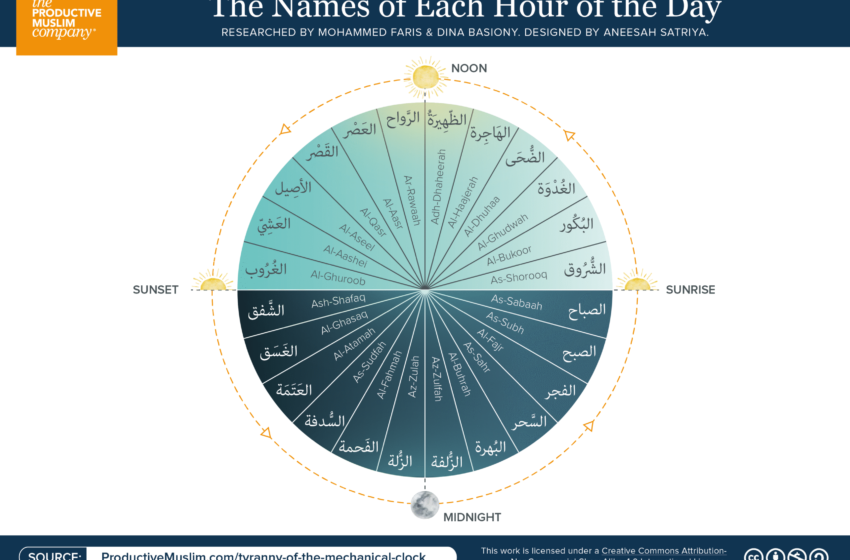
The word sa’a in Arabic is often translated as “hour”. But it doesn’t necessarily mean sixty minutes. Before mechanical clocks, a sa’a meant a part of the day, a fluid stretch of time that expands and contracts with the season and the task.
In fact, the Arabs used to give each part of the day its own name, as depicted in the image below:

Making an hour heavy isn’t about cramming more tasks into sixty-minute blocks. It’s about being intentional with each part of your day, knowing what you will do, why you’re doing it, and how it connects to your akhira.
This is about fulfilling the rights of each part of your day according to the different roles you play. With the right intentions, the hour you spend as a parent playing with your kids, or prepping a meal, or the hour you spend in focused work, or rest, can all be heavy on the day of judgment.
Ask yourself at each part of the day: What is this hour for? And how can I make it heavy?
3. The Weight of the Day
The weight of the day is anchored by the five daily prayers.
Salah is not an interruption to your day. It is the structure of your day that allows you to fill what’s in between with meaningful hours and moments.
The five prayers sync your internal rhythm with the movement of the sun and your biological clock
Unfortunately, most of us have artificially structured our days around the 9-to-5 work structure which decouples us from the celestial world and the natural rhythm. Salah restores a fitra (natural disposition) based routine aligned with creation itself.
A day becomes heavy when you pray on time. When you fill it with intentional hours and meaningful moments.
The weight of the day increases with each act of service to others – visiting the sick, attending a funeral, fulfilling the needs of others, seeking beneficial knowledge, giving charity, and yes, earning an honest living.
Ibn Umar رضي الله عنه said:
When evening comes, do not wait for morning. And when morning comes, do not wait for evening.
A heavy day is one lived with this purposeful urgency. not rushing, but present. Not waiting for time to pass, but filling it with what will weigh heavily on the day of Judgement.
4. The Weight of the Week
The weight of the week is not measured from Monday to Friday, with a “weekend” as a reward for your labor.
In Islam, the week begins and ends with Jumu’ah.
The Prophet ﷺ said:
The best day on which the sun rises is Friday. On it Adam was created, on it he entered Paradise, and on it he was expelled from it. And the Hour will not be established except on Friday.
(Muslim)
Friday is the anchor. It’s the day we pause from business before the prayer, gather to hear a reminder, and seek Allah’s forgiveness during that special hour when no dua is left unanswered. We cap our week with the recitation of Surah Al-Kahf, so it gives us light that guides us until the following Friday.
But Friday isn’t just about showing up. The weight of your Friday increases when you prepare for it: performing ghusl, wearing your best clothes, arriving early to the masjid, sitting close to the imam, listening attentively, and sending abundant salawat upon the Prophet ﷺ.
And the week is punctuated by voluntary fasting on Mondays and Thursdays. Why these days? The Prophet ﷺ told us:
“Deeds are presented on Monday and Thursday, and I love for my deeds to be presented while I am fasting.”
(Tirmidhi)
Imagine: your deeds are being shown to Allah twice a week. What do you want Him to see?
This creates a rhythm for your week that starts and ends with Friday and is punctuated by fasting on Mondays and Thursdays.
We don’t measure our weeks by how much we produce at work. We measure them by how we structured them to get closer to Allah, fulfill the rights of others and ourselves, and yes, how productive we were without compromising our spirituality, health, and relationships.
That’s what makes a week heavy.
5. The Weight of the Month
The Gregorian months – January, February, and March. etc – are spiritually hollow. Named after Roman gods and emperors, they carry no meaning beyond administrative convenience.
The Islamic months are different. They are spiritually alive as I share in my article, “Why The Islamic Calendar Matters More Than You Think“.
When you see a new moon, your hope is renewed, no matter what difficulties you went through the previous month. This hope is captured in this beautiful dua that is said at the sight of the new month:
“Allāhumma ahillahu ʿalaynā bil-yumni wal-īmān, was-salāmati wal-islām. Rabbī wa rabbuk Allāh.” (O Allah, bring this moon upon us with blessing, faith, safety, and Islam. My Lord and your Lord is Allah.)
The lunar cycle is a monthly reminder of your life’s arc.
The moon begins as a sliver—weak, barely visible. Night by night, it waxes until it reaches its fullness. Then it wanes, shrinking back to darkness. Similarly, you start weak. You grow into strength and maturity. And then, inevitably, you decline. The moon shows you this arc every single month, not to discourage you, but to wake you up. Where are you in your arc?
When the moon is full, we are encouraged to fast the three white days—the 13th, 14th, and 15th of the lunar month. Why? Perhaps to remind us: when you are at your fullest, that is precisely when you should restrain yourself. Humble yourself.
If fasting those days consecutively is difficult, we’re reminded to fast any 3 days of the month to make the month weigh heavy on the scale of the day of judgement.
Finally, the sacred months – Dhul Qi’dah, Dhul Hijjah, Muharram, and Rajab – carry extra weight. Good deeds are heavier in these months and so are bad deeds and sin. These months invite us to be God-conscious and have taqwa so we they weight heavy on our scales.
6. The Weight of the Year
The weight of a year is measured by how you make the most of Ramadan.
Consider this hadith:
Two men from the tribe of Bali came to the Prophet ﷺ and accepted Islam together. One of them was more rigorous in his striving than the other. The more striving one went out to fight and was martyred. The other lived for another year, then passed away.
Talhah ibn Ubaydillah رضي الله عنه saw them both in a dream. He was standing at the gates of Paradise when someone came out and admitted the one who died last first. Then he admitted the martyr. Talhah woke up amazed and told the people, and they were equally astonished. How could the one who died on his bed enter Paradise before the one who died as a shaheed?
When the Prophet ﷺ heard this, he wasn’t surprised. He asked:
“Did he not stay behind for a year?”
They said yes.
“And did not Ramadan come, and he fasted it, and he offered such and such prayers during that year?”
They said yes.
The Prophet ﷺ said:
“The difference between them is greater than the difference between heaven and earth.”
This is the weight of a year.
And within Ramadan lies an even greater gift: Laylatul Qadr, the Night of Power, which is better than a thousand months. One night that carries more weight than eighty-three years of worship. Allah, in His mercy, placed a lifetime’s worth of weight inside a single night.
If you want to make your year heavy, pour yourself into Ramadan. And within Ramadan, pour yourself into the last ten nights. And within the last ten nights, seek the night that outweighs a thousand months.
7. The Weight of a Lifetime
The weight of your lifetime is the sum of all above. On the day of Judgement, we’ll be asked 5 questions, one of them is about how our life and how we spent it. Every moment, every hour, every day, month, and year – they all add up to give us the weight of our lifetime.
But Allah, in His mercy, also gives us a chance for a hard reset: Hajj.
The Prophet ﷺ said:
Whoever performs Hajj and does not commit any obscenity or transgression will return [free from sins] as on the day his mother bore him.
So if you felt that your lifetime is ‘light’ from good deeds and heavy with sin. Then, Hajj is a chance to wipe the slate clean. To reset the scale/mizan, in your favor.
And after you die, you can still add weights to your scale. How? The Prophet ﷺ told us:
When a person dies, their deeds come to an end except for three: ongoing charity, knowledge that benefits others, and a righteous child who prays for them.
(Muslim)
The question of our lifetime is not: how much did I accomplish? It’s: how heavy will my scale be when I stand before my Lord?
What Does This Mean For You?
The surat after Surat Al-Qariah that we began this article with is Surat Al-Takathur, where Allah reminds us that our racing and competition towards worldly gain distracts us from our true purpose in life.
Competition in [worldly] increase diverts you, until you end up in ˹your˺ graves.
When you see time as money, you’ll only value your time based on economic output and you’ll find yourself constantly racing until you reach the grave.
But when you see time as scale/mizan, everything shifts.
You’ll stop asking: How do I get more done? You start asking: How do I make this moment heavy?
Monday morning feels different. It’s not the start of another exhausting week, it’s a day your deeds are presented to Allah. You want to be fasting.
Being stuck in traffic is not wasted time; it’s an opportunity to say “SubhanAllah wa bihamdihi, SubahanaAllah al-atheem,” which is light on the tongue, heavy on the scale.
Praying Dhuhr in the middle of a busy day won’t feel like an interruption, but a welcome pause from the rat race of life.
The goal is no longer to reach the end of your life having done the most. The goal is to reach the end of your life having carried the most for your hereafter.
…Whatever good you do, Allah ˹fully˺ knows of it. Take ˹necessary˺ provisions ˹for the journey˺—surely the best provision is righteousness.