


Friday Sermon Summary 23rd January 2026: ‘The Holy Prophet’s (sa) Love for God Almighty’
Summary prepared by The Review of Religions
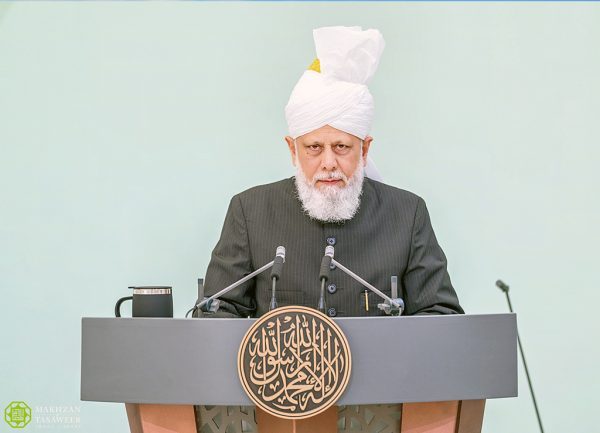
After reciting Tashahhud, Ta‘awwuz and Surah al-Fatihah, His Holiness, Hazrat Mirza Masroor Ahmad (aba) said that in previous sermons, he has been mentioning the Holy Prophet’s (sa) love for the God, and he would continue on this topic, with reference to traditions and the manner in which the Holy Prophet’s (sa) most ardent devotee, the Promised Messiah, Hazrat Mirza Ghulam Ahmad (as) has written on the topic.
The Holy Prophet’s (sa) Example in Supplicating
His Holiness (aba) said that one companion relates that one night he stood alongside the Holy Prophet (sa) in prayer. The Holy Prophet (sa) began reciting the second chapter of the Holy Qur’an, Surah al-Baqarah. The companion thought the Holy Prophet (sa) would bow down after reciting a hundred verses, but the Holy Prophet (sa) continued reciting. Then the companion thought that the Holy Prophet (sa) would bow down after completely reciting the entire chapter; however, the Holy Prophet (sa) continued reciting even after completing it. The companion then thought that the Holy Prophet (sa) would stop at some point; however, he completed the third chapter of the Holy Qur’an and moved on to the fourth. The Holy Prophet (sa) was not reciting at a fast pace; rather, he was reciting very carefully and deliberately. It would only be upon completing his recitation of the fourth chapter that he bowed down, and his bowing was as long as the time he had been standing. Then he stood back for a long time before going down into supplication, which was also similar in length to his standing.
His Holiness (aba) said that according to Hazrat A’ishah (ra), once the Holy Prophet (sa) stood in prayer whilst reciting the same chapter of the Holy Qur’an over and over after having recited the opening chapter of the Holy Qur’an. With regards to how long the Holy Prophet (sa) stood for, Hazrat A’ishah (ra) said that the length and beauty of the Holy Prophet’s (sa) prayers could not be described in words. Another companion relates that the Holy Prophet (sa) stood in prayer and recited one verse until the morning, and that verse was:
‘If Thou punish them, they are Thy servants; and if Thou forgive them, Thou surely art the Mighty, the Wise.’ (The Holy Qur’an, 5:119)
His Holiness (aba) said that when there was a solar eclipse during the lifetime of the Holy Prophet (sa), he offered prayer during the eclipse, thus teaching the manner of offering the eclipse prayer. Thereafter, the Holy Prophet (sa) delivered a sermon and said that the sun and the moon are signs of God, and so when sees them, they should glorify God, pray to Him and give charity. The Holy Prophet (sa) then enjoined Muslims towards worshipping and turning to God, saying that if they knew what he knew, they would certainly weep before God.
His Desire for Allah to Be Worshipped
His Holiness (aba) said that during the Battle of Badr, the Holy Prophet (sa) turned towards the direction of the Ka‘bah and prayed for God to fulfil His promise to the Holy Prophet (sa). The Holy Prophet (sa) prayed that if the Muslims were destroyed that day, then there would remain no one on the face of the earth to worship God. The Holy Prophet (sa) was praying so fervently that his body trembled to the point that the Holy Prophet’s (sa) mantle fell from his shoulders. Seeing this, Hazrat Abu Bakr (ra) placed the mantle back on the shoulders of the Holy Prophet (sa) and embraced him, saying that God would certainly fulfil His promises. Upon this, the following Qur’anic verse was revealed:
‘When you implored the assistance of your Lord, and He answered you, saying, ‘I will assist you with a thousand of the angels, following one another.’’ (The Holy Qur’an, 8:10)
His Holiness (aba) quoted the Promised Messiah (as) who writes:
‘In the Holy Quran, the Holy Prophet, may peace and blessings of Allah be upon him, was repeatedly given the promise of the victory over the disbelievers, but when the Battle of Badr – which was the first battle of Islam – started, the Holy Prophet, may peace and blessings of Allah be upon him, began supplicating and praying, and these are the words that issued from his tongue:
Meaning: ‘O my Lord! If you destroy these people (they were just three hundred and thirteen men), none will worship You till Doomsday.’
When Hadrat Abu Bakr, may Allah be p these words from the mouth of the Holy Prophet, may peace and blessings of Allah be upon him, he submitted, ‘O Prophet of Allah, may peace and blessings of Allah be upon him, why are you so perturbed? God has given you the firm promise that He would give victory.’ He said, ‘This is true, but I am keeping my eyes on the fact that He is in need of no one.’ That is to say, God is not obligated to fulfil any promise. Now, it must be understood that when the Holy Prophet, may peace and blessing of Allah be upon him, observed this much deference to the etiquettes of respect of God, why should one turn aside from this accepted belief of all Prophets, may peace be upon them, that sometimes God’s prophecy is fulfilled literally, and sometimes it is fulfilled metaphorically and figuratively?’ (Barahin-e-Ahmadiyya, Part V, pp. 343-344)
His Holiness (aba) further quoted the Promised Messiah (as) who writes:
‘Understand it well that true monotheists are those who do not make the slightest display of their virtues and are not afraid of the world in accepting the truth. They do not care if the world becomes alarmed by any of their actions. Some say that the extent to which the companions (ra) used to strive or fast is not proven in the case of the Holy Prophet, may peace and blessings of Allah be upon him. Some of the companions (ra) had well-nigh reached a life of monasticism.
It does not follow from this that they were (God forbid) superior to the Holy Prophet, may peace and blessings of Allah be upon him. Instead, the real issue is that the Holy Prophet, may peace and blessings of Allah be upon him, was brought before the world by Allah the Exalted through force and coercion. His habit of living behind a veil had not gone away. Who knows how much striving and worship he remained engaged in secretly.
On one occasion, Hadrat Ayesha, may Allah be pleased with her, states that it was the day that the Holy Prophet, may peace and blessings of Allah be upon him, would stay at her home. When she opened her eyes at night, she saw that the Holy Prophet, may peace and blessings of Allah be upon him, was not there. She was very surprised and looked for him. When he
was nowhere to be found, she discovered that he was in a cemetery supplicating with intense fervour, ‘O my God! My soul, my life, my bones, my every hair prostrates before You.’
Now, had Ayesha, may Allah be pleased with her, remained unaware of this incident, who would have fathomed his interpersonal relationship with his Lord? The same was the case with his striving and worship. Since Allah makes it a habit of these people that they stay hidden, the world does not come to know about their entire state of affairs. They do not do anything for the sake of the world. The one with whom there is some dealing and connection knows every place and sees.’ (Malfuzat, Vol. 8, pp. 317-318)
His Yearning for People to Abandon Shirk
His Holiness (aba) said that another example of the Holy Prophet’s (sa) love for God was when he went to preach the message of Islam to the people of Ta’if. However, ultimately, the people of Ta’if began pelting the Holy Prophet (sa) with stones, causing him to become wounded. Once, one of the Holy Prophet’s (sa) wives asked him whether he had experienced a day more painful than the day of Uhud, to which the Holy Prophet (sa) cited that day in Ta’if when he was pelted with stones and wounded. The Holy Prophet (sa) left Ta’if and made his way to a mountain, and when he looked up, he saw that the shade of a cloud had covered him, and the angel Gabriel descended. He told the Holy Prophet (sa) that God had seen everything that had just happened and said that the Holy Prophet (sa) could decide whatever he pleased regarding the people of Ta’if. The Holy Prophet (sa) even offered that the people of Ta’if could be crushed between two mountains. However, the Holy Prophet (sa) responded saying no, for it was possible that the progeny of those very people would believe in God and desist from associating partners with him.
The Greatest Delight of the Holy Prophet (sa)
His Holiness (aba) quoted the Promised Messiah (as) who writes:
‘‘That high degree of light which was granted to man – that is to say, upon the perfect man – was not within the angels, the stars, the moon, or the sun; neither was it in the oceans and the rivers of the earth, nor was it in rubies, emeralds, sapphires, diamonds, or pearls. In short, it was not in any earthly or heavenly object. It was only in man; that is, the perfect man, whose most complete, highest and loftiest, and most perfect example was our Lord and Master, the Chief of the Prophets, the Chief of all living ones, Muhammad, the Chosen One, may peace and blessings of Allah be upon him. So that light was bestowed upon this [perfect] man and, according to their ranks, upon all those who bear some degree of the same nature and disposition.
The trust refers to all faculties, intellect, knowledge, mind, life, senses, fear, love, honour, grandeur, and all the physical and spiritual bounties that God Almighty grants to the perfect man. Then, in compliance with the following verse, the perfect man renders all these back to His Divine Majesty [Allah]:
That is to say, he annihilates his self completely in Allah and devotes it entirely in His path, as I have explained already in describing the subject of the essence of Islam.
And this grand stature was found in its highest, complete, and most perfect form in our Lord, Master, and Guide, the Immaculate Prophet, the Righteous One, testified to by the righteous, Muhammad (sa) Mustafa, [the Chosen One], may peace and blessings of Allah be upon him. As God Almighty Himself says in the Noble Qur’an: Meaning that: Tell them that my prayer and my striving in worship, my sacrifices, my remaining alive, and my dying, are all for the sake of and in the way of God—that same God who is the Lord of all the worlds, who has no partner. And this is what I have been commanded to do. And I am the Foremost of the Muslims; that is, from the beginning of the world to its end, there is no other perfect man like me to attain such a lofty degree of self-annihilation in Allah and be able to return all the trusts of God Almighty to Him.
This verse contains a refutation of those ignorant Unitarians who hold the belief that our Holy Prophet, may peace and blessings of Allah be upon him, is not proven to have complete superiority over the other Prophets, and who say, on the basis of ahadith of weak authenticity, that the Holy Prophet, may peace and blessings of Allah be upon him, has forbidden that he be given superiority even over Yunus bin Matta [ Jonah son of Amittai]. These ignorant people do not realise that even if that hadith is authentic, it is only an expression of humility and modesty, which was ever the way of our Master, may peace and blessings of Allah be upon him. There is a time and occasion for everything. How ignorant and mischievous it would be if a righteous man, who describes himself in a letter as ‘the lowliest of all servants of Allah’, were to truly be considered the worst of all people of the world, to the extent of being even worse than the idolaters and all transgressors, because he himself acknowledges that he is the lowliest of all servants of Allah!
Think it over carefully. Allah, glorified be His eminence, names the Holy Prophet, may peace and blessings of Allah be upon him, as the first of the Muslims and He holds him to be the head of all who obey and submit and describes the Holy Prophet to be the first to fulfil the amanat given to him. Is there any room left after this for a believer in the Noble Qur’an to raise any type of objection concerning the high spiritual station of the Holy Prophet, may peace and blessings of Allah be upon him? In the verse cited above, God Almighty, after setting forth the various stages in Islam, has determined the highest stage to be that which was imbued in the nature of the Holy Prophet, may peace and blessings of Allah be upon him.
Then the remaining translation [of the verses quoted earlier] is as follows. Allah, glorified be His eminence, addressing His Messenger, says: Tell them, my path alone is the path that is straight, so you should follow it and do not tread along other paths because they will lead you away from God Almighty. Tell them that if you love God Almighty, come and walk faithfully behind me – that is to say, tread upon my path, which is the lofty essence of Islam; then, God Almighty will also love you and will forgive your sins. Tell them that my path is that I have been commanded to devote my entire being to God Almighty and to sincerely and entirely belong to Rabbul-‘alamin [the Lord of all the worlds]; that is, by annihilating myself in Him, I should make myself a servant of all the worlds, just as He is the Lord of all the worlds, and that I should become devoted completely to Him and to His path. So, I have turned over to God Almighty my entire being and all that belonged to me; now, nothing belongs to me – all that is mine is His.’ (The Mirror of the Excellences of Islam, pp. 142-146)
His Ardent Desire to Spread the Oneness of God
His Holiness (aba) quoted the Promised Messiah (as) who writes:
‘I always wonder what a sublime Prophet this Arabian Prophet is, whose name is Muhammad (thousands upon thousands of blessings and peace be upon him). One cannot fathom the limit of his sublime status and it is not given to man to estimate the extent of his spiritual effectiveness. It is a pity that his rank has not been recognised as it should have been. He is the champion who restored to the world the Tauhid which had disappeared from the world; he loved God to the extreme, and his soul melted to the extreme out of sympathy for mankind. Therefore, God, who knew the secret of his heart, exalted him above all the Prophets and all the first ones and the last ones and bestowed upon him all that he desired within his lifetime. It is he who is the fountainhead of every grace, and anyone who claims any superiority without acknowledging his grace is not a human being but is the spawn of Satan, because he (the Holy Prophet (sa)) has been bestowed the key to every exaltation, and he has been given the treasure house of every understanding. He who does not receive through him is deprived forever. I am nothing and possess nothing. What am I, and what do I amount to? I would be ungrateful if I were not to confess that I have found true Tauhid through this very Prophet. I have attained the recognition of the Living God through this same perfect Prophet and through his light. The honour of converse and communion with God, through which I behold His countenance, has been bestowed upon me through the same Great Prophet. The rays from this Sun of Guidance fall upon me like sunshine and I continue to be illumined only so long as I am facing towards it.
Those who adhere to the notion that one who does not believe in the Holy Prophet, may peace and blessings of Allah be upon him, or turns apostate but remains firm in Tauhid and considers God to be One without any partner will attain salvation and shall suffer no harm on account of his disbelief or apostasy—as is the belief of ‘Abdul- Hakim Khan—are indeed ignorant of the true meaning of Tauhid. I have pointed out a number of times that even Satan as such considers God to be One without partner. But mere belief that He is One is not enough for salvation; rather, salvation depends on two things:
1. One is the absolute conviction in the Being and Oneness of God Almighty.
2. Second is that such perfect love for the One Glorious God should be instilled in one’s heart that, as a consequence of its influence and dominance, obedience to God Almighty should truly become the delight of one’s heart without which he could not live at all. Love for the Divine should trample and obliterate love for all besides Him.
This is true Tauhid that can never be achieved except through following our lord and master, Hadrat Muhammad, may peace and blessings of Allah be upon him. Why can it not be achieved? The answer is that the Being of God is unseen beyond the unseen, concealed beyond concealed, and extremely hidden. The reasoning faculties of humans cannot discover Him on their own. No rational argument can constitute an incontrovertible proof of His existence, because the reach and access of reason is limited to the extent of realising the need for a Creator by reflecting upon the created beings in the universe. However, to acknowledge the need for His existence is one thing, but it is quite another to arrive at the stage of ‘ainul-yaqin [certainty by sight] that God, the need for whose existence has been acknowledged, does indeed exist. However, since the methodology of reason is imperfect, incomplete, and doubtful, not every philosopher can recognise God through reason alone. Rather, most people who seek to discover God solely through reason become atheists in the end. Their reflections on the created things in the earth and heavens cannot benefit them at all. They ridicule and mock God’s elect, contending: ‘There are thousands of things throughout the world whose existence we do not find useful, and our research in them does not indicate any such creativity that would prove the existence of a Creator; on the contrary, the existence of these things is entirely pointless and useless.’ It is a pity that such ignorant people do not understand that the lack of knowledge about something does not entail its non-existence. There are hundreds of thousands of such people in the world today who consider themselves superior intellectuals and philosophers, yet they vehemently deny the existence of God Almighty. It is obvious that if they had found any strong rational argument, they would not have denied the existence of God Almighty. Nor would they have repudiated the existence of God Almighty with extreme shamelessness, disdain, and ridicule, had they been proven wrong by an irrefutable rational argument for the existence of the Glorious Maker. So, no one can be delivered from the storm of doubts while sailing in the ark of the philosophers; rather, he would certainly drown and will forever be deprived of the elixir of pure Tauhid.
Now ponder how false and foul the notion is that Tauhid can be achieved, and salvation can be attained, without the medium of the Holy Prophet, may peace and blessings of Allah be upon him. O ignorant ones! How can there be faith in His Tauhid until there is perfect certainty in the existence of God? Know for sure, therefore, that certainty of Tauhid can be achieved only through a Prophet, as our Holy Prophet, may peace and blessings of Allah be upon him, convinced the atheists and pagans of Arabia of the existence of God Almighty by showing them thousands of heavenly Signs. Even to this day, true and perfect followers of the Holy Prophet, may peace and blessings of Allah be upon him, present those Signs to the atheists. What is really true is that, until a person observes the living powers of the Living God, Satan does not depart from his heart, nor does true Tauhid enter into it, nor can he be convinced with certainty of the existence of God. This pure and perfect Tauhid is attained only through the Holy Prophet, may peace and blessings of Allah be upon him.’ (The Philosophy of Divine Revelation, pp. 137-141)
His Holiness (aba) then quoted the Promised Messiah (as) who writes:
‘Have you any notion what was the strange event that occurred in the wasteland of Arabia when hundreds of thousands of the dead were revived within a few days, and those who had been misguided through generations exhibited Divine complexion, and those who were blind began to see, and those who had been dumb began to utter words of Divine wisdom, and the world underwent a revolution which no eye had seen before and no ear had heard of. Do you know how all this came about? It was the supplications during dark nights of one who had lost himself in God which caused a revolution in the world, and showed such wonders as could never have been expected from that Unlettered and Helpless one [the Holy Prophet (sa)].
Send down Thy blessings and peace, O Allah, on him and his people according to the amount of pain and anguish he felt for his umma, and pour down upon him the light of Thy mercy forever.
I too have observed from personal experience that the effect of prayers far excels that of water and fire. In fact, nothing in the chain of natural causes is as gloriously potent as prayer.’ (Blessings of Prayer, pp. 17-18)
His Holiness (aba) prayed that may Allah enable to offer prayers in the truest sense that can gain acceptance. May Allah make us true believers who do justice to offering prayers and to become those who strive to follow the example of the Holy Prophet (sa).