


Friday Sermon Summary 27th March 2026: ‘The Holy Prophet’s (sa) Devotion to Upholding the Oneness of God’
Summary prepared by The Review of Religions
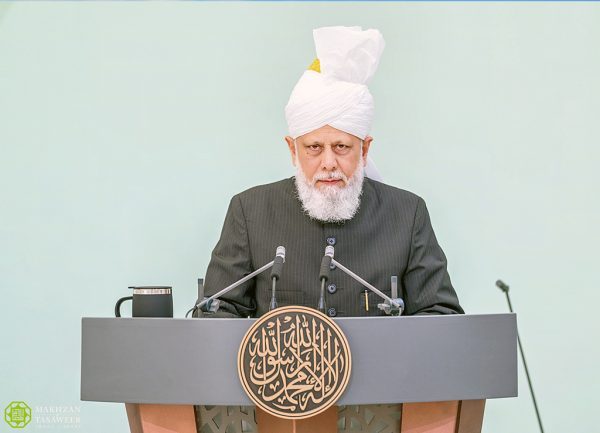
After reciting Tashahhud, Ta‘awwuz and Surah al-Fatihah, His Holiness, Hazrat Mirza Masroor Ahmad (aba) said that he had been mentioning incidents from the life of the Holy Prophet (sa) which reflected his devotion to the unity of God.
The Holy Prophet’s (sa) Firmness Against Associating Partners with God
His Holiness (aba) said that in previous sermons, he had detailed the incident during the Conquest of Makkah when the Holy Prophet (sa) destroyed the idols that occupied the Holy Ka’bah. He did this to demonstrate to the Makkans the futility and uselessness of the idols that they worshipped. This had a ripple effect, with prominent idols around Makkah, such as Manat, Uzza, and Suwa, also being destroyed. The people of Ta’if worshipped a prominent idol called Lat. The people of Ta’if requested the Holy Prophet (sa) that this idol not be destroyed for three years; however, the Holy Prophet (sa) could not accept this. They then requested that the idol not be destroyed for one year; however, the Holy Prophet (sa) refused yet again. Finally, they requested that the idol not be destroyed for one month, so that people may still accept Islam, but the weak and unlearned would not become distanced by seeing the idol that they used to worship being immediately destroyed. However, the Holy Prophet (sa) still did not allow for this and ensured that the idol was immediately destroyed. The Holy Prophet’s (sa) devotion to the Unity of God and the honour which he held for it did not allow for that idol to remain for another moment.
His Holiness (aba) said that the Holy Prophet (sa) had instructed that all things besides Allah which had become the object of worship should be destroyed. It is unfortunate that today, a large number of Muslims still prostrate to graves, and rather than seeking help from God, they seek help by calling to those buried in those graves. There is no doubt that the Holy Prophet (sa) confronted the powerful and well-armed people of Makkah to uphold the unity of God and ultimately rid the Holy Ka’bah of the 360 idols that had been there. Furthermore, the Holy Prophet (sa) undertook a great struggle to firmly establish the Unity of God within the hearts of the people.
His Holiness (aba) said the Holy Prophet (sa) taught and trained his companions whilst mindful of the minutest of details, which resulted in the fact that it was impossible for even the slightest hint of associating partners with God to exist in those companions. This included teaching the companions not to exaggerate even in their praise of the Holy Prophet (sa). It is recorded that the Holy Prophet (sa) instructed Muslims not to exaggerate in praising him, as the Christians had exaggerated in their praise of Jesus (as). The Holy Prophet (sa) said that he was merely a servant of God, so when speaking of him, they should say that he was a servant of God and His Messenger.
His Holiness (aba) said that once, the Holy Prophet (sa) heard Hazrat Umar (ra) swearing by his father, to which the Holy Prophet (sa) said that God had forbidden swearing by one’s forefathers. If one is to swear by anything, then they should swear by God; otherwise, they should remain silent. The Holy Prophet (sa) could not bear even a hint of something being set up as a partner with God.
A Warning Against Judging the Faith of Others
His Holiness (aba) said that once, some companions presented a hypothetical scenario before the Holy Prophet (sa), where they were face to face with a disbeliever in battle, and the disbeliever was to strike them with his sword and sever their arm. Then the disbeliever hides behind a tree and says that he accepts Islam for the sake of Allah. In this instance, should they still kill that man? The Holy Prophet (sa) said that in such an instance, the disbeliever should not be killed. One companion asked even if he said this after having severed his hand? The Holy Prophet (sa) said that if the man uttered belief in One God, then he must not be killed. For if he were killed, then the Muslim who killed him would fall to the rank of that same disbelieving man before his declaration of faith, while he would ascend to the rank of a Muslim. This was the pristine teaching of the Holy Prophet (sa), yet today, in Pakistan, Ahmadis are subjected to the cruellest of atrocities at the hands of so-called Muslim clerics. Those who follow these clerics should awaken and take heed.
His Holiness (aba) said that once, during a battle, it so happened that in the course of combat, a companion struck a disbeliever with his spear and killed him, even after he had quickly uttered his belief in One God. When the incident was brought to the attention of the Holy Prophet (sa), he asked the companion if he had killed the man despite his declaration of faith in One God? The companion replied that he had, but also said that this man had only expressed his faith out of fear of the sword. The Holy Prophet (sa) said that he should have opened the man’s chest and looked into his heart to see what his true intentions were or weren’t. The Holy Prophet (sa) continued repeating this to the companion, to the extent that the companion said he wished he had only accepted Islam on that day and thus avoided the displeasure of the Holy Prophet (sa).
Importance of Avoiding Subtle Shirk
His Holiness (aba) said that the Holy Prophet (sa) said that the thing he feared most for his people was the Subtle Shirk [association of partners with God]. The companions asked what the Subtle Shirk was. The Holy Prophet (sa) said that it was ostentation, to show off. On the Day of Judgement, God will say to those people who showed off that they should go to those people to whom they used to show off and see if they can find any reward with them instead. Thus, the Holy Prophet (sa) taught that showing off to others in hopes of earning their favour also amounts to associating partners with God.
His Holiness (aba) said that when the following Qur’anic verse was revealed:
‘Those who believe and mix not up their belief with injustice – it is they who shall have peace, and who are rightly guided.’ (The Holy Qur’an, 6:83)
The companions worriedly said to the Holy Prophet (sa) that everyone, in some way or another, even unknowingly commits injustices. Then, God revealed another verse in which He said:
‘Surely, associating partners with God is a grievous wrong.’ (The Holy Qur’an, 31:14)
Thus, God explained that associating partners with God is a grave injustice which must be avoided even in its most subtle manifestations. In his commentary of Sahih al-Bukhari, Hazrat Waliullah Shah (rh) explains that injustice (zulm) means the misplacement or misuse of something from its appropriate place or use. In the explanation of disbelief (kufr), associating partners with God has been rendered the greatest form of disbelief. Similarly, the explanation of injustice (zulm) shows that associating partners with God is the greatest form of injustice. These are the fine details and aspects which every person should reflect upon and use that reflection to analyse their own state.
His Holiness (aba) said that Imam Bukhari has explained true belief as being that which is entirely pure and free of any and every form of association of partners with God, and supplemented by good deeds. This is the standard which the Holy Prophet (sa) taught. Thus, it is recorded that the Holy Prophet (sa) explained that God said: “A person who denies me denies the hereafter, and a person who says that God had a son effectively curses God, whereas God is Independent and Self-Sufficient.”
The Four Types of Shirk & Establishing True Oneness of God
His Holiness (aba) quoted the Promised Messiah, Hazrat Mirza Ghulam Ahmad (as), who writes in explanation of Chapter 112 of the Holy Qur’an:
‘It should be observed how concisely in this brief statement the Being of the Creator has been shown to be free from every kind of association. Associations can be of four types. It could be in respect of number, rank, descent, or action and effect. In this Surah, it has been declared that God is free from association with all these types. It has been made clear that He is the One in number and is not two or three; He is the Besought of all; He alone is Self-Existing while everything else is contingent and mortal and is ever dependent upon Him; and He is which means that He has no son who can claim to be His partner; and He is which means that he has no father to share His power; and He is which means that no one can be His equal in His works to claim partnership with Him on this account. Thus, it has been made clear that God Almighty is free from associates of any of the four types and is One, without Associate.’ (Essence of Islam, Vol. 1, p. 86)
His Holiness (aba) said that it is recorded that once, the Holy Prophet (sa) appointed someone as the leader of an expedition, and whenever he led his contingent in prayer, he would always recite Chapter 112 of the Holy Qur’an. Upon returning from the expedition, this was reported to the Holy Prophet (sa). The Holy Prophet (sa) told them to ask why he did so. The man replied that he did this because this chapter renumerates the attributes of the Gracious God, and he found enjoyment in reciting it. The Holy Prophet (sa) told them to inform the man that, since he loved God’s unity, God loved him in return.
His Holiness (aba) said that similarly, Hazrat Anas bin Malik (ra) relates:
‘There was a man from the Ansar who led them (in Salat) at Masjid Quba. Every time he was to recite a chapter for them during prayer, he would begin by reciting “Say He is Allah, the One” until he finished, then he would recite another chapter with it. He did that in each unit of prayer. His companions talked to him and said, “You recite this chapter. You should either recite it or leave it and recite another Surah.’” He said: “I shall not leave it. If you would like me to lead you with it, then I shall do so, and if you do not like it, then I shall leave you.” And they considered him the best among them, and they did not like the idea of someone else leading them. So when the Prophet (sa) came to them, they informed him about what had happened, and he (sa) said: “O so-and-so! What prevents you from doing what your companions told you to do? Why do you recite this Surah in every Rak’ah?” He said: “O Messenger of Allah! Indeed, I love it.” So the Messenger of Allah (sa) said: “Your love for it shall have you admitted into Paradise.”’
His Holiness (aba) said that the Holy Prophet (sa) declared Chapter 112 of the Holy Qur’an (Al-Ikhlas), which highlights the unity of God, to be a third of the Holy Qur’an. This does not mean that this chapter is exactly a third of the Qur’an’s overall text, but it shines light on the importance of its message. This chapter shows that there were to be two great disorders in the world: 1. Association of partners with God, and 2. Complete and outright rejection of God’s existence. This chapter completely dispels and refutes both of these disorders.
His Holiness (aba) quoted the Promised Messiah (as) who writes:
‘Know for sure, therefore, that certainty of Tauhid can be achieved only through a Prophet, as our Holy Prophet, may peace and blessings of Allah be upon him, convinced the atheists and pagans of Arabia of the existence of God Almighty by showing them thousands of heavenly Signs. Even to this day, true and perfect followers of the Holy Prophet, may peace and blessings of Allah be upon him, present those Signs to the atheists. What is really true is that, until a person observes the living powers of the Living God, Satan does not depart from his heart, nor does true Tauhid enter into it, nor can he be convinced with certainty of the existence of God. This pure and perfect Tauhid is attained only through the Holy Prophet, may peace and blessings of Allah be upon him.’ (The Philosophy of Divine Revelation, pp. 140-141)
Significance of the Promised Messiah (as) Day
His Holiness (aba) said that in this era, when not only were there the forces of Gog and Magog detracting from belief in God, but unfortunately, even amongst the Muslim world, the unity of God had become lost. It was for this reason that God sent the Promised Messiah (as) to revive that same message of God’s unity which was brought by the Holy Prophet (sa). As Ahmadis, we can only do justice to our pledge of allegiance to the Promised Messiah (as) when we truly and firmly uphold the unity of God. 23 March marks the Promised Messiah (as) Day. We must bear in mind that in order to truly be the followers of the Promised Messiah (as), not only should we hold programmes in commemoration, but we must fulfil the objective for which he came, by establishing and upholding the unity of God within our homes, societies and the world at large. His Holiness (aba) prayed that may Allah enable the Muslims to recognise the Promised Messiah (as) in order to come to accept the unity of God, and break through the Antichrist forces of Gog and Magog.
His Holiness (aba) said that the Holy Prophet (sa) is reported to have stated: “Allah, Blessed is He and Most High, said: ‘O son of Adam! Verily, as long as you called upon Me and hoped in Me, I forgave you, despite whatever may have occurred from you, and I did not mind. O son of Adam! Were your sins to reach the clouds of the sky, then you sought forgiveness from Me, I would forgive you, and I would not mind. So son of Adam! If you came to me with sins nearly as great as the earth, and then you met Me not associating anything with Me, I would come to you with forgiveness nearly as great as it.’”
His Holiness (aba) quoted the Promised Messiah (as) who writes:
‘It is the teaching of the Holy Prophet (peace and blessings of Allah be on him) that sins are removed by the affirmation that:
“There is none worthy of worship except Allah, and Muhammad is the Messenger of Allah.”
It is a reality that he who believes in God as One without associate and that Muhammad, the chosen one (peace and blessings of Allah be on him) was sent by the same All-Powerful Unique One, will doubtless attain salvation, if he dies in the belief. There is no salvation under heaven through the suicide of anyone, and no one can be more insane than one who thinks so. But to believe in God as One without associate and so Compassionate that by His great mercy, in order to rescue the world from misguidance, He sent His Messenger whose name is Muhammad, the chosen one (peace and blessings of Allah be on him) is the doctrine by adhering to which the darkness of the soul is removed and the ego is replaced by the belief in the Unity of God. In the end, the mighty upsurge of Unity spreads over the whole heart, and a heavenly life begins in this very world. As you observe that by the advent of light, darkness disappears, in the same way, when the bright reflection of “There is no god but Allah” falls upon a heart, the dark passions of the ego disappear. The essence of sin is that there is a tumult in the passions of the ego by yielding to which a person is called a sinner, and the meaning of: “There is no god but Allah” which are derived from its various meanings in the Arabic lexicon is that there is no one to be desired, or to be loved, or to be worshipped, or to be obeyed except Allah.
Now it is obvious that this concept is totally opposed to the reality of sin and its true source. If a person with the sincerity of his heart establishes this meaning in his soul, then necessarily any opposite concept will be driven out of his heart, inasmuch as opposites cannot subsist together. When the passions of the ego are excluded, that is the condition which is called true purity and real righteousness. The purpose of the second part of the credo, that is to say, to believe in the Messenger of God, is that faith might be established in the Word of God also, for it is necessary for a person who confesses that he desires to become an obedient servant of God that he should believe in God’s commandments; and belief in God’s commandments is not possible without belief in him through whom the commandments have been conveyed. This is the true meaning of the credo.’ (The Essence of Islam, Vol. 2, pp. 289-291)
His Holiness (aba) said that it is recorded that the Holy Prophet (sa) would pray in the morning: ‘We have reached the morning following the original religion of Islam, the assertion of God’s unity, the religion of our Prophet Muhammad, and the rite of our father Abraham who was a hanif and was not one of the polytheists.’ This is just one prayer among the many which the Holy Prophet (sa) would recite on any and every occasion in life, which would be a clear reflection of his constant mindfulness of God and His unity. The Holy Prophet (sa) never left an opportunity to exemplify and teach the unity of God. This was to the extent that even the opponents of the Holy Prophet (sa) and his detractors accept that he was truly devoted to God. Even a French historian who was critical of the Holy Prophet (sa) had to attest that he had never seen devotion to God in the same manner as he did throughout the life of the Holy Prophet (sa).
His Holiness (aba) said that it was this passionate devotion to the unity of God which led the Holy Prophet (sa) to be deemed the perfect man. His mission was to establish, teach and spread to the entire world one message: the oneness of God.
His Holiness (aba) said that even the last message of the Holy Prophet (sa) to his people before his demise was not to make him an object of worship and associating partners with God, as the followers of previous religions had done with their prophets. The Holy Prophet (sa) said that this would not please him, in fact if anyone made him the object of their worship, then his soul would curse them. This is the degree to which, even in his final words, the Holy Prophet (sa) was concerned with ensuring the avoidance of any form of association of partners with God.
His Holiness (aba) said that, as those who have accepted the True Servant of the Holy Prophet (sa) who has directed us to understanding the true unity of God as taught by the Holy Prophet (sa), it is our duty to uphold the true unity of God in the world today. His Holiness (aba) prayed that may Allah enable us to do so.
Deepening Discord in the World & Appeal for Prayers
His Holiness (aba) said that the conditions of war in the world today are continuing to worsen. America and Israel are bent on establishing their power over the world, especially the Muslim world. The Prime Minister of Israel said when the war on Palestine started that they would completely alter the face of Arab countries on the world map. This is their end goal. The Muslim world must realise the direction in which this situation is headed, and they must unite.
His Holiness (aba) said that there are reports of Pakistan attempting to broker peace between Iran and America. Some factions with Iran have taken exception to this, and some in Iran have gone so far as to say that Pakistan is attempting to aid those forces who are seeking to attack Iran. Pakistan has denied this; yet the enemy seeks to take advantage of this discord. There is a great need for prayer. His Holiness (aba) prayed that may Allah enable everyone to truly pray in this regard and may the Muslim world become united.