

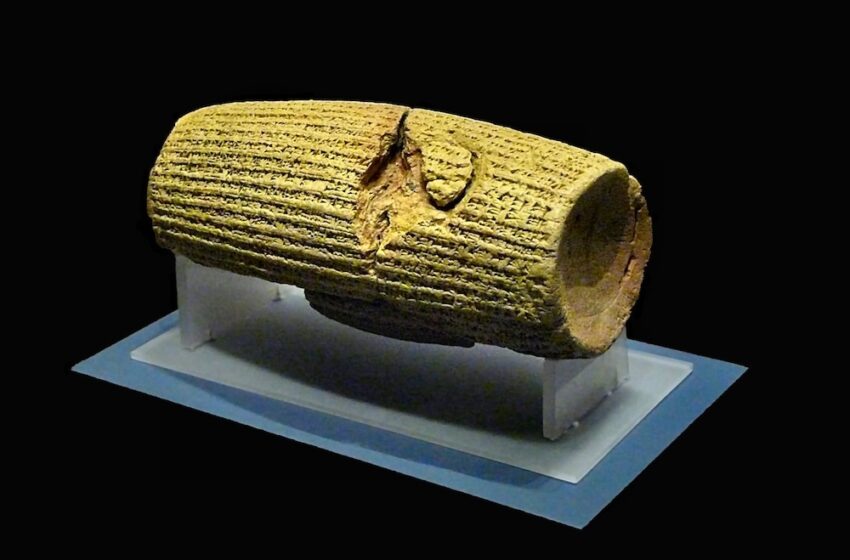
Objects in Focus: The Cyrus Cylinder
How a Persian King from modern day Iran was a saviour for Jews over 2000 years ago and inspired Thomas Jefferson in writing the Declaration of Independence.
Rizwan Safir
Archaeology Section Editor
“Back to the Stone Age”.
This recent taunt in the form of a tweet by the United States Minister of Defence (rebranded as Minister of War) was directed at Iran. The insinuation was his army would destroy this nation, returning it to its pre-civilised state and in turn, safeguard Jews in Israel from further attack.
Yet Pete Hegseth would benefit from reflecting on Iran’s history, where its ancient ruler remains a revered saviour for Judaism and influenced the code of civilisation that inspired the founding of the United States.
Around 2600 years ago, a Persian King from the land of modern-day Iran was protecting Jews from persecution and displacement, granting them return from exile to Jerusalem.
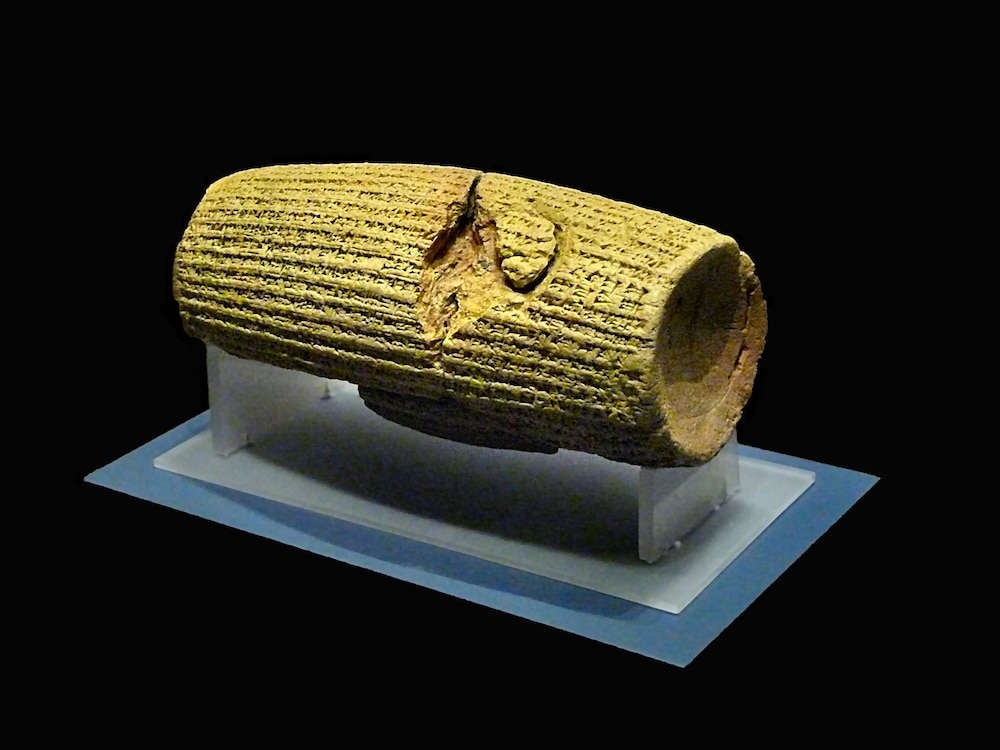
The story of Cyrus the Great is enshrined in this seemingly mundane, rugby-ball shaped lump of clay that sits in the British Museum in London. Rediscovered in 1879, it is no exaggeration to say this unassuming object inspired change across the world – from its mention in the Bible to Thomas Jefferson’s Declaration of Independence, to a permanent copy displayed in the United Nations headquarters in New York.
The cylinder is written in the ancient cuneiform script and references the victory of Cyrus the Great over Babylonia. Cyrus ruled the Persian Achaemenid empire in the 6th century BC. He led the empire to its maximum extent – from modern day Pakistan in the east to the Greek coast in the west. It was the largest empire the world had ever seen.
It was also an empire founded on tolerance and justice. The cylinder is the equivalent of a document, or the first “Bill of Rights” as it has commonly been dubbed. It outlines religious freedoms, allowing communities under his rule to continue practicing their beliefs. Persian culture was not imposed on the population, rather, local customs and languages were protected.
Crucially, it granted previously exiled groups to return to their homelands. Some 50 years before the cylinder, the Babylonian ruler Nebuchadnezzar II destroyed Jerusalem and burned the Temple of Soloman in response to a Jewish rebellion against his authority. Jews were forcibly deported and dispersed. It was Cyrus that liberated Jews from their banishment as documented in several instances in the Bible, such as Isaiah 45:13:
“I have stirred [Cyrus] up in righteousness, and I will make all his ways level; he shall build my city and set my exiles free, not for price or reward, says the Lord of hosts.”
The cylinder preserved his model of rule, inspiring politicians and philosophers for thousands of years. In around 370BC the Greek historian Xenophon – a contemporary of Socrates – wrote a book named Cyropaedia on Cyrus, presenting him as an ideal and just ruler.
The book outlined the foundations of a multi-ethnic, multi-religious empire led by Cyrus that introduced new forms of writing, religious coexistence, art and culture.
Over 1400 years later Thomas Jefferson – considered the Founding Father of the United States – was deeply moved by Cyropaedia and was intrigued by whether Cyrus’ model of governance could apply in his day. In a letter to his son he wrote, ‘when you start to learn Greek, the first book you should read is Cyropaedia’. The concept of a state based on diverse cultures was adopted soon after in the Declaration of Independence.
Cyrus remains a celebrated figure of Persian descent across cultures, including for Muslims. The perception that Muslims and Jews are inherent enemies has been a deeply false construct, perpetrated by foreign powers to create division and justify occupation. The second Caliph of the Ahmadiyya Muslim Community is one of several Muslim leaders that acknowledged and celebrated Cyrus as a ruler that protected and saved Jews, rather than encouraged enmity towards them:
“Cyrus was a righteous king. He not only conquered many lands but used his power for the protection of the weak. His most famous act was the liberation of the Israelites from their Babylonian captivity and his decree for the rebuilding of the Temple at Jerusalem.” (Introduction to the Study of the Holy Quran, pg. 89)
The Cyrus Cylinder is testament to the prolonged history of Persians and Jews that looks beyond current conflicts. It further demonstrates the importance of historic objects, where a humble piece of clay can go on to inspire the world.
About the Author: Rizwan Safir is the Archaeology section Editor for the Review of Religions and currently serves as the Chairman of the Ahmadiyya Muslim Research Association in the UK. Professionally, he works as the Head of Research for Barker Langham, a cultural consultancy that develops museums and archaeological research projects, specialising in the Middle East region. He has worked on archaeological projects across the Middle East for over 10 years.