

Sabr Notepad: Navigate Emotions with Intention
LnRiLWNvbnRhaW5lciAudGItY29udGFpbmVyLWlubmVye3dpZHRoOjEwMCU7bWFyZ2luOjAgYXV0b30gLndwLWJsb2NrLXRvb2xzZXQtYmxvY2tzLWNvbnRhaW5lci50Yi1jb250YWluZXJbZGF0YS10b29sc2V0LWJsb2Nrcy1jb250YWluZXI9ImViOGY4Njg0MjRkZTEzYzdhZjZmZTZmOGQzOTIxNjIwIl0geyBiYWNrZ3JvdW5kOiByZ2JhKCAyMzgsIDIzOCwgMjM4LCAxICk7cGFkZGluZzogMjVweDttYXJnaW4tdG9wOiAxMHB4O21hcmdpbi1ib3R0b206IDEwcHg7IH0gQG1lZGlhIG9ubHkgc2NyZWVuIGFuZCAobWF4LXdpZHRoOiA3ODFweCkgeyAudGItY29udGFpbmVyIC50Yi1jb250YWluZXItaW5uZXJ7d2lkdGg6MTAwJTttYXJnaW46MCBhdXRvfSB9IEBtZWRpYSBvbmx5IHNjcmVlbiBhbmQgKG1heC13aWR0aDogNTk5cHgpIHsgLnRiLWNvbnRhaW5lciAudGItY29udGFpbmVyLWlubmVye3dpZHRoOjEwMCU7bWFyZ2luOjAgYXV0b30gfSA=
Over the past few months, I’ve been working alongside Productive Muslim to develop the Sabr Notepad, a simple, practical tool designed to help us respond to life’s triggers with steadiness rather than impulse. Check it out here!
The intention of the notepad is to to offer a guided framework that helps you process intense emotions in real time so your reactions align more with how Allah wants us to respond to a situation vs. how our nafs and shaytaan want to respond.
In this article, I want to share the thinking behind the Sabr Notepad, starting with why we’ve become so quick to react to our emotions rather than lead them and why a structured process for emotional regulation is essential. I’ll break down the guided framework and show you how it helps you respond with greater intention, clarity and perspective.
But before I do that, I’d like you to picture this:
Or imagine…
Or perhaps…
Three different scenarios but one common thread running through all of them.
The emotion took the wheel before the heart had the opportunity to steady itself with Sabr, wisdom and rationale.
Why This Happens More Often Than We Realize
Most of us aren’t reacting to the moment itself. We’re reacting from impulse or exhaustion, from unprocessed feelings and from old narratives that resurface the moment something triggers them.
From a neuroscience perspective, when something negative happens, the brain’s amygdala, responsible for threat detection and emotional reactivity, becomes more easily activated. At the same time, the prefrontal cortex, the part of the brain responsible for reasoning, reflection and regulation, becomes less effective. In other words, when we are triggered, our default setting is to react rather than reflect.
From a faith perspective, this is usually the moment the nafs (ego) steps forward. Without conscious intervention, there is little to no time to pause and weigh in wisdom or consequence. It seeks immediate defence, validation or release. And in that unguarded space, the waswasah of Shaytaan can creep in, amplifying suspicion, fueling assumptions and pushing the reaction further than it needs to go. Without conscious restraint, the gap between trigger and response is quickly filled and what follows is often regret and a path that can easily turn destructive.
Faith does not leave us at the mercy of our impulses. It teaches us how to intervene in that narrow but powerful space between trigger and response.
Our emotions themselves are not the problem. They are the bridge inviting us toward greater awareness, clarity and conscious choice. When we bypass that bridge, we move straight from feeling to reaction and that’s usually when we act in ways that don’t reflect who we want to be.
Sabr in Motion
This is precisely where the concept of Sabr becomes transformative.
Sabr is often translated simply as patience, but within our tradition it carries a far richer meaning. It is not passive endurance or silent suppression. It is emotional steadiness anchored in trust and the ability to restrain the self from harmful reactions while remaining inwardly composed and spiritually aligned.
Allah reminds us in the Qur’an:
Indeed, Allah is with the patient.
(Quran 2:153)
This closeness with Allah is not promised to those who never feel anger, hurt or frustration. It is promised to those who manage those feelings with restraint and consciousness.
The Prophet ﷺ also said:
The strong is not the one who overcomes the people by his strength, but the strong is the one who controls himself while in anger.
(Sahih al-Bukhari 6114)
On a practical level, Sabr steadies us because it re-engages the reflective part of the mind while also creating space for something deeper. When we pause intentionally, even briefly, we allow the prefrontal cortex to come back online. At the same time, we give space for the fitrah (our innate, God-given disposition) to be heard, allowing the spiritual heart and its inner wisdom to guide the response rather than the ego. In doing so, we interrupt the automatic loop and create room for deliberate choice and for Barakah to enter the situation and settle within our hearts.
It is precisely this space that the Sabr Notepad was created to support. It was designed to help you hold the emotion, examine it and respond with intention rather than impulse.
How the Sabr Notepad Works
The Sabr Notepad is a one-page tear-out reflection tool designed for real-life moments when emotions feel immediate and intense. It guides you through a structured series of prompts that move you from reactivity to reflection, leaving you able to act with greater clarity, intention and composure.
Here’s a breakdown of each section and how it can help you.
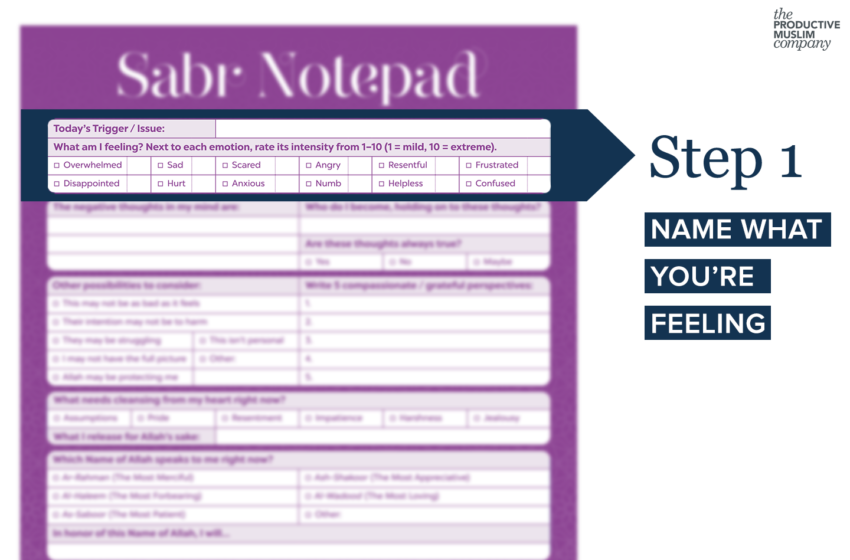
Step One: Name What You’re Feeling

The process begins with raising self-awareness. You identify the trigger and name the emotion you are experiencing, rating its intensity. In the heat of the moment, it is easy to be swept away by a strong emotion without being able to articulate what you are actually feeling. This step creates the first intervention.
Research shows that naming an emotion lowers its intensity, a process known as “affect labeling”. When you put language to a feeling, you create distance from it. It shifts from something overwhelming you to something you can observe and work with.
Step Two: Examine the Story Behind It

Next, you are guided to look at the thoughts attached to the emotion. What story is your mind telling you right now? What assumptions are you making? Are those thoughts always true, or are they interpretations? And if you keep holding onto them, who do you become?
In many cases, it is not the event itself that escalates the situation, it is the internal narrative we build around it. The prompts help you bring that narrative into focus and get curious about what it is stirring in you. This reduces the emotional charge and opens the door to higher thinking.
Step Three: Expand and Cleanse the Heart

From there, the framework invites you to widen your perspective. You are encouraged to consider alternative explanations, elevate your outlook through gratitude and compassionate thinking and return to husnul dhun (thinking well of others). At this stage, the focus shifts from ego-driven reaction to more soulful reflection.
In any emotionally charged situation, an essential question arises: what is the condition of my heart right now? It is easy to point outward but sincere growth begins inward. As the Qur’an reminds us:
Indeed, Allah will not change the condition of a people until they change what is within themselves.
(Quran 11:13)
This is the space for muhasabah (honest self-evaluation). If unhealthy states such as pride, resentment or jealousy are present, they are brought into awareness, not for self-blame but for purification. Without this step, the nafs can easily take over and we may overlook what needs addressing within our own hearts. Emotional regulation in our Islamic tradition is not only about behavioral control, it is rooted in heart work.
Step Four: Anchor Using Allah’s Names

The process then moves into spiritual grounding. You are invited to reflect on which Name(s) of Allah speaks most to you at that moment. By doing so, you lean into your relationship with Him, remembering who He is for you and who you are before Him.
This step draws the experience out of a purely personal frame and into a spiritually conscious one. The emotion is no longer just about “me and what happened.” It becomes about who I choose to be before Allah in this situation.
Step Five: Reframe Your Thoughts, Renew Your Intentions and Take Action

At this stage, you are no longer operating from compulsion. You have paused and explored long enough to move from automatic reaction into conscious choice.
Having named the emotion, examined the story, cleansed the heart and anchored yourself spiritually, you are now invited to reframe the situation. What is a truer, healthier thought you can hold? What perspective reflects your values rather than your impulse? And if you hold that perspective, how does it change what you feel and what you are about to do?
From here, you are given a few options to renew your intention for how you want to move forward and you are then invited to choose one clear, actionable next step, which might include having a respectful conversation, setting a boundary or letting something go entirely. Whatever you choose as your first step, it is deliberate, guided by reason and by the inner wisdom that is aligned with your faith perspective.
Step Six: Elevate and Steady the Heart

As a final step in the process, you are guided to close with a praiseworthy practice that helps regulate the heart, mind and emotions. You are invited to write down three final thoughts of gratitude. This reinforces the elevated perspective you have cultivated, anchors a sense of contentment and invites the help of Allah, who tells us:
If you are grateful, I will surely increase you…
(Quran 14:7)
At the end, you can also return to the emotion you rated at the beginning of the page and assess it again. This simple act makes the transformation tangible. What began as overwhelming will, inshaAllah, now feel more measured and manageable.
The entire flow is laid out clearly on a single sheet, which you can keep for future reference or throw away once you’ve worked through it. The process itself takes only a few minutes, yet those few minutes can prevent hours (even days) of rumination, escalation or regret.
Consider Those Earlier Scenarios Again
The tired professional arriving home.
The colleague at work.
The son or daughter tending to an elderly parent.
The situations didn’t change. The responses did.
Making Sabr Practical
At this point, you may be wondering how this can be applied in a practical, day-to-day way. The first thing to understand is that Sabr is built through repetition and through forming the habit of practising the pause.
I am not suggesting that you carry the notepad everywhere you go or that you stop mid-conversation to complete a page. What I am suggesting is that you build the reflective muscle before you need it most.
Like any muscle, if it is never exercised, it will not respond when placed under strain.
Here are simple ways to make it a practical part of your life:
In the case of the tired professional arriving home, imagine walking through the door already aware that this tool exists and that you have been using it regularly. That awareness alone increases your capacity for restraint. And if words begin to escalate, you know you can step away, sit quietly for a few minutes and work through a page. That pause could reset the entire evening and protect the relationship.
Sabr, when practised consistently, does more than prevent regret. It cultivates inner strength, protects relationships and draws us closer to Allah.
Order Your Sabr Notepad