

Doubt, Depression, Grief, Shame, Addiction: Week 3 Recap | Night 21 with the Qur’an
This series is a collaboration between Dr. Ali and MuslimMatters, bringing Quranic wisdom to the questions Muslim families are navigating.
Six nights. Six struggles. One theme.
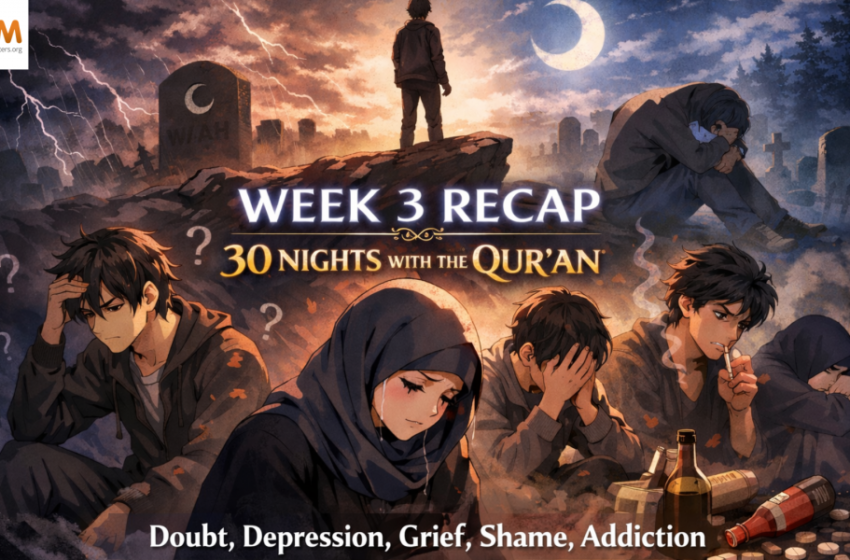
Week 3 of “30 Nights with the Quran” went somewhere that Islamic content rarely goes — into the interior life of Muslim teenagers with honesty and without flinching. Doubt. Empty prayer. Depression. Grief and loss. The feeling that Islam is a burden. Guilt and shame. Addiction.
Keep supporting MuslimMatters for the sake of Allah
Alhamdulillah, we’re at over 850 supporters. Help us get to 900 supporters this month. All it takes is a small gift from a reader like you to keep us going, for just $2 / month.
The Prophet (SAW) has taught us the best of deeds are those that done consistently, even if they are small.
Click here to support MuslimMatters with a monthly donation of $2 per month. Set it and collect blessings from Allah (swt) for the khayr you’re supporting without thinking about it.
This recap is for the parent who wants to understand what their teenager may have received this week — and what it means for how you show up for them.
The thread that ran through every night
Each night of Week 3 told a different story with a different struggle at its center. But every story had the same movement at its core.
Ibrahim ﷺ brought his need for reassurance directly to Allah. Hanzalah brought his spiritual low to the Prophet ﷺ. Ayyub ﷺ cried out from years of suffering — raw, unfiltered, exactly as he was. Yaqub ﷺ poured his grief out before Allah and no one else. Ka’b stood before the Prophet ﷺ and refused to construct an excuse.
In every case, the turning point was the direction they turned toward. The person stopped carrying their struggle alone and brought it — exactly as it was, without managing or cleaning it up first — to Allah.
That is the movement Week 3 was teaching. From carrying it alone to bringing it to Allah.
If your teenager watched this week, that is the seed that was planted. The question for you as a parent is: are you the kind of person they can practice that movement with?
What each night was really saying to your teenager
Night 15 — Doubt: Your teen learned that doubt is not the opposite of faith, and that Ibrahim ﷺ — Allah’s beloved friend — needed reassurance. They were given permission to bring their questions to Allah rather than bury them.
Night 16 — Empty Prayer: Your teen learned that spiritual lows are human and expected, that the Prophet ﷺ explicitly addressed it, and that the prayer done when you feel nothing may be the most valuable prayer of all. They were encouraged to keep showing up even when it feels hollow.
Night 17 — Depression: Your teen learned that depression is not a lack of faith, that Ayyub ﷺ suffered for years and was called righteous, and that seeking clinical help is following the Sunnah of seeking treatment. They were given permission to acknowledge that they are struggling and to seek help.
Night 18 — Grief: Your teen learned that Yaqub ﷺ wept until he lost his sight and the Quran recorded it without criticism, that pouring grief out before Allah is the Prophetic model, and that the wisdom behind loss is often invisible from inside the pain. They were given permission to grieve honestly and to bring that grief to Allah.
Night 19 — Islam as Burden: Your teen learned that all people are a slave to something, that desire never satisfies, and that Allah promises a genuinely good life — hayatan tayyibah — to the believer who does good. They were given a vision of what obedience produces, not just a list of what it prohibits.
Night 20 — Guilt and Shame: Your teen learned that guilt and shame are different, that Ka’b ibn Malik’s radical honesty before the Prophet ﷺ was what saved him, and that there is no refuge from Allah except in Him. They were encouraged to stop hiding and start returning.
What this week revealed about the teenage interior
One of the things Week 3 made visible — and that parents most need to understand — is how much Muslim teenagers are carrying alone.
The shame around doubt. The embarrassment around empty prayer. The fear that depression means weak faith. The grief that has never been properly expressed or released because Muslim grief is supposed to look composed. The desire that feels shameful to name. The addiction that has never been told to a single person.
These are not edge cases. They are the normal interior life of a significant proportion of Muslim teenagers in the West today.
And most of them are managing it alone — not because they don’t need support, but because they have not been given a safe place to bring it.
Your teen’s willingness to bring these struggles to you depends almost entirely on one thing: whether they have evidence that you can hold difficult truths without withdrawing love, without panicking, without making their struggle about your feelings.
That evidence is built over years — in small moments, in how you responded to smaller failures, in whether you have modeled your own vulnerability and return to Allah in front of them.
Week 3 gave your teenager permission to bring things to Allah. Your job is to be a safe human being they can practice that with.
The common parenting mistakes Week 3 was pushing back against
Across the six nights of this week, several patterns of parental response kept appearing as things that make each struggle worse:
Performative faith expectations. Expecting teenagers to present a composed, certain, spiritually elevated version of themselves — and responding with alarm or disappointment when they don’t. This teaches them that their real interior state must be hidden.
Theological short-circuits. Responding to depression with “just pray more,” to doubt with “Muslims don’t ask that,” to grief with “have sabr,” to shame with “make tawbah and move on.” These responses are not wrong exactly — but they are incomplete, and when delivered without sitting with the struggle first, they communicate that you don’t understand what your teenager is actually dealing with.
Making their struggle about you. “How could you feel this way after everything we’ve done?” “What will people think?” “This is shameful for the family.” These responses center your feelings over their wellbeing and guarantee that they will not come to you again.
Isolation as discipline. Withdrawing warmth, connection, or relationship in response to a teenager’s spiritual struggle. This is the opposite of what every story this week modeled. Every turning point happened when someone was met — by Allah, by the Prophet ﷺ — not when they were pushed further away.
What Week 3 is asking of you as a parent
Be the person they can bring things to.
You don’t need to have perfect answers to their doubt. You don’t need to fix their depression or resolve their grief or cure their addiction. You need to be a safe place — a human being in whose presence they can say something true and not be met with panic, judgment, or withdrawal.
Watch tonight’s video with your teenager if you can. Or share it. Let the Week 3 recap be an opening — a way of saying: this week happened, I watched it, I want to know how it landed for you.
The conversation doesn’t have to be deep at first. It just has to begin.
Resources from Week 3
- Khalil Center (khalilcenter.com) — Muslim mental health support covering depression, grief, and addiction
- Purify Your Gaze (purifyyourgaze.com) — Muslim-specific recovery program for pornography addiction
- 988 Suicide & Crisis Lifeline — call or text 988 if any struggle has become a crisis
- Surah Yusuf — the Quran’s most complete portrait of suffering, patience, and restoration. Read it together this week.
- Surah at-Tawbah 9:117-118 — Ka’b’s forgiveness. Read it, and the accompanying tafsir, with your teenager.
Discussion questions for families — Week 3 reflection
For teens:
- Which night this week landed hardest for you? What did it name that you’d been carrying?
- Is there something you’ve been managing alone that you’ve been afraid to bring to Allah — or to anyone else?
- What does it mean to you that every prophet and companion in this week’s stories brought their struggle directly to Allah without cleaning it up first?
For parents:
- Which night surprised you most — either in its content or in how you think your teenager may have received it?
- Is there a struggle your teenager might be carrying for which you haven’t created a safe space so they can bring it to you?
- How do you model bringing your own struggles to Allah in front of your children?
For discussion together:
- What is the difference between managing a struggle and bringing it to Allah?
- Which story from Week 3 resonated most with you, and why?
- What is one thing our family can do differently — practically — to make it safer to name struggles rather than hide them?
Looking ahead: Week 4
Next week — Purpose, Legacy, and the Long Game — moves from the interior to the horizon. From what you’re struggling with to what you’re building. From surviving to contributing.
Week 3 cleared the ground. Week 4 is about what gets built on it.
The bottom line
Your teenager spent this week being told — through Quranic stories and prophetic examples — that they don’t have to carry it alone, and that it is very human to experience the emotions covered. That Allah meets people exactly where they are. That the turning point is when we turn fully to Allah and make Him our refuge.
Your job is to be a human embodiment of that same message.
Be the person they can turn toward.
Continue the Journey
This is Night 21 of Dr. Ali’s 30-part Ramadan series, “30 Nights with the Quran: Stories for the Seeking Soul.”
Tomorrow, insha Allah: Week 4 begins — Purpose, Legacy, and the Long Game
For daily extended reflections with journaling prompts, personal stories, and deeper resources, join Dr. Ali’s email community: https://30nightswithquran.beehiiv.com/
Related:
30 Nights with the Qur’an: A Ramadan Series for Muslim Teens