

Pakistan Helps US and Iran Agree to Ceasefire and Reopen Strait of Hormuz
Key Takeaways
- Pakistan brokered a two-week ceasefire between the US and Iran, effective immediately, with both sides agreeing to halt hostilities across all fronts.
- The ceasefire is conditioned on Iran reopening the Strait of Hormuz, which handles approximately one-fifth of global oil shipments.
- Iran’s Parliament Speaker Ghalibaf and US Vice President JD Vance are expected to lead their respective delegations at Friday’s talks in Islamabad.
Pakistani Prime Minister Shehbaz Sharif announced in the early hours of Wednesday, April 9, 2026, that Iran and the United States, along with their allies, had agreed to an immediate ceasefire effective immediately — a dramatic development that pulled the world back from the brink of a wider conflict now in its sixth week.
Sharif invited both delegations to Islamabad on Friday, April 10, to continue negotiations toward a conclusive and lasting agreement.
Trump’s Last-Minute Turnaround
US President Donald Trump agreed to the two-week ceasefire with less than two hours remaining before his self-imposed deadline for Tehran to reopen the Strait of Hormuz — or face what he described as devastating attacks on Iranian civilian infrastructure.
Earlier in the day, Trump had issued an extraordinary warning that “a whole civilisation will die tonight” if his demands were not met, sending shockwaves through global financial markets and drawing widespread international condemnation.
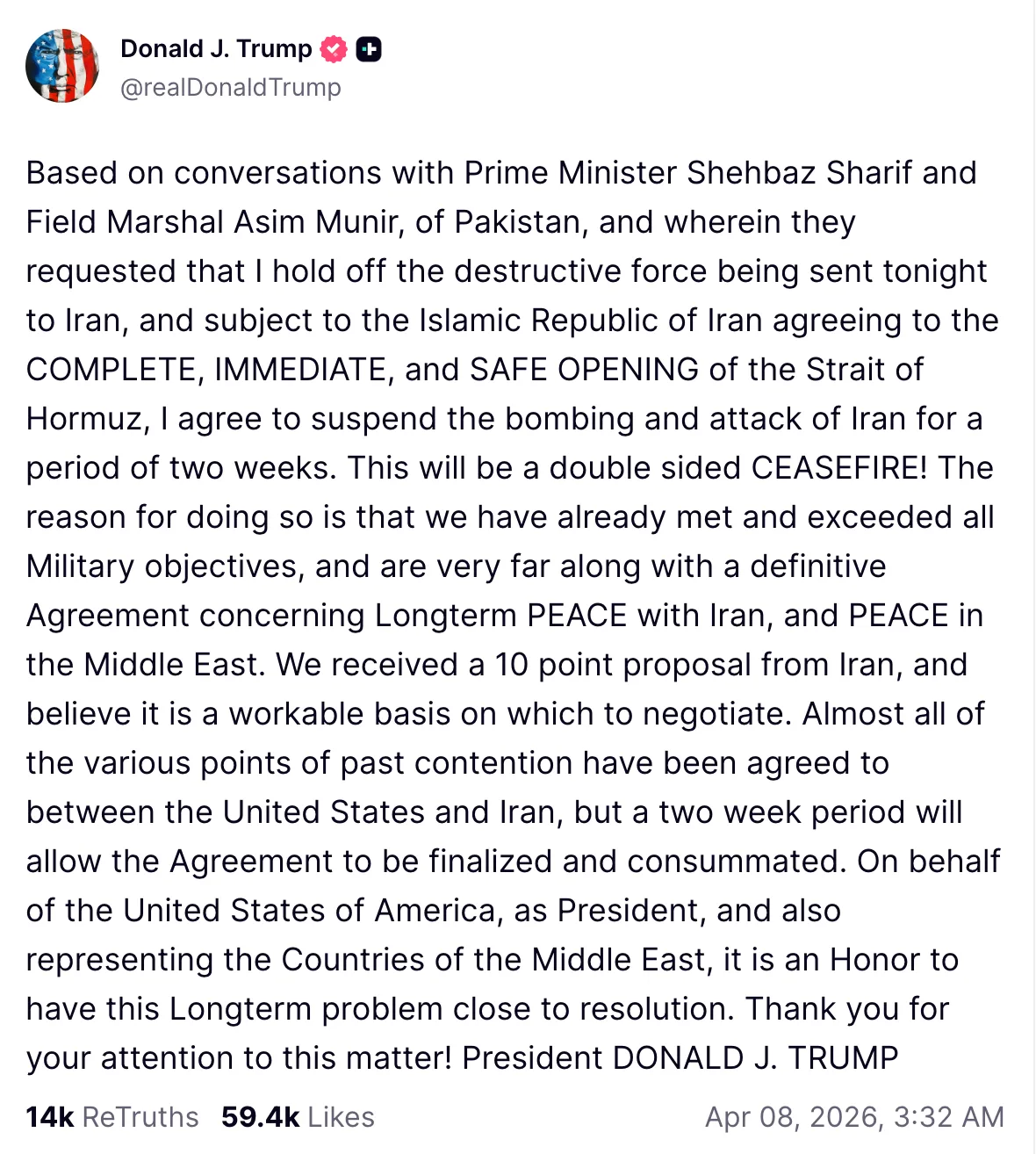
The ceasefire announcement represented an abrupt reversal. “A big day for World Peace! Iran wants it to happen, they’ve had enough! Likewise, so has everyone else!” Trump wrote on Truth Social.
He added that “The United States of America will be helping with the traffic buildup in the Strait of Hormuz.”
Trump stated that the deal was subject to Iran pausing its blockade of the strait and described Iran’s 10-point proposal as a “workable basis” for negotiations, adding that he expected a final agreement to be reached within the two-week window.
Iran’s Position
Iran’s Foreign Minister Abbas Araghchi confirmed that Tehran would halt counter-attacks and provide safe passage through the Strait of Hormuz.
Iran’s Supreme National Security Council released a statement describing the outcome as a victory, saying Trump had accepted Iran’s conditions for ending hostilities and that “nearly all the objectives of the war have been achieved.”
Iran’s 10-point framework covers its nuclear programme, regional security, the lifting of all primary and secondary sanctions dating back approximately 45 years, the release of blocked Iranian assets abroad, and safe transit protocols through the Strait of Hormuz — with Iran maintaining a coordinating role in passage through the waterway.
Pakistan’s Role
Iran expressed direct gratitude to Pakistan for its mediation, with the information account for Operation True Promise releasing a statement thanking Pakistan’s “leadership and its people for the constant and unwavering efforts and support.”
The successful brokering of the ceasefire marks a significant moment for Pakistan’s diplomatic standing on the world stage.
Iran’s Parliament Speaker Mohammad Bagher Ghalibaf is expected to lead Tehran’s negotiating team in Islamabad on Friday, with US Vice President JD Vance set to represent Washington, according to Iran’s ISNA news agency.
The Human Cost of Six Weeks of War
The conflict, now in its sixth week, has claimed more than 5,000 lives across nearly a dozen countries — including more than 1,600 civilians in Iran and over 1,000 civilians in Lebanon, according to government sources and human rights groups.
The war’s toll on civilian life drew condemnation from the United Nations and Pope Leo, with international law experts warning that attacks on civilian infrastructure could constitute war crimes.
Lebanon — The Unresolved Question
The ceasefire’s application to Lebanon remains disputed. PM Shehbaz stated the agreement includes a cessation of Israel’s campaign in Lebanon, but Israeli Prime Minister Benjamin Netanyahu said the ceasefire “does not include Lebanon.”
Israel continued strikes on southern Lebanon after the announcement, and Hezbollah — which accepted the ceasefire — halted fire on northern Israel despite ongoing Israeli attacks.
French President Emmanuel Macron welcomed the ceasefire but warned that the situation in Lebanon remained critical and that the deal should extend to cover it.
Markets React, Oil Prices Fall
Global markets responded with immediate relief. US stock futures rose sharply in the minutes following Trump’s announcement, while oil prices fell significantly — with US crude futures touching their lowest level since March 26.
The closure of the Strait of Hormuz had pushed oil prices sharply higher in preceding weeks, raising fears of a global recession.
What Comes Next
The two-week ceasefire is being treated cautiously by those familiar with the talks, with one source describing it as a “trust-building exercise” and expressing concern that Iran may be buying time.
British Prime Minister Keir Starmer travelled to the Gulf on Wednesday to hold talks with partners on ensuring the Strait of Hormuz remains permanently open, describing the ceasefire as “a moment of relief to the region and the world.”
Iraq’s Islamic Resistance announced it would suspend operations across the region for two weeks in line with the ceasefire. The world now watches Islamabad.