

![Far Away [Part 11] – Deep Harbor](https://islamicneekah.com/wp-content/uploads/2026/05/deep_harbor_roasted_nuts-1024x683-850x560.jpg)
Far Away [Part 11] – Deep Harbor
Deep Harbor overwhelms Darius with its immense masjid, refugee camps and wide river, while tensions within the family deepen.
Read Part 1 | Part 2 | Part 3 | Part 4 | Part 5 | Part 6 | Part 7 | Part 8 | Part 9 | Part 10
* * *
Preparing for the Journey
Keep supporting MuslimMatters for the sake of Allah
Alhamdulillah, we’re at over 850 supporters. Help us get to 900 supporters this month. All it takes is a small gift from a reader like you to keep us going, for just $2 / month.
The Prophet (SAW) has taught us the best of deeds are those that done consistently, even if they are small.
Click here to support MuslimMatters with a monthly donation of $2 per month. Set it and collect blessings from Allah (swt) for the khayr you’re supporting without thinking about it.
The next day was consumed by work.
Zihan Ma wanted the farm put in order before we left, so Haaris and I labored from dawn until nearly sunset. We repaired a loose section of fence near the north pasture, hauled water, split wood, cleaned the barn and replenished the feed bins. We cut and soaked fodder for the animals, mixing it with bean mash in great steaming buckets while the donkeys brayed impatiently nearby. The weather had turned colder still, and our breath hung white in the air.
Far Away spent most of the day asleep, but by afternoon he had begun moving about the house on his own. His splinted leg forced him into an awkward hobbling gait, and several times I moved instinctively to pick him up, but he glared at me with such offense that I relented.
Bao-Bao shadowed him everywhere.
The old cat behaved as though Far Away were some wounded soldier under her authority. She followed him from room to room, occasionally stopping to lick the fur around his ears or inspect his bandages with grave seriousness. Once I caught Bao-Bao cuffing him lightly on the head after he tried to jump onto a stool and failed.
I laughed despite myself.
“You see?” Haaris said smugly. “Bao-Bao likes him.”
“I think she thinks he’s her long-lost brother or something.”
“That too.”
Far Away eventually settled beside the stove and fell asleep again, while Bao-Bao curled protectively beside him like a guardian spirit.
That evening, after Maghreb, I sat alone in my room looking unhappily at my belongings. I owned very little: my blanket, travel pack, dao and spear, work clothes and the softer set of clothes I wore around the house or to sleep. I had nothing suitable for Jum’ah in a masjid, or a visit to family.
I imagined myself standing among wealthy merchants and educated men dressed like a scarecrow from a muddy farm. The thought filled me with embarrassment.
A while later there came a knock at the doorframe. Zihan Ma entered carrying a folded bundle.
“I nearly forgot,” he said.
He handed the bundle to me. Inside was a new suit of clothing: dark blue trousers, a long tunic of thick but soft cloth, and a black outer vest with careful stitching along the edges. Beneath the clothing lay a pair of sturdy black shoes. The clothes were beautiful and much nicer than anything I’d ever owned.
I stared at them. “For me?”
“Who else?” Zihan Ma said mildly. “You cannot attend Jum’ah looking like a farm hand.”
My throat tightened unexpectedly. “Thank you,” I managed.
He nodded once and left without further words.
The Road North
We departed before sunrise on Jum’ah. I wore my clothing and shoes, the Muslim kufi cap Zihan Ma had given me, and the dhikr beads around my neck. I felt natty and pleased with myself, and happy to be going on this trip. A thread of worry worked its way through my gut – what would happen if we encountered my mother’s family? – but I waved my hand to dismiss these thoughts.
Still, I strapped my dao across my back. It was not only the threat of my mother’s family that worried me. Whatever Zihan Ma believed about violence, the roads were no longer safe. The memory of the six intruders had not left me. Life had repeatedly taught me an important lesson: that there were people out there who saw other human beings as nothing more than prey. I would not be caught unprepared.
The wagon creaked softly as we loaded our things. Lee Ayi packed food for the journey while Haaris secured blankets and water gourds. I strapped my dao across my back before climbing aboard. I also brought my travel pack and a few of the gold coins I’d brought with me to my aunt’s house. I had of course passed through Starling once before – for that, I’d learned, was the name of the city to the south where I’d been assaulted and where Zihan Ma’s sister lived. It had seemed chaotic and overwhelming back then. But at the time it was my first glimpse of a big city, and I was wounded and feverish. Maybe it was actually a nice place. There might be things to buy. I wanted to get something for Haaris in particular. I knew I’d been cold toward him lately, and I needed to make up for it.
Zihan Ma and Lee Ayi sat on the front seat of the wagon, and Haaris and I behind them. As I settled myself, I caught Zihan Ma looking at the dao. Not a glance, but a long, solemn stare. He said nothing, however, and that somehow felt heavier than disapproval.
The wagon rolled out through the gate and onto the main road. Frost silvered the fields. The morning air smelled of damp earth and smoke from distant cookfires.
At the crossroads the wagon turned north.
“Wait,” I said. “We’re not going to Starling?”
“No,” Lee Ayi replied from beside me. “We’re going to Deep Harbor.”
I sat up straighter. “Deep Harbor?”
“My mother lives there,” she explained. “It’s her birthday.”
My stomach tightened slightly at the mention of my grandmother. I had almost forgotten she existed.
The Vendor
We breakfasted on steamed vegetable buns and pickled cabbage as the donkeys trotted along and the wagon rumbled over the dirt road. Fog lay over the fields and the road like the breath of an ice-dragon, and I pulled my tunic tight. All the farms we passed had high walls – many of which looked newly constructed – and had either heavy gates, or guarded entrances. Some sold their farm products at roadside stands.
We passed through a small village halfway to Deep Harbor. and the air brought the scent of roasted chestnuts. Haaris pleaded for some. Relenting with exaggerated reluctance, Zihan Ma dismounted to haggle with a vendor selling a variety of roasted nuts heated in an iron pan over hot coals.
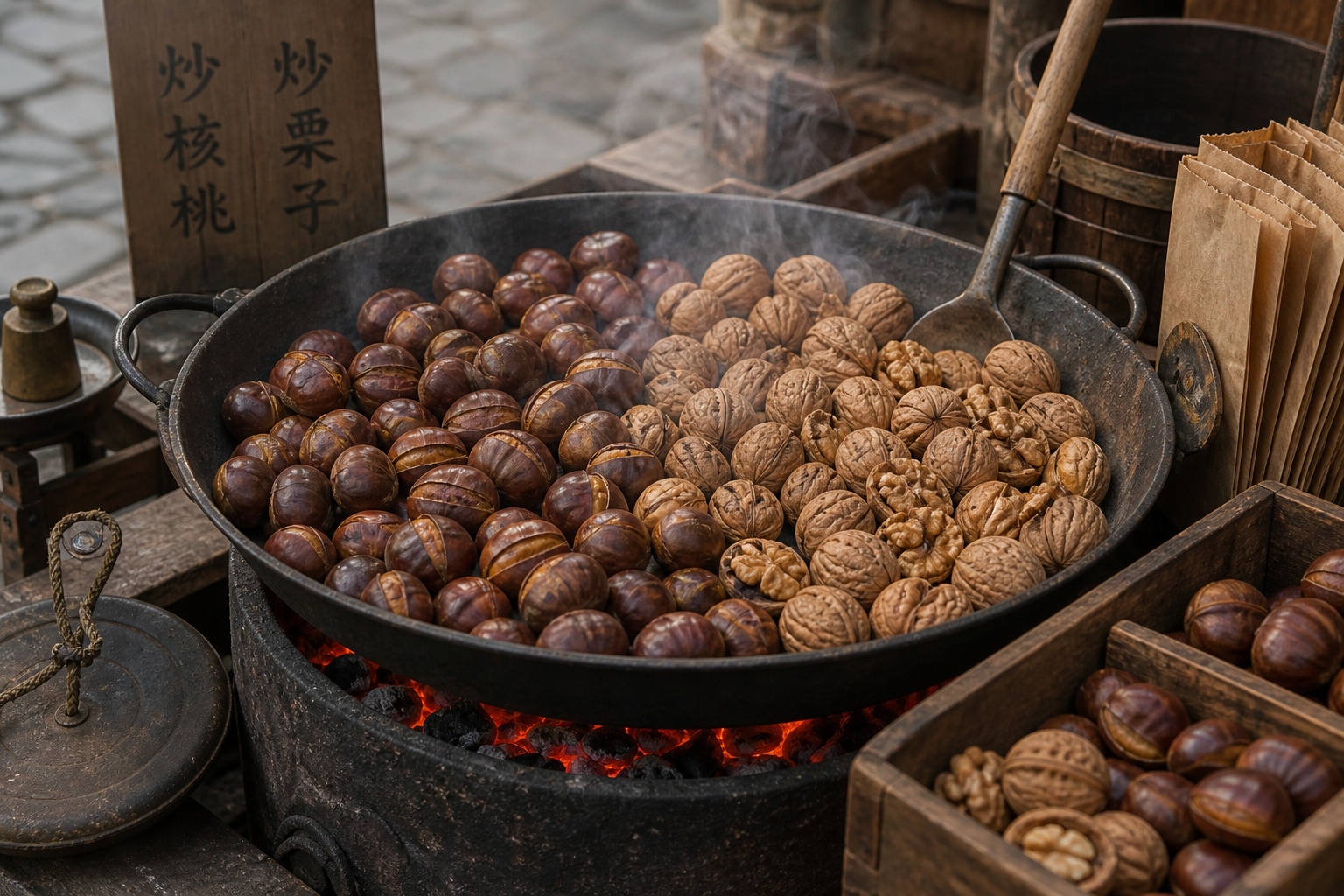
I dismounted to stretch my legs. The vendor, a thin man with a mustache, weighed the nuts on a scale, then scooped them into a paper wrapper, moving quickly with practiced hands.
The vendor cheated my uncle. I saw it with my own eyes. My father had taught me many kinds of scams and tricks, not necessarily to employ them, but to be aware. I bit my upper lip, wrestling with the question of whether to say something, but as it turned out it wasn’t necessary, for Zihan Ma stopped the vendor with an upheld hand.
“Your scale is rigged,” he said mildly. “You charge for a full measure, yet give less.”
The vendor spread his hands innocently. “Impossible, honored uncle.”
Zihan Ma reached into a coat pocket and came out with a small iron disk. “This,” he said, “is a half-jin measure.” He dropped it on the scale, and I watched as the needle on the scale settled on half a jin plus two liang.
The vendor’s face reddened, and he shot a glance at a burly man who stood nearby.
Zihan Ma followed the man’s gaze. “Your boss doesn’t know. You’re pocketing the difference.”
The vendor formed prayer hands and bowed deeply to Zihan Ma. “Please do not say anything, honored uncle. I beg you. I have a family…” He went on like this.
Ignoring him, Zihan Ma called out to the boss and informed him of what was happening.
The boss crossed his arms and set his jaw. “Why should I believe you? Maybe you’re the cheater. This man has worked for me for two years.”
“Believe as you wish,” Zihan Ma said calmly. “It’s your loss.”
He was about to turn to leave, accepting the loss of a few copper coins. I could not accept that. It wasn’t the loss of the coins, but that someone might question the honor of this great man, the best man I had ever known. I pointed to the mustachioed vendor.
“Right front pocket,” I said. “He used a magnet to rig the scale.”
Looking skeptical, the boss slipped a hand into his employee’s pocket and found the magnet I knew was there.
As the boss seized the vendor and began to shout at him, Zihan Ma turned away. A little further down the road, he bought a bag of carrots. Back on the wagon, Lee Ayi, Haaris and I ate our chestnuts in silence as Zihan Ma fed the carrots to the donkeys.
The nuts were salty and rich. I kept licking my fingers for the salt. The vendor might have been a thief, but he cooked good nuts. The scene that had transpired with the vendor did not bother me. I had seen and been through much worse. But Zihan Ma was quiet, and seemed troubled.
Dishonesty
Donkeys fed, we continued on our way. After a while, Zihan Ma looked back at me and asked, “How did you know about the magnet?”
I gave a slight shrug. “My father taught me to ignore people’s words and watch their hands.”
He nodded slowly. “That’s good advice. What did you think of the chestnut vendor?”
Something told me that I was on unsteady ground. Zihan Ma rarely asked casual questions. I weighed my words. “Cheating is wrong.”
“I agree,” my uncle said. “Dishonesty troubles me greatly.”
“Yeah,” Haaris said. “That guy was a crook.”
“Dishonesty among family,” Zihan Ma went on, “is the worst of all, for the closer the relationship, the worse the hurt.”
My uncle glanced back at me, where I sat on the back bench with Haaris. Looking forward again, he said, “If two people practiced martial arts every Friday on my farm, I would likely hear of it. Farmworkers speak. Especially when they are curious.”
Neither Lee Ayi nor I answered. My throat was tight as I swallowed.
“And,” Zihann Ma went on, “if I found part of the far field trampled repeatedly, with familiar footprints in the soil, and if I saw a boy returning late at night carrying a dao…” He shrugged lightly. “I might make certain guesses.”
“Forgive me,” Lee Ayi blurted out. She dropped to her knees in the wagon and pressed her forehead to Zihan Ma’s knees as he drove. Her arms hugged his legs. “Husband, I’m sorry. I should have told you.”
Haaris’s face showed alarm. “What happened? What is it?”
Zihan Ma looked genuinely distressed. “Jade, sit in your place. This is not seemly.”
“No,” she said miserably. “I deceived you.”
He gently took her one arm and lifted her back to her seat.
“You are my wife, not my servant,” he said softly. “Enough.”
I wanted to apologize too. The words gathered in my chest, but would not come out. Because the truth was ugly and tangled: I was sorry for deceiving him, but not for training.
At last I lowered my eyes and said quietly, “I will do better.”
Zihan Ma turned his head to study me for a long moment, and I could not tell if he was satisfied or saddened.
“What are you guys talking about?” Haaris demanded again.
When nobody spoke, I answered him. “Your mom and I were practicing martial arts.”
He sat back with a puzzled frown. “Oh. That’s all?” After a moment, he added, “My mom knows martial arts?”
“All of us Lees do, apparently.” Though my words were dry, something inside me felt heavy. I had been called a liar without the word ever being spoken aloud, and worse still, it was true.
Yet what else could I have done? The dao, the training, the movement of my body through forms and strikes – these things felt less like choices and more like a current carrying me somewhere I could neither understand nor resist.
Sadaqah
For the rest of the drive, my thoughts were jumbled. I didn’t know how to feel. On the one hand, I was scared that Zihan Ma’s opinion of me was souring. I didn’t know what that might mean for my future. On the other hand, I was relieved that the truth was out. At least I didn’t have to pretend anymore.
As we approached the city, I encountered a world I had not seen before. Refugees crowded the roadsides. Some lived beneath crude shelters made of sticks and cloth. Others huddled beneath wagons or slept in ditches wrapped in blankets so thin they scarcely deserved the name. Children watched the road with hollow eyes.
“I had no idea it was this bad,” Lee Ayi said.
“It’s worse in Starling ,” Zihan Ma muttered. “The refugees are coming from the south in great waves.”
Barefoot people trudged along the road with their packs on their backs. Women carried crying babies. An old man with one arm stood beside the road holding out a bowl without speaking. At one point we passed a woman crouched beside a tiny cookfire, boiling common weeds in a small blackened pot while two little girls sat beside her silently, too tired even to cry.
“Stop please,” I said suddenly.
Zihan Ma pulled gently on the reins.
I climbed down from the wagon and retrieved one of the wrapped food bundles Lee Ayi had prepared for the journey. The woman looked up at me uncertainly as I approached.
“For you,” I said awkwardly, offering the food.
One of the little girls stared at the bundle with enormous eyes. The sight of her struck me unexpectedly hard. I remembered another little girl, offering me a sweet treat on a stick while I was wounded and alone in the streets of Starling. I remembered her kindness, small as it had been, and how much it had mattered. Now it was my turn.
The woman accepted the food with trembling hands. “May the ancestors reward you,” she whispered.
Though I did not believe as she did, I said, “Thank you. May Allah make it easy.”
When I climbed back into the wagon, Lee Ayi rubbed my shoulder affectionately.
Zihan Ma smiled faintly. “The Messenger of Allah ﷺ taught that every bone in the body must give charity each day. Today Darius has given his sadaqah before the rest of us. He has set a good example.”
With some of the heaviness inside me lightened, I lowered my eyes awkwardly while Haaris grinned at me proudly.
Deep Harbor
As the sun arrived at its zenith, Deep Harbor appeared.
I had never seen a city so large. Gray walls rose high above the surrounding land, their watchtowers crowned with curved roofs. Beyond them I glimpsed tiled buildings packed together like scales upon a fish. But what struck me most was the river. It was enormous.
I had seen streams, ponds and irrigation channels all my life, but this moving expanse of water seemed like a living thing. Barges floated upon it carrying cargo beneath tall square sails. Smaller boats darted between them like water insects. Hundreds of birds wheeled overhead crying harshly. The air smelled of wet wood, fish, mud, smoke and river water.

I stared openly.
Haaris laughed. “You’ve never seen a real river before.”
“No,” I admitted.
The roads thickened with traffic as we approached the city: merchants, ox carts, laborers, mounted officials, wandering monks, and refugees pressed together in uneasy currents. I noticed that many people carried weapons, from spears to daggers, and a few swords.
The city gates stood open, guarded by weary soldiers carrying spears and wearing armor.
Inside was noise. Vendors shouted from crowded stalls. Metal clanged. Wheels rattled over stone. Steam and smoke drifted through the narrow streets carrying the smells of frying oil, fish, dung, incense and humanity packed too tightly together.
I turned constantly, trying to absorb everything at once.
“There,” Haaris said proudly, pointing ahead.
The masjid stood in the distance among the crowded streets like a place from another world, its twin minarets reaching for the sky.
Before we entered the masjid district, Zihan Ma pulled the wagon into a riverside stable yard thick with the smells of hay, manure and mud. Stable hands shouted, and a bell rang from a nearby ship where dozens of men unloaded crates onto a wooden pier. In the stable, many horses and donkeys were housed, some calmly eating, and others – not used to the city – were nervous, with ears swiveling. Our donkeys were a bit anxious, but Haaris stroked their faces and whispered in their ears, and they calmed down.
“You will not be able to enter the masjid with the dao,” my uncle whispered to me. Conceal it in the wagon, under your blanket.
I chewed my upper lip, thinking. The idea of leaving my weapon unguarded was abhorrent. But what choice did I have? I did as Zihan Ma said, and he paid the stable keeper, and we proceeded on foot to the masjid.
I craned my neck, trying to take it all in. The towering structure was easily the largest I had ever seen. Its architecture resembled the surrounding Chinese buildings, with sweeping tiled roofs and carved beams, yet Arabic calligraphy adorned the entrance in flowing black strokes, and the minarets seemed to pierce the sky. Hui men streamed through guarded gates wearing robes, caps and turbans, speaking in a dozen accents and dialects, while women in hijab entered from a separate gate.
A Resolution at Jum’ah
Lee Ayi bade us all goodbye and entered through the women’s gate.
The adhan began. I had heard Zihan Ma call the adhan many times at the farm, and had learned to call it myself. But this was different. The voice rose high above the noise of the city, echoing against walls and rooftops until it seemed to fill the entire district.
I followed Zihan Ma and Haaris through the courtyard and into the prayer hall. The room was immense. Sunlight filtered through latticed windows onto thick carpets over polished wooden floors. Hundreds of men sat cross-legged, rich and poor alike. I saw merchants in fine silk beside laborers with patched sleeves. Old men leaning on canes. Young boys scarcely older than Haaris.
The khutbah was about the meaning of success in Islam. The Imam said that we insisted on measuring success in material terms, but in Islam that was meaningless. Rather, success was defined as nearness to Allah, sincerity with all people, righteousness in public, and compassion in the home.
It was interesting, but maybe over my head. And I was distracted by the spectacle. When the prayer began, a thousand people stood shoulder to shoulder, and a hush fell over the assembly. I understood in that moment what it meant to belong to something greater than myself. I resolved in that moment that I would try to be the man Zihan Ma wanted me to be. I would put away the sword and take up the acupuncture needles, the sewing thread, and the herbs. I would strive to be the best healer I could be, under his tutelage. It was a great opportunity to be more than I had been raised to be, more than my father had been. I would be a fool not to take it.
When the prayer ended, the worshippers flowed gradually back into the streets of Deep Harbor. The noise of the city returned all at once, as if someone had lifted a curtain. Vendors shouted, gulls wheeled overhead, and somewhere nearby a man hammered metal with steady ringing sounds.
Gifts
The streets near the river were crowded almost beyond belief. We passed spice merchants, tea houses, fishmongers, butchers and wandering peddlers carrying entire shops suspended from shoulder poles. Barges drifted along the river beside us while laborers shouted and unloaded crates by hand.
“Listen carefully,” Lee Ayi said as we walked. “My mother’s name is Safiya Bai. You will address her as Nai Nai.”
I nodded.
“My stepfather is Su Chen. You should call him Master Chen.”
Something in her tone made me glance sideways at her.
“He is… particular,” she said carefully.
“That means he’s mean,” Haaris translated helpfully.
“Haaris.”
“What? It’s true.”
Lee Ayi sighed. “Master Chen values manners very highly. Be polite. Speak little. Don’t argue with him.”
“I don’t argue with people.”
Haaris snorted so loudly that a passing merchant looked over. “You are arguing about arguing.”.
“I am not.”
“Also you argued with me yesterday about whether crows can understand insults.”
“You were being silly.”
Haaris burst into laughter while even Lee Ayi smiled faintly.
We stopped beside a food stall where an old Hui man was pulling noodles by hand. He stretched and folded the dough so quickly I could hardly keep track of his hands. The noodles were dropped into boiling broth along with sliced lamb, greens and oil bright with chili.
We bought four steaming bowls and stood eating beside the man’s stall while gulls cried overhead. It was the best noodle soup I had ever tasted.
Nearby another vendor sold skewers coated in sesame and honey. Haaris wanted three. Zihan Ma allowed him one, and one for me.
As we continued through the marketplace, I found myself studying the stalls carefully. There were things here I had never imagined: tiny carved animals made of jade, lacquered boxes, clocks worked by water, silver rings, embroidered slippers, fishing lures with feathered hooks, paper lanterns painted like flowers.
At one stall I stopped short.
The merchant sold knives.
Not fighting knives. Folding knives, utility blades, skinning knives and carving tools. One particular knife caught my eye. It was compact and sturdy, with a polished wooden handle and a locking brass ring.
It was perfect for Haaris. I imagined buying it for him as a gift, and the delight on his face. Then I imagined Zihan Ma’s disapproving expression, and moved on.
A few stalls later I found an old man selling whistles carved in the shapes of birds. Some were painted brightly, others plain polished wood. When blown, they produced trilling calls remarkably similar to real birdsong. I remembered Haaris trying to learn to whistle through a blade of grass.
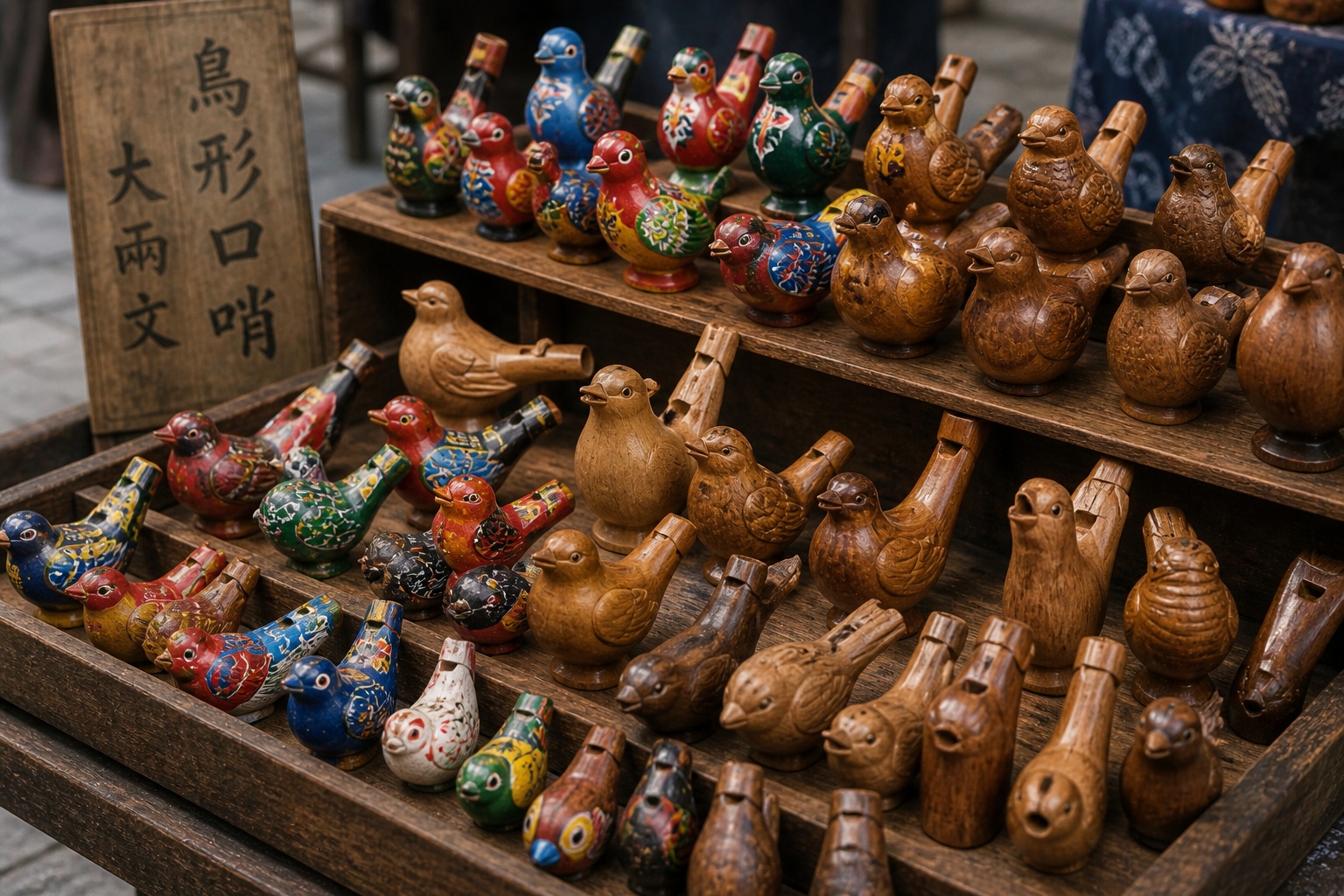
I picked up a swallow-shaped whistle carved from dark cedar. “I’ll take this one,” I said. The merchant wrapped it carefully in cloth.
It was the first time in my life I had ever bought a gift for someone. I was surprised by the warm, happy feeling in my chest. I found that I was smiling as I imagined how excited Haaris would be. I loved this feeling, and decided that I would buy gifts for the others as well. Maybe… maybe Zihan Ma would not be angry at me anymore if I got him something nice. My smile slipped for a moment as these sad thoughts intruded, but I continued shopping.
Farther along I found something for myself: a soft leather money belt worn beneath the clothing, with a hidden inner compartment stitched cleverly into the lining. I examined the stitching carefully before buying it. No one looking at it would guess it concealed anything valuable. That alone made me trust it.
At another stall I found a beautiful medical needle set housed in a slim bamboo case alongside fine silk thread. The needles were more delicate than the ones we used at the farm.
“This is excellent steel,” the merchant insisted. “Made in the western provinces.”
I bought it for Zihan Ma and dropped it into my travel pack.
“What’s that?” Haaris asked, craning his neck.
“You’ll see.”
“Come, Darius,” Zihan Ma said. “It’s time to go.”
“One minute!” Hastily I began studying the nearby stalls. My gaze landed on a table covered in combs, pins and ornaments. Some were wooden, and others were fashioned from shell or polished bone. One comb caught my attention. It was simple but elegant, carved from dark wood with tiny inlaid flowers of mother-of-pearl near the handle. I picked it up.
Lee Ayi’s hair was almost always tied back hurriedly for work. I realized suddenly that I had never seen her own anything decorative at all.
“That one,” I said.
The vendor smiled knowingly.
I smiled to myself, thinking of how much fun it would be to give these gifts to my new family. I would surprise them when we returned home. It would be exciting!
We moved away from the river, and the homes around us improved, becoming large, with high walls and ornate gates. We stopped in front of a grand home – a palace to my eyes – with a colorfully dressed guard at the gate.
Lee Ayi regarded me solemnly. “This is Master Chen’s house. Remember what I told you. Do not speak unless spoken to.”
Something in her tone put me on edge, and I felt my warm, cozy feeling disappear.
* * *
Come back next week for Part 12 – Accused
Reader comments and constructive criticism are important to me, so please comment!
See the Story Index for Wael Abdelgawad’s other stories on this website.

Wael Abdelgawad’s novels – including Pieces of a Dream, The Repeaters and Zaid Karim Private Investigator – are available in ebook and print form on his author page at Amazon.com.
Related: