

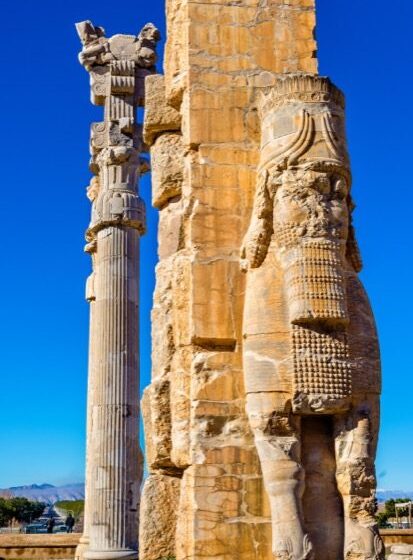
How the Achaemenid Empire turned Central Asia into a Crossroads for Religions
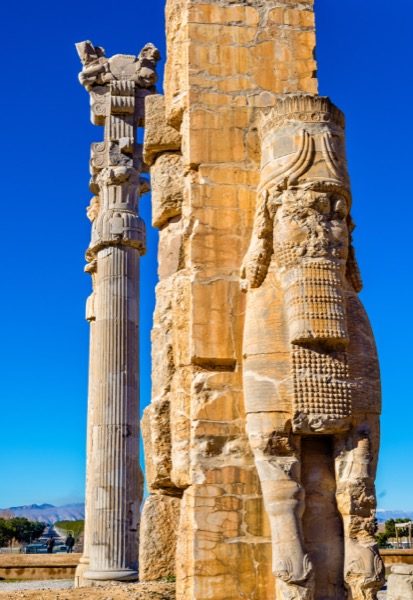
© Shutterstock
Rastagar Ahmad Ilyas Munir
Samarqand and Bukhara are renowned heritage sites in the region of Central Asia, owing to the richness of their heritage to being “Persianate” – a term Marshall Hodgson coined to describe certain medieval Muslim regions influenced by Persian culture. Among them is Central Asia. What this term eclipses is that the region around these cities, packed with millennia of rich history, had been in contact with present-day Iran centuries prior to the exposure to Islam. While some pieces of evidence push these contacts as back as the third millennium BCE [1], a fuller picture starts to emerge in the sixth to fifth centuries BCE when the region came under the Achaemenid Empire (sixth till fourth centuries BCE) – the first realm to stretch from Europe (southern Balkans) and Northeast Africa (Libya and Egypt) all the way to the Indus and Central Asia. With the origin of the empire lying in Persia.
Achaemenid Rule and Infrastructure in Central Asia
For a long time, data on Achaemenid Central Asia relied mostly on imperial administrative documents from the capitals, Susa and Persepolis [2]. Intensive excavation activities in this area during the 2010s under Xin Wu, however, revealed that Central Asia did have numerous highly developed local centers and cities with distinctive infrastructure built under Achaemenid rule [3]. Some of them were built on older Bronze Age settlements, and others were newly found. Several hectares of fortresses with citadels, administrative units, and workshops for various crafts made up the settled areas. Road systems connected these settlements with each other and to the imperial center, easily enabling permanent long-distance travel for goods and people. And for religions as well [4].
Transfer of Religions
Being a conquered region, one would expect a forced conversion to the imperial ideology. However, the archeological finds attest to a wide array of religious traditions in Central Asia, which the Achaemenid Empire supported by constructing places of worship.
Among them are platforms, temples, and altars found at sites across present-day Uzbekistan and Afghanistan, including Koktepe (near Samarqand), Sangir-Tepa, Kindyktepa, Kyzyltepa, Cheshm-e-Shāfa, and Shor-Tepe, often built on top of loess mounds or earlier structures. Located near but still outside of the closest settlement, it gave access to both the urban and the countryside population. Traces of ash and fire in these edifices led to their interpretation as fire temples and subsequent association with Zoroastrianism or Mazdeanism. But other religions can very well also have fire-employing rituals. While Achaemenid kings themselves declared to follow Zoroastrianism’s supreme deity, Ahura Mazda, Achaemenid Persia observed a complex blend of many early, often polytheistic beliefs. After all, the religion of Zoroastrianism did not consolidate into its known form until the Sassanid Empire (third-seventh centuries). Recent research is showing that many practices associated today with Zoroastrianism, such as fire temples and altars, seemingly originated in Central Asia. This has led to the inference that the religion was transferred from there to Persia and not the other way around. Hence, it should not be surprising that Central Asia is given great weight and importance in the Avesta, the holy scripture of Zoroastrianism. In this regard, annexing Central Asia to the empire would mean to source or even appropriate the religion favoured by the kings [5].
Various autochthonous deities of Central Asia represented naturescapes, such as rivers or mountains. The site of Cheshm-e-Shāfa yielded, along with a fire altar, also what appears to be a water temple, owing to the healing properties of nearby rivers as well as the local worship of rivers, such as the cult of the river Oxus with its associated deity Vaxš. Interestingly, the deities were not worshipped through images in human or animal form but only in relation to their natural element [6].
Additionally, cults from other parts of the empire reached Central Asia. This is especially documented in the Oxus Treasure, a hoard of gold offerings associated with Achaemenid Central Asia. As such, two objects from that convolute show the Egyptian deity Bes. Having enjoyed popularity across much of the Empire, he found his way to Central Asia and even beyond the empire to Siberia, as his depictions appear in the Pazyryk burials in the Altai. In fact, the finds from the Pazyryk burials show many entanglements with the Achaemenid Empire. While some of them may be just artistic exchanges, such as the depiction of animal beasts, others are seen as proof for the transfer of the beforementioned river worship [7].
Thus, by having transformed Central Asia into a crossroads for cultural and religious exchanges in any direction, the Achaemenid Empire pioneered imperial trade networks (popularly known as ‘the Silk Road’) a few centuries prior to Alexander the Great’s conquest.
A Continued Legacy
Many of these cities were continuously expanded in the subsequent Hellenistic period, thus fostering Hellenistic cults. In the beginning of the first millennium CE, Buddhism entered the stage. From there on, many other faiths followed, including Manichaeism, Nestorian Christianity, and finally, in the early eighth century, Islam. All existed alongside, side by side. Without doubt, history is always made by all the people who lived through it. One such person from Central Asia was the fifteenth-century Mirza Hadi Beg, who moved with his relatives, the later Mughal Dynasty, southwards to India. Three centuries later, his posterity brought forth Hazrat Mirza Ghulam Ahmad of Qadian (as). Not all these religions and cultures showing up throughout the centuries link directly to the Achaemenid rule in this region. But perhaps it was the latter that lastingly invested in setting ground to make Central Asia evolve it into the rich cultural tapestry it should be celebrated as.
About the Author: Rastagar Ahmad Ilyas Munir studied Asian Archaeology and Art History, Egyptology and East Asian Studies at the University of Vienna and Heidelberg University. He is currently working on his PhD.
Bibliography
Lorenzo Crescioli, The Scythians and the Eastern Limits of the Greek Influence: The Pazyryk Culture and Its Foreign Artistic Influences, in: Claudia Antonetti / Paolo Biagi (Hrsgb.), With Alexander in India and Central Asia: Moving East and Back to West, Oxford 2017, S. 122-152.
Bruno Jacobs, Saken und Skythen aus persischer Sicht, in: Wilfried Menghin / Hermann Parzinger (Hrsg.), Im Zeichen des goldenen Greifen. Königsgräber der Skythen, (Kat. Ausst. Berlin, München, Hamburg 2007-2008) München, 2007, S.158-161.
Michele Minardi, The Northeastern Regions of the Persian Empire: Bactriana, Sogdiana, Margiana, Chorasmia, Aria, Parthia, the Sakas, and the Dahae, in: Karen Radner / Nadine Moeller / D.T. Potts (Hrsgb,), The Oxford History of the Ancient Near East Volume V: The Age of Persia, New York, 2023. DOI: https://doi.org/10.1093/oso/9780190687663.003.0062.
Maurizio Tosi / C.C. Lamberg-Karlovsky, Pathways across Eurasia, in: Aruz, Joan/Wallenfels, Ronald (eds.), Art of the First Cities. The Third Millennium B.C. from the Mediterranean to the Indus, New York/New Haven 2003, pp. 347-354.
Xin Wu / Leonid M. Sverchkov / Nikolaus Boroffka, The 2010–2011 Seasons of Excavations at Kyzyltepa, (VIth–IVth Centuries BCE), in Southern Uzbekistan, in: Iranica Antiqua 52, 2017, S. 283-362.
Xin Wu, Persian and Central Asian Contributions to the Formation of Social Landscape of the Early Nomads in Pazyryk, Southern Siberia, in: Laura M. Popova / Charles W. Hartley / Adam T. Smith (Hrsgb.), Social Orders and Social Landscapes. Newcastle, 2017, S. 120–150.
Xin Wu, Exploiting the Virgin Land: Kyzyltepa and the Effects of the Achaemenid Persian Empire On Its Central Asian Frontier, in: Johanna Lhuillier / Nikolaus Boroffka (Hrsgb.), A Millennium of History: The Iron Age in Central Asia (2nd and 1st millennia BC), Mainz 2018, S. 189–214.
Xin Wu, Central Asia in the Achaemenid period, in: Rachel Mairs (Hrsgb.), The Graeco-Bactrian and Indo-Greek World, Oxon /New York 2020, S. 595-618.
Xin Wu, The Sacred Landscape of Central Asia in the Achaemenid Period, in: STUDIA HERCYNIA XXVII/1, 2023, S. 13–53.
ENDNOTES
[1] Maurizio Tosi / C.C. Lamberg-Karlovsky, Pathways across Eurasia
[2] Bruno Jacobs, Saken und Skythen aus persischer Sicht
[3] Xin Wu / Leonid M. Sverchkov / Nikolaus Boroffka, The 2010–2011 Seasons of Excavations at Kyzyltepa
[4] Michele Minardi, The Northeastern Regions of the Persian Empire, Xin Wu, Central Asia in the Achaemenid period
[5] Xin Wu, The Sacred Landscape of Central Asia in the Achaemenid Period
[6] Xin Wu, Exploiting the Virgin Land: Kyzyltepa and the Effects of the Achaemenid Persian Empire
[7] Lorenzo Crescioli, The Scythians and the Eastern Limits of the Greek Influence, Xin Wu, Persian and Central Asian Contributions to the Formation of Social Landscape of the Early Nomads in Pazyryk, Southern Siberia