

Selective Memory undermines Lebanese Patriotism and Populace
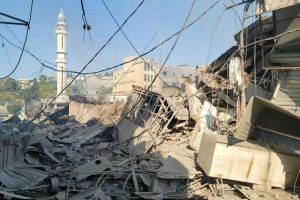
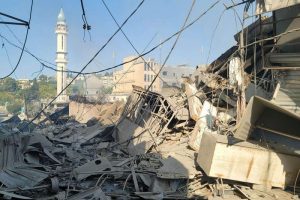
Southern Lebanon has been devastated by the Israeli assault; ruins dot the county of Nabatieh.
A significant aspect in the ongoing war and negotiations between the United States and Iran has been the related Israeli attack on Lebanon, whose Shia community and in particular Hezbollah militia has close religious, historical, and political ties to Iran. As it has done for over fifty years, the Israeli military has intermittently attacked Lebanon since 2024, but this latest round that began in spring 2026 has received proportionately far less attention than earlier attacks despite enormous bloodshed and its direct relevance to both the war in the Persian Gulf and the genocide of Palestine. More than anything, the war and a blatantly lopsided ceasefire that went into effect last month has exposed the limitations and bluster of a Lebanese government that loudly asserts its privileges but chronically fails to meet its responsibility, especially security against a rabidly aggressive neighbor.
The area most obviously abandoned to repeated Israeli attack is the largely Shia south, which has suffered immense damage not simply during the mid-2020s but from Israeli incursions, on and off, for over half a century. The south is often pathologized, certainly by Israel but also by domestic Lebanese critics, as a reckless hotbed whose fealty to Hezbollah will only bring peril to Lebanon at large. Yet Hezbollah, for all its faults, has managed a security and level of services that the Lebanese government has never afforded the region.
Keep supporting MuslimMatters for the sake of Allah
Alhamdulillah, we’re at over 850 supporters. Help us get to 900 supporters this month. All it takes is a small gift from a reader like you to keep us going, for just $2 / month.
The Prophet (SAW) has taught us the best of deeds are those that done consistently, even if they are small.
Click here to support MuslimMatters with a monthly donation of $2 per month. Set it and collect blessings from Allah (swt) for the khayr you’re supporting without thinking about it.
Nor are the southern Shias alone as scapegoats for Lebanon’s plight. Historically, one group after another has been blamed whenever Lebanon’s integrity is violated: at the moment it is Hezbollah and Shias in the south; earlier it was Syrian refugees and their largely Sunni supporters in areas such as Arsal and Sidon; earlier it was alleged Sunni “jihadists” in cities such as Tripoli; and earlier, at the outset of the 1975-90 war, it was Palestinians and their Lebanese supporters across a number of the country’s demographic groups, largely Muslims or Druze.
Lebanon was originally set up in the 1920s by France as an enclave for the region’s Christians, especially Maronites who shared the Catholic faith of most Frenchmen. At the time, anti-Muslim sentiments ran deep within French colonial policy, which largely caricatured the Muslim majority of the region as naturally predisposed to violence against minorities. In addition they were inclined to side with Maronites in a long-running feud with Druze, another of Lebanon’s minorities. It was only belatedly and grudgingly that France resorted to a long-outdated formula of splitting power between the elites of various confessional groups. Yet the fact that even in a newly formed Lebanese state Muslims, Sunnis and Shias, soon outnumbered Maronites contributed to the system’s inherent tensions, which were already apparent in the 1950s and resurfaced with major violence in the 1970s.
During this period, conservative and rightwing Lebanese politicians, often but not always Maronites, were inclined to resort to an ossified form of nationalism that exceptionalized Lebanon and pretended that it existed in a regional vacuum. Where links with France were seen as natural in preserving this Lebanese exceptionalism, links with outsiders – whether those of Sunnis with Palestinians or of Shias with Iran – were treated with suspicion. Today, after the 1980s Lebanese war’s resolution contributed to an officially more equitable adjustment in the confessional balance of power, this nationalism manifests itself chiefly in loudly decrying the “foreign links” of Hezbollah with Iran while ignoring those of every other Lebanese actor with other foreign powers.
The lopsided peace deal that Joseph Aoun and Nawaf Salam’s Lebanese government struck with Israel has virtually signed away practical Lebanese independence when it comes to the United States and its approved regional states, while loudly asserting Lebanese sovereignty when it comes to disarming Hezbollah. This rests on the pretence that Hezbollah does not have a major domestic constituency based off years of not only warfare but genuine sociopolitical services. It also rests on ignoring countless Israeli provocations and incursions throughout Lebanese history, since long before Hezbollah was founded.
The irony is that time and again Lebanese ultranationalists, who frequently scapegoat their compatriots for undermining the state, have time and again been the quickest to give way and even collaborate when the country is actually invaded: this was the case throughout Israel’s repeated invasions since the 1970s and largely through the thirty-year Syrian occupation of Lebanon. Both these invasions were directed, principally and initially, at the Palestinians in Lebanon. One reason that many other factions and most of the Lebanese government faded meekly away before these invasions, which came at the cost of not only Palestinians but Lebanese citizens as well, was because Palestinians had been scapegoated for Lebanon’s sociopolitical problems.
When the Syrian occupation of Lebanon ended in 2005, complaints about the occupation, its corruption and abuses, were commonplace among rightwing and conservative Lebanese nationalists: yet it had been the same current who had welcomed and benefited from the original 1976 invasion in order to crush their Palestinian opponents. Many rightwingers, particularly the populist far-right militias of the so-called Lebanese Front and the South Lebanon Army, supported the even more brutal 1982 Israeli invasion, which installed their leader Bashir Gemayel as a shortlived vassal before his assassination. The Palestinians’ removal as a significant factor from Lebanese politics only brought the turn of other Lebanese citizens, ranging from Sunni Islamists in the north and Shia Islamists in the south to Druze leftists in the east, to come under attack by either the Syrian or Israeli armies, or both.
The most significant of these have been the Hezbollah group, which is now some forty years of age. An unusual closeness to Iran, who sent a large number of military “advisors” to train and equip the group in the 1980s, was frequently noted, yet treated as an exception, by rival groups and factions themselves close to one foreign power or other. In its early years Hezbollah fought Israel and, alongside Palestinians and Sunni Lebanese, the Syrian occupation of Hafiz Assad. Eventually and controversially, Iranian brokerage prompted a Hezbollah rapprochement with Syria, to the extent of assisting Assad’s son Bashar during the 2010s war.
Collaboration with the Assads, in which Lebanese nationalists were themselves involved until it fell out of fashion, is not the main criticism of Hezbollah. Rather, like the Palestinians of the 1970s, Hezbollah is blamed for having provoked Israeli “reprisals” in the service of a foreign agenda, thereby weakening the Lebanese state. Yet the record is clear that Israel has repeatedly, deliberately, and systematically attacked Lebanon since long before Hezbollah existed. The Lebanese state itself has little record to which it can point, certainly not in the south, even during peacetime. And as for foreign agendas, the scapegoating of resistance in Lebanon – whether that resistance was by Palestinians in the 1970s or Hezbollah in the 2020s – has long been led by those actors who were most amenable to actual foreign invasions of Lebanon, whether by the Assads’ Syria or by Israel.

Under fire: Lebanese army commander Rodolf Haykal has come under sustained foreign criticism for his reluctance to attack Hezbollah on behalf of Israel.
The year 2026 brings several anniversaries of this record. In summer 1976, Assad dispatched a major invasion to support the Lebanese rightwing against a combination of leftist, Muslim Lebanese, and especially Palestinian opponents: this brought about three decades of occupation where the Assad family famously manipulated and shaped the Lebanese political process. Israel’s role was even worse: having already mounted an invasion all the way to Beirut as well as made repeated raids during the 1980s, in the spring of 1996 and the summer of 2006 Israel again made major, pointedly brutal incursions into southern Lebanon: it was here that the Israeli military gave a moniker to its longstanding tradition of deliberate viciousness, the “Dahiya Doctrine”, named for a town that was flattened over and over as a form of pressure. The Dahiya Doctrine has of course been on full view in other Israeli misadventures, notably Gaza. Yet as in Gaza, it had little demonstrable military effect: instead, particularly in summer 2006, Hezbollah shot to international fame for having outlasted and outfought a more powerful Israeli foe.
Despite the bruising blows that the group has suffered over the Israeli invasion of 2024-26, there is no indication that Hezbollah will fold on this occasion either: indeed, as Lebanese army commander Rodolf Haykal among others has recognized, the group’s prestige has only soared after fighting Israeli invasions. Once more, as in the summer of 2006, it is the Lebanese government that has looked impotent and inept, browbeaten by the United States into accepting a lopsided agreement. Wiser exceptions to this rule, such as Haykal, were subjected to diplomatic snubs and a smear campaign by neoconservatives in Washington, such as Lindsay Graham, and their confederates in Israel: he was accused of having “gone rogue” and defeatism against Hezbollah. Defeatism against Hezbollah, a Lebanese group operating in its homeland, was apparently a bigger crime than defeatism against a pointedly brutal Israeli invasion.
That the country invading Lebanon could accuse the Lebanese army commander of being a “defeatist” against his own compatriots is an indication of the ludicrous expectation that the Lebanese state is meant to act not as a government for its citizens but a check against those same citizens. That is, of course, how Israel and thus, unfortunately, much of Washington see the Muslim and Arab worlds at large: that is to be expected. What is particularly absurd is that Lebanese “nationalists” with a long and almost seamless record of collaborating with foreign invasions should then turn on their own compatriots in the name of strengthening the Lebanese state. Very often, as in the case of the rightwing, this is accompanied by anti-Muslim prejudices that in effect call into the question of Lebanese Muslims, whether it was the Sunnis of the 1970s or Shias since the 1990s.
No state is strengthened or its people served by a hostile foreign invasion. But the pretence that Iran is the only foreign actor involved in Lebanon serves as a method of justifying actual foreign invasions, with undisguised brutality and contempt for Lebanese life, by far worse actors. The Lebanese government and its supposedly nationalist supporters do their country a major disservice with this selective patriotism.