

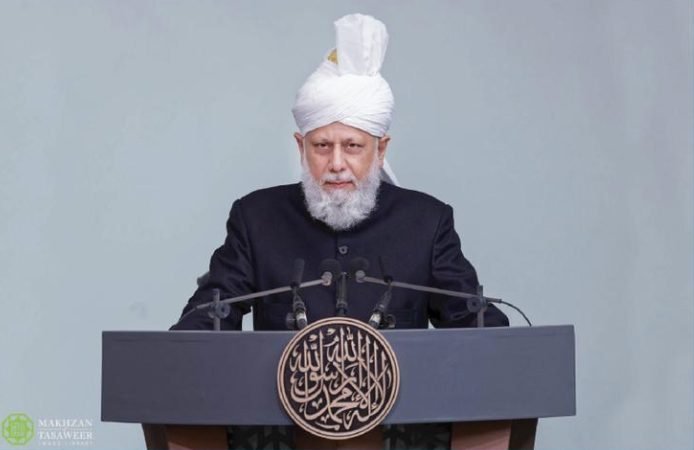
Friday Sermon Summary 30th October 2026: ‘The Holy Prophet’s (sa) Life of Contentment & Simplicity’
Summary prepared by The Review of Religions
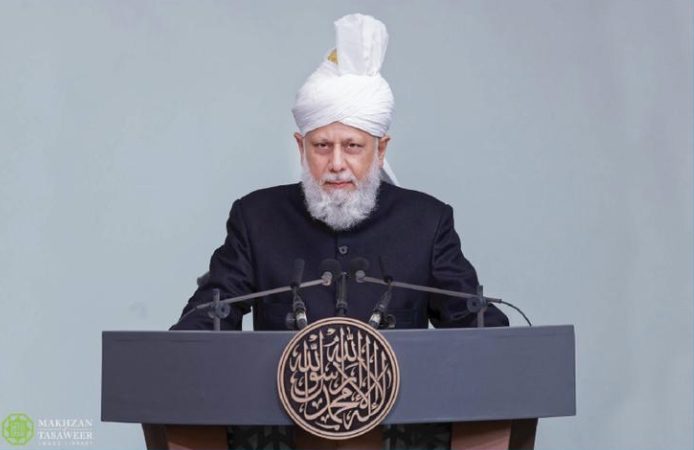
After reciting Tashahhud, Ta`awwuz and Surah al-Fatihah, His Holiness, Hazrat Mirza Masroor Ahmad (aba) said that he would continue speaking about hte simple life and lifestyle of the Holy Prophet (sa).
Perfect Model of Simplicity
His Holiness (aba) quoted Hazrat Mirza Bashiruddin Mahmud Ahmad (ra), the Second Caliph of the Ahmadiyya Community that some might think that the Holy Prophet (sa) would have eaten the best foods and would have royal spreads placed before him. But they will be surprised to know that the reality was the complete opposite. As a perfect example in all matters, the Holy Prophet (sa) was also the perfect model of simplicity and leading a simple life. It is recorded that two months at a time would pass by and the stove in the Holy Prophet’s (sa) would not be lit. Instead, he would suffice upon dates and water and at most, milk that would be sent by the neighbours. Such was the Holy Prophet’s (sa) simple life that nothing would be cooked in his home for two months at a time. Today, people face financial difficulties, and this can also be traced back to increasing desires attached to food and wanting to eat the most and best foods. However, the Holy Prophet’s (sa) example was contrary to this, and rather than eating excessively, he ate only as much as was necessary. At the same time, the Holy Prophet (sa) kept a balance. He did not prefer asceticism, rather he would eat the best of what was available whilst maintaining moderation. Thus, the purpose of the Holy Prophet’s (sa) life was not to eat the best foods, rather he ate the best of what was available.
His Holiness (aba) said that the Holy Prophet (sa) would also eat good foods. It is recorded that the Holy Prophet (sa) was once eating a lamb shank which he was cutting with a knife. It then became time for prayer and so the Holy Prophet (sa) immediately dropped the knife and went to offer prayer, as he had already performed ablution.
His Holiness (aba) quoted the Promised Messiah (as) who said that Islam does not prohibit eating with forks and knives, however Islam does not prefer ostentation like some other nations. The Holy Prophet (sa) showed the example of using a knife while eating so as to afford ease. Hence, there is nothing wrong with doing so; however there is also nothing wrong with other manners of eating, nor should they be looked down upon. The Promised Messiah (as) gave his own example of there being times when he would sit on a mat upon the floor to eat. Thus, one should not try to entirely adopt the ways of other nations, but should adopt simplicity as the best practice.
Accepting Even the Smallest of Gifts is a Virtue
HIs Holiness (aba) said that the Holy Prophet (sa) would accept even the smallest gift. He said that if he were ever invited to eat a small piece of lamb he would accept the invitation and if he were ever sent a small piece of lamb as a gift he would accept the gift. In other words, the Holy Prophet (sa) would not reject even the simplest of invitations or gifts. In fact, the Holy Prophet (sa) taught that it is very displeasing to reject a gift. Conversely, it is a reflection of good morals to accept a gift no matter how small or simple it might be. The Holy Prophet (sa) encouraged giving gifts to one another as it increases mutual love.
His Holiness (aba) said that once, the Holy Prophet (sa) was presented with a dish that contained meat and some gourd which the Holy Prophet (sa) liked. It is recorded that the Holy Prophet (sa) would pick out the gourd with his fingers and eat it. Yet, there were also times when the Holy Prophet (Sa) had nothing to eat. Foolish is one who wonders why the Holy Prophet (sa) had something so nice to eat, because there were times when the Holy Prophet (sa) would remain hungry for days on end, and times when the Holy Prophet (sa) would tie stones to his stomach due to his hunger.
Remaining Mindful of the Less Fortunate
His Holiness (aba) said that once a woman with two young daughters went to Hazrat A’ishah (ra) seeking help as they had nothing to eat. There was only one date in the Holy Prophet’s (sa) home, which Hazrat A’ishah (ra) gave to the woman. The woman split the date into two pieces and gave it to the woman. When Hazrat A’ishah (ra) told the Holy Prophet (sa) about this, he replied saying that God has decreed Paradise for a person who has two daughters and raises them well. Thus, the Holy Prophet (sa) never complained in times of hunger. Indeed, one who does not complain during times of hunger truly deserves all the blessings of the world, for they are content with their Lord in all conditions and circumstances.
His Holiness (aba) quoted Hazrat Mirza Bashiruddin Mahmud Ahmad (ra) who writes:
‘The Prophet was extremely simple in the matter of food and drink. He never expressed displeasure with ill-prepared or ill-cooked food. If he could eat such food he would do so to save the person who had prepared it from disappointment. If, however, a dish was uneatable, he merely refrained from partaking of it and never expressed his disapproval of it. When he sat down to a meal he paid attention to the food placed before him and used to say that he did not like an attitude of indifference towards food as if the person eating was above paying attention to mere matters of food and drink. When any eatable was presented to him he always shared it with those present. On one occasion somebody presented him with some dates. He looked round and after making an estimate of the number of people present divided the dates equally among them, each of them receiving seven. Abu Hurayrah relates that the Holy Prophet never ate his fill even of barley bread.
On one occasion while he was passing along a road he noticed some people gathered round a roast kid ready to enjoy the feast. When they saw the Holy Prophet they invited him to join them, but he declined. This was not due to his not having a liking for roast meat but to the fact that he did not approve of people indulging in a feast in the open where they could be observed by poor people who had themselves not enough to eat. It is related of him that on other occasions he did partake of roast meat. Ayesha has related that the Holy Prophet did not, till the day of his death, on any occasion, eat his fill on three consecutive days. (Introduction to the Study of the Holy Qur’an, pp. 226-227)
His Holiness (aba) said that those of us who are fortunate to eat good food should also think of the less fortunate and give alms for them so that they too may have something to eat.
His Holiness (aba) said that one the day of the Victory of Makkah, the Holy Prophet (sa) was hungry and went to the Umm Hani’s home and asked if there was anything to eat. She said that she only had some dry bread and she felt embarrassed to present it to the Holy Prophet (sa). The Holy Prophet (sa) insisted that it be brought. He then asked if she had any stew. She replied saying she only had vinegar. The Holy Prophet (sa) asked for it to be brought and he at the dry bread with vinegar. The Holy Prophet (sa) said that vinegar was indeed the best stew and any home that had vinegar was blessed. He said that vinegar was the stew of the prophets.
His Holiness (aba) said that once, someone asked for a meal to be prepared which the Holy Prophet (sa) also used to eat. He was told that the Holy Prophet’s (sa) food was so simple that if it were made now this person would not like it. However he insisted, and so some barley was crushed, mixed with olive oil and some spices. This was the food that the Holy Prophet (sa) often ate and liked.
Simplicity in Attire
His Holiness (aba) said that it is recorded that the Holy Prophet (sa) never cursed at anyone, nor did he ever have clothes folded away. In other words, the Holy Prophet (sa) often only had the clothes he was wearing and did not have extra sets of clothes folded away. If ever the clothes had to be washed, the Holy Prophet (sa) would wash them and often wear them before they were completely dry, to the point that water marks could still be seen on them as he wore the clothes. Such simplicity has never been replicated, nor can it be.
His Holiness (aba) said that the Holy Prophet (sa) said that only those men wear silk who do not care for their life in the hereafter. If ever the Holy Prophet (sa) gifted someone silk, it was not so that they wore it themselves; rather, it was so that they could benefit from it either through trade or to give it to their women to wear. Silk is considered a means of beautification for women, not for men.
His Holiness (aba) said that at the same time, the Holy Prophet (sa) did not forbid men from dressing well. Once, the Holy Prophet (sa) said that arrogant people will not enter Paradise. Someone said to the Holy Prophet (sa) that men desire to wear good clothes and good shoes. The Holy Prophet (sa) replied saying that God is Beautiful and prefers beauty. Thus, there is nothing wrong with wearing good clothes, however it should not result in arrogance or looking down upon others.
Avoid Arrogance
His Holiness (aba) said that once, the Holy Prophet (sa) told Hazrat A’ishah (ra) that if she wished to meet him in the hereafter, then she should treat this world like the means for a traveller. He advised her not to adopt the company of the wealthy. He also advised her not to discard clothes but instead to mend them. He instilled this habit of simplicity within his family as well. Thus, the Holy Prophet (sa) advised to wear good clothes but to ensure that it does not lead to arrogance. He also advised the poor not to fall into any inferiority complex about their attire and to mend it when necessary.
His Holiness (aba) said that once, the Holy Prophet (sa) said that one who wears clothes in this world to show off and be seen by others will be disgraced in the hereafter.
His Holiness (aba) said that the Holy Prophet (sa) said that the stomach is a vessel which will become ruined if it becomes completely filled. Instead, food should be eaten as a necessity. If one has ample food, they should eat enough to fill one third of their stomach, then leave one third for water and one third for air. Today, dietitians and medical experts give similar advice to what the Holy Prophet (sa) said 1,400 years ago.
His Holiness (aba) said that while he did not forbid it, the Holy Prophet (sa) did not prefer two drinks to be mixed in the same cup or for one plate to contain two different types of dishes. This was to the extent that the Holy Prophet (sa) would not even prefer to mix honey in his milk. The reason for this was that the Holy Prophet (sa) said he had adopted simplicity for the sake of God. Today, people become worried when they are not able to afford the same foods or find the same foods they are used to because of the conditions of the world. His Holiness (aba) warned that such conditions will only worsen if a world war breaks out on a global level. Thus, we must adopt simiplicity and contentment. We should not become wholly dependent on such worldly things.
His Holiness (aba) said that we should pray that Allah the Almighty saves the world from such calamities and may the world be saved from the destruction it is bringing about due to its own arrogance, otherwise this destruction is certain. Rather than trying to usurp the wealth and lands of others, these nations should look to serve their people.
His Holiness (aba) prayed that may Allah enable us all to remain established upon virtue.