

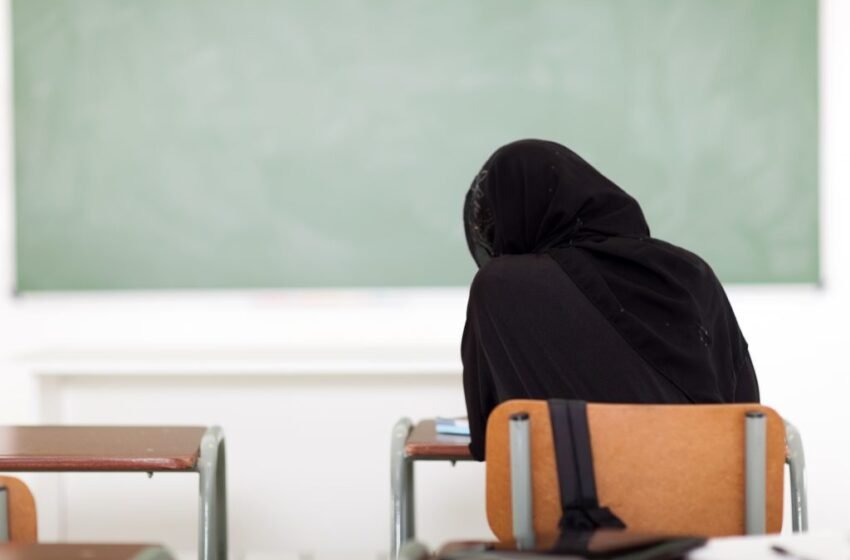
Locked Out of Getting an Education
Maliha Shahzad, UK
“The heart-breaking sight of a young girl desperately wiping away her tears and clinging to her friends for one last hug, as she is forced to leave the school premises and denied her basic right to an education. Why? ‘Because of a government policy’ she is told!”
Can you guess the country…?
Well, if you were to say Afghanistan, it wouldn’t be a surprise, given that girls are barred from attending school beyond the primary level since the emergence of Taliban rule, whose regressive decisions have left over 2 million young girls out of education since 2021.[1]
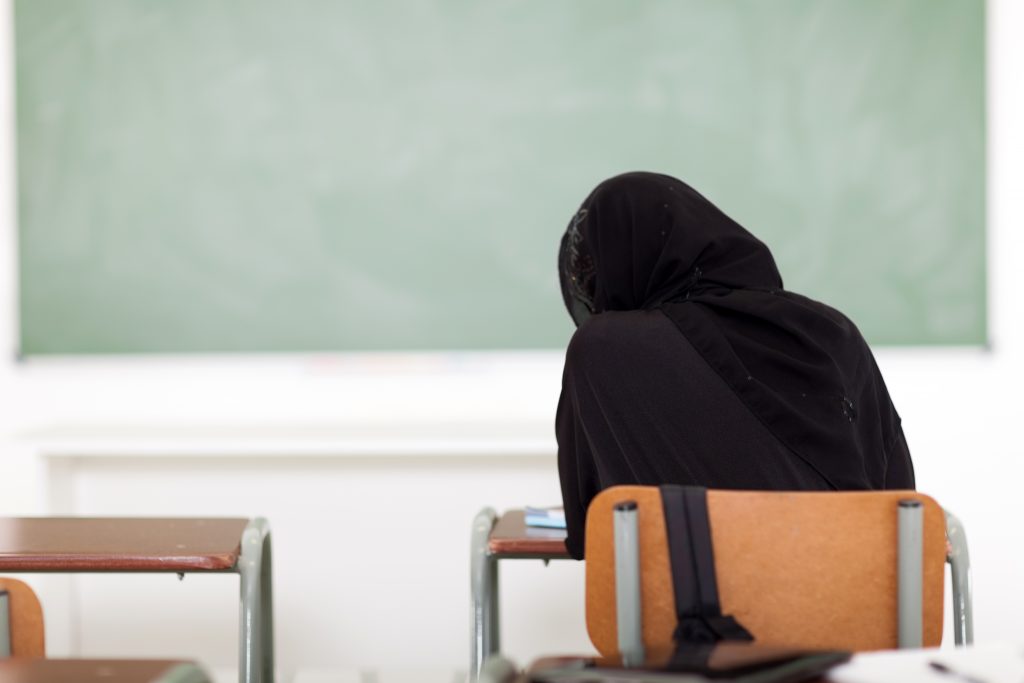
But what is deeply alarming and concerning is that the exact aforementioned description can sadly also be used as an entirely accurate and vivid depiction of what is happening currently in Azerbaijan, as heart-wrenching images and videos went viral across social media of young Muslim school-girls wearing the Hijab being denied entry to schools.
Of course, the two examples are worlds apart and markedly different, but it just illustrates how extreme attitudes, in either case, whether it be a theocratic state or a secular one, can have very dire consequences.
The first time I wrote about my experience with the hijab at school was in 2009, defending my right to wear it. Fast forward to 2026, and my social media feed is flooded once again with young girls defending their right to wear the hijab, (or more simply put; an item of clothing of their choice). How unfortunate that in the past decade where people are increasingly acquiring freedom, liberty and choice in almost every facet of life, even to the extent to identify as almost anything, it is the hijab that is being banned!
Throughout my life, the veil, the hijab and the burqa have always made headlines, but rarely for the right reasons. Muslim women have spent decades defending their choices about what to wear – a choice they make as an expression of their faith and devotion to God. That leaves me with just one question: When will governments stop policing what girls can and cannot wear?
When Iran forced the hijab on its women, the world was in uproar. But what happens when countries such as Austria and Azerbaijan ban it? We often hear the slogan: “my body, my choice” — unless my choice is to cover it. But “my body, my choice” applies to modesty, too. And it is the right of every woman to determine that, not a government.
Young girls, teachers and other workers in Azerbaijan are being banned from their educational establishments simply because they cover their heads. Whilst forcing a woman to wear the hijab is wrong, forcing a woman to remove it is equally wrong.
Moreover, whilst the hijab represents a Muslim woman’s choice and a symbol of empowerment and modesty, above all, it is a fundamental injunction of Islam. And so, in a country where 96% of the population is Muslim, forcing the removal of the hijab in schools would compel any practising Muslim girl or woman to make an unthinkable and impossible choice of whether to seek an education or follow its religion? Thus, it’s not the Hijab that is the barrier to education, rather it is the discriminatory laws against it.
As Muslim women across the world speak out against this; perhaps the simplest and yet profound of all was a simple post that read:
“Education is a human right not a privilege…
A little girl belongs behind a school desk, not outside its gates. Her hands should be holding books, not fighting for the right to hold them.
Stop policing what girls wear. Start protecting their right to learn. To grow. To dream. To exist without being forced to choose between their faith and their future…Lift the hijab ban. Open the school gates. Let our girls learn.”
As many Muslim women speak out against this discriminatory law, the feminists and so-called liberals – who rightly object to when Muslim women are forced to wear the hijab or Muslim girls are barred from school – seem strangely silent as is the Western media. This is because the West perceives the hijab a symbol of oppression. But has anyone actually asked us Muslim whether we feel oppressed?
Today, women who wear the hijab ride bikes, drive cars and even fly planes. Women wearing hijab have broken societal barriers, embraced independence and integrated themselves into society without having to leave their hijab behind. And just when you think the world has come so far, you are reminded that some girls are still being denied the freedom to learn simply because of what they choose to wear.
About the Author: Maliha Shahzad has obtained an MSc in Psychological Sciences. She is a regular contributor to the Voice of Islam Radio and is an active member of the Ahmadiyya Women’s Auxiliary Organisation in the UK.
ENDNOTES
[1] https://www.unesco.org/en/articles/afghanistan-four-years-22-million-girls-still-banned-school