

![Far Away [Part 15] – Caravan Guard](https://islamicneekah.com/wp-content/uploads/2026/06/caravan_training_forest_arrows-1024x683-850x560.jpg)
Far Away [Part 15] – Caravan Guard
As Darius embraces the dangerous freedom of caravan life, success and adventure cannot erase the ache of the home and family he left behind.
Read Part 1 | Part 2 | Part 3 | Part 4 | Part 5 | Part 6 | Part 7 | Part 8 | Part 9 | Part 10 | Part 11 | Part 12 | Part 13 | Part 14
* * *
Training to Exhaustion
Keep supporting MuslimMatters for the sake of Allah
Alhamdulillah, we’re at over 850 supporters. Help us get to 900 supporters this month. All it takes is a small gift from a reader like you to keep us going, for just $2 / month.
The Prophet (SAW) has taught us the best of deeds are those that done consistently, even if they are small.
Click here to support MuslimMatters with a monthly donation of $2 per month. Set it and collect blessings from Allah (swt) for the khayr you’re supporting without thinking about it.
I arrived before dawn at the Five Stars western compound, expecting a few drills and lectures before being handed a uniform and sent onto the roads. After all, I’d already won a fighting tournament, right?
First we were all de-loused, then given physicals. Upon learning of my cracked tooth, the screener gave me a note and sent me to a dentist two streets over, who applied a resin to seal my tooth. Then I returned to training.
It did not consist of easy drills and lectures. Instead, Sergeant Karim nearly killed us.
There were twenty-three candidates on the first day. To my surprise, five of these were women, including Deng Weili, the young woman who’d won the archery competition. Five Star apparently cared far more about ability than background..
“I don’t care if you squat to pee or not,” Sergeant Karim declared on the first day. “I don’t give a crap if you come from merchant or warrior families, or if you crawled out from under a rock. I don’t care if you are Muslim, Buddhist, Confucianist or if you pray to your own left foot. I don’t even care if you are a Korean lunatic, Tibetan navel-gazer or Uighur yak driver. All I care about is whether you can perform. The second I see weakness in you, the instant you say, ‘I cannot do it,’ you’re gone.”
Sifu Lu was not among the trainees. He apparently fought in the tournament only for status; he had a thriving school and I supposed he did not need the caravan guard job.
By the end of the second week, only eleven remained, myself and Deng Weili included. Sergeant Karim believed in exhausting men and women until their true character emerged.
“If you cannot function while tired,” he barked repeatedly, “then you cannot function at all.”
Weili made me nervous. She was nineteen years old, with intelligent dark eyes and an expression that often suggested she was privately amused by everyone around her. She wore her hair tied neatly braided and moved with quiet confidence whether holding a bow, climbing a wagon or cleaning horse tack. When she was around, I felt like I could not put my feet right.
There was another woman survivor as well. Her name was Meilin, which meant beautiful and delicate, which was funny because she was in her thirties, ruddy faced and a bit chubby, yet as muscular as an ox. I didn’t know if she grew up in a wushu school or what, but she could do cartwheels and flips, and could wield a variety of weapons with skill, including the three-sectioned staff and the broadsword. Yet she looked like a farm woman. Watching her was like encountering a young piglet, thinking how cute it was, and seeing it transform into a tiger before your eyes.
Fortunately, there was little time for male-female interactions, or any socialization at all. We recruits rose before dawn each morning. Out of the eleven, seven were Muslim, and were given the opportunity to pray Fajr. Then we ran the warehouse perimeter carrying sandbags on our shoulders. After prayer came conditioning drills: climbing ropes, hauling crates, lifting wagon wheels, carrying injured men on stretchers and pushing overloaded carts through mud pits behind the stables.
The Real Instruction
After breakfast the real instruction began.
Environmental awareness was Karim’s obsession.
“A caravan guard who notices danger after the attack begins is already dead.”
So he trained us to observe constantly:
- disturbed mud beside roads
- unnatural silence in forests
- travelers who avoided eye contact
- broken branches
- missing birdsong
- fresh horse dung
- suspicious movement on ridgelines
- hidden weapons beneath cloaks
Several times daily he deliberately tested us. One moment we might be marching normally; the next he would suddenly bark:
“How many blue doors did we pass?”
“Which horse is limping?”
“What was the innkeeper’s daughter carrying?”
“Who was watching us from the alley?”
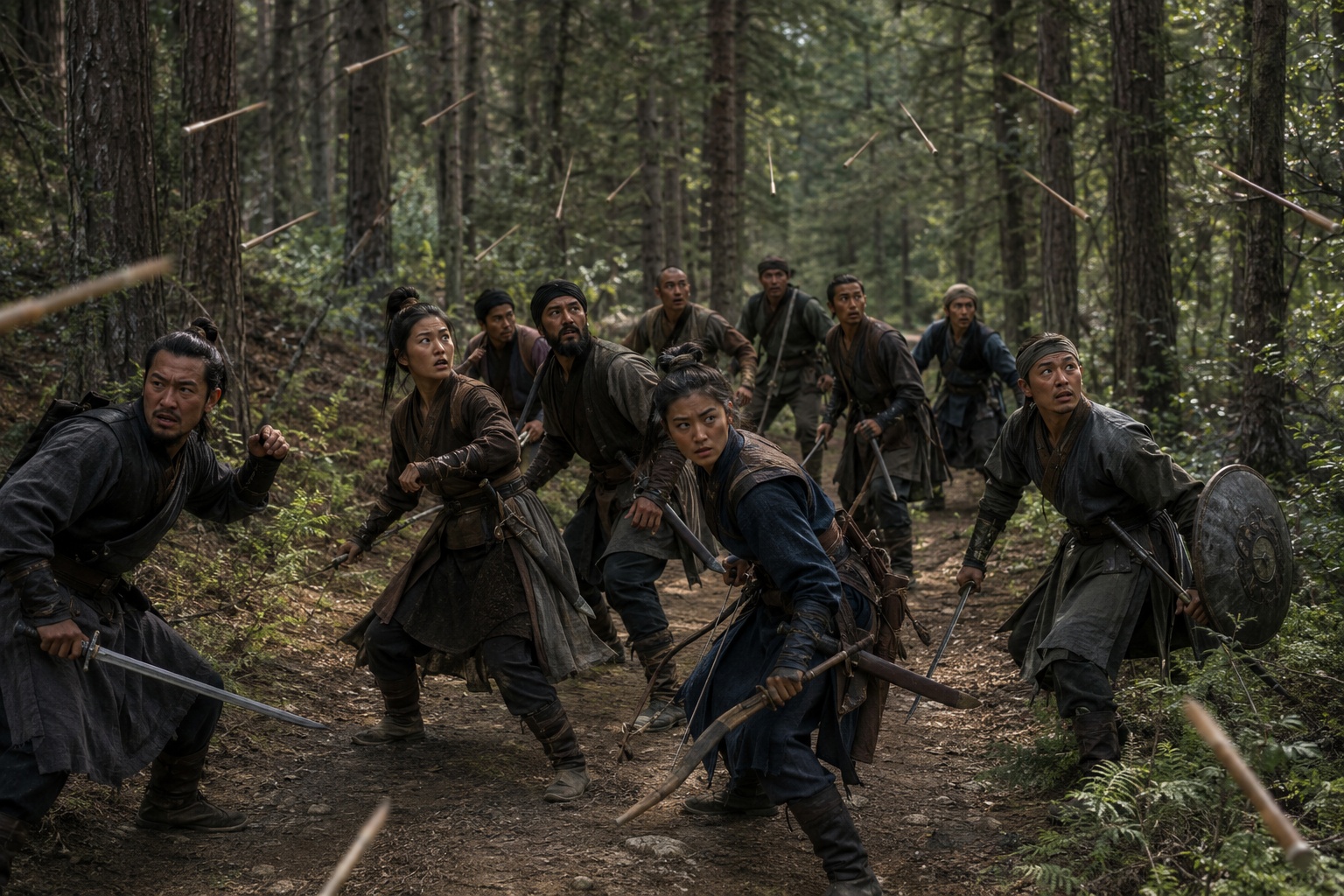
Or we’d be marching through the forest, and a volley of dull arrows would come flying from an unseen location – once from archers perched high in the surrounding trees. These arrows could still bruise and cut, and in once case broke a man’s arm. He was not eliminated from the program, but was put on leave, and would have to repeat the training from the beginning when he recovered. So we were down to ten.
Wrong answers to questions earned punishment – usually running. There was always more running.
We learned hand signals for silence, danger, retreat, ambush and changing formation. Karim expected us to communicate almost wordlessly while moving.
“The roads are noisy,” he said. “People panic. Horses scream. Rain falls. Learn to use your eyes and hands.”
Group combat proved even harder. Individually many of the trainees were competent fighters. Together we were a disaster. Men collided with one another, blocked each other’s strikes or line of sight, broke formation and forgot their assignments entirely.
Karim beat us across the shoulders with a bamboo rod whenever we drifted out of position.
“You are guards,” he roared. “Not opera performers!”
The exception was a man in his thirties named Ahmed. He was slight of build, but with muscles as hard as stones sliding beneath his skin. He was a rare veteran of the war against the invaders, highly experienced in all battlefield tactics and maneuvers. Very little in the training program was new to him, and I was surprised they even put him through it. He was also a faithful Muslim, and would rally the rest of us to pray together every day. I made it a point to stay near him in training, watch him and learn from him.
Another vital lesson was that the merchants and cargo always came first. This was the prime responsibility of a Five Stars guard.
“If a guard dies protecting the wagons, that is acceptable,” Karim shouted. “If the wagons burn because a guard chased glory, he has failed.”
We practiced defensive wagon circles, escort formations and retreat drills. We learned how to shield the caravan merchants during attacks and how to prioritize wounded horses versus damaged cargo.
Horse Care and a Bad Companion
Horse care itself consumed astonishing amounts of time.
I had cared for and occasionally ridden the donkeys on the farm, but had never ridden a horse in my life. Suddenly I had to learn horse feeding schedules, hoof cleaning, recognizing sickness, repairing tack, calming frightened animals, and spotting exhaustion before collapse.
“An abused horse remembers,” Karim warned us. “And a dead horse can delay the entire caravan.”
I learned why Ahmed, our unofficial Imam, had been forced to go through this program: he had no experience with horses. He’d been an infantry soldier, and never even brushed or shoed a horse. It was odd to see this battle-hardened veteran shying away from a rearing horse. I showed him how to approach an animal gently, and speak to it softly to win its trust.
These concepts did not sit well with one of the recruits, a sallow-faced, mean young man named Kuangren, whose name meant madman. I supposed that was a street nickname that he was proud of. He was the son of a noble, skinny and bad tempered, and he always whipped the horses too hard.
“They’re stupid beasts,” he would complain. “You have to show them who’s boss.”
In spite of Sergeant Karim‘s earlier lecture about absolute egalitarianism, Kuangren often seemed to get a pass. Sure, the Sarge often shouted at him, but he never put his hands on the sullen young man. It was said that Kuangren had been excommunicated from his rich family for excessive drinking, gambling and consorting with prostitutes. He was arrogant and did not work well with others. I had to admit that he was good with a bow and a sword. Still, I found it baffling that he hadn’t been cut.
Afternoons were devoted to languages, customs and etiquette. That surprised me, as I had expected lessons in fighting, not lectures on understanding cultures. But Karim insisted: “A stupid guard starts wars. A smart one smooths over conflict.”
We learned basic greetings from neighboring regions, local taboos, negotiation etiquette and religious customs.
“In some places,” Karim explained, “showing the sole of your foot is an insult. Elsewhere refusing tea is offensive. Somewhere else touching a man’s wife, even bumping into her by accident in the marketplace, might get your throat cut. Learn the difference.”
One trainee laughed during the lecture.
Karim expelled him from the program. “Go live ignorant,” he said.
Nine of us were left. Then a boy, the youngest of us at only 14, loosed an arrow by mistake and shot another recruit in the leg. The boy was fired, and the other one was given leave.
Yet another young man became violently ill after eating or drinking something bad. He continued to waste away until he was sent to a Five Star medical clinic.
Good At Everything
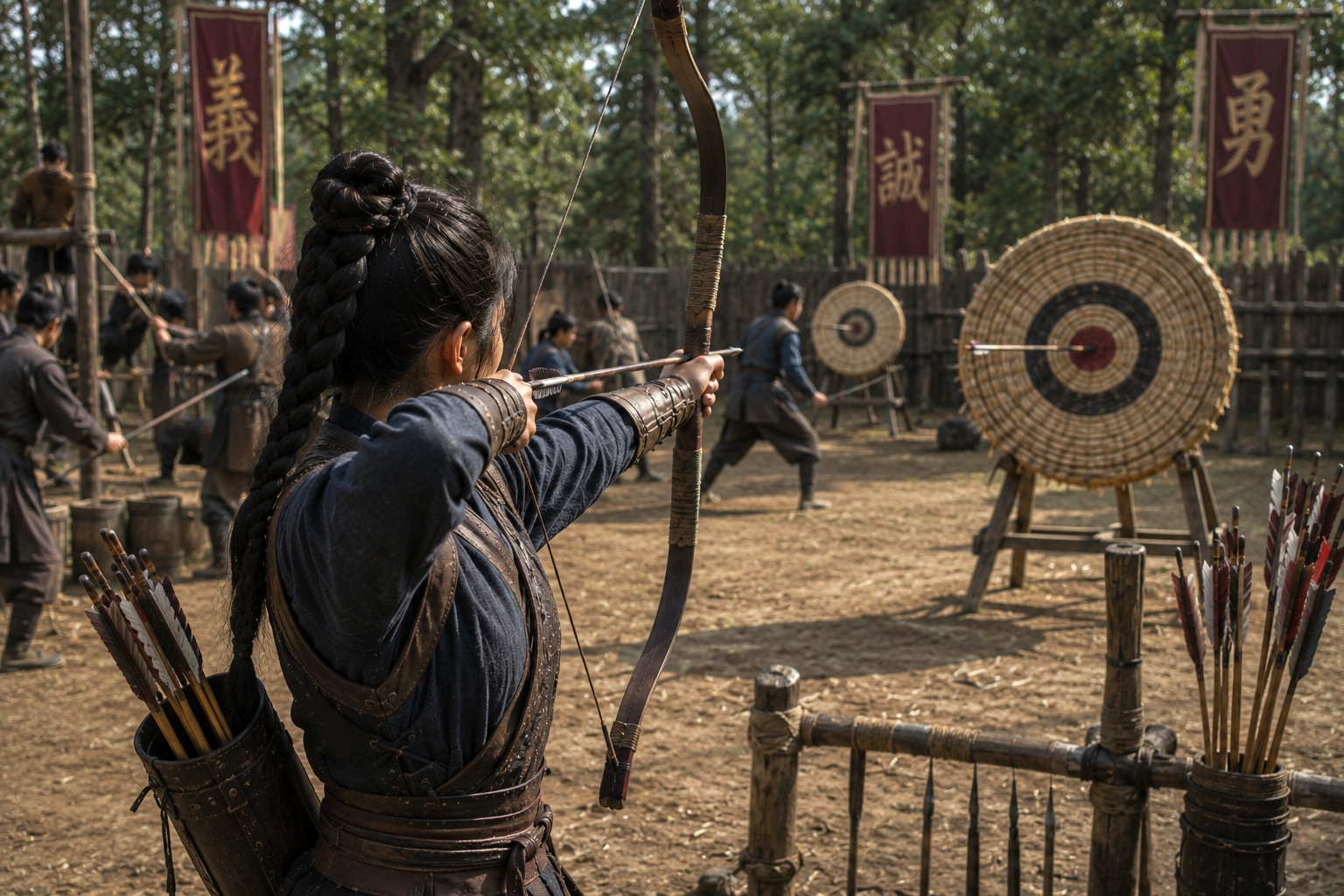
Deng Weili, the archer girl, was somehow even more intimidating up close than she had been on the tournament field. She was good at everything, and Karim clearly respected her, which meant the rest of us suffered for it.
“Observe Deng!” he barked repeatedly. “She notices things before you idiots step in them!”
The other trainees grumbled openly about this. Not me though, I admired the girl.
Unfortunately, whenever Weili spoke directly to me, my brain stopped functioning. Once she asked me to hand her a water bucket and I nearly dropped it onto my own foot. Another time she caught me staring at her archery practice and raised one eyebrow.
“You trying to put the evil eye on me?”
“I was only observing your form,” I replied.
“And what conclusions did you reach?”
“That you rarely miss.”
She smirked slightly. “You are more right than you know, Bridge Boy.”
I had no idea how to answer that, beyond to say, “Don’t call me Bridge Boy.”
She walked away shaking her head while several trainees laughed openly at me.
At night we slept in long warehouse barracks smelling of sweat, leather and horse blankets. Men snored and shouted in their sleep. Bruises covered my body constantly. My hands blistered. Twice I considered quitting, but each time I remembered sleeping beneath the bridge. Besides, if the women could make it, so could I.
Occasionally Shah Suliman visited the compound to confer privately with Karim. The two would stand overlooking the training yard discussing routes, supply reports and candidates while Karim gestured toward us with visible irritation. Suliman never approached me directly, but more than once I noticed him watching me thoughtfully while I trained.
Six of us graduated: myself, Ahmed, Meilin the chubby farm fighter, the nasty youth Kuangren, Deng Weili, and a tall, muscular man named Longwei, who was thought stupid because he spoke slowly, but who – if you took the time to converse with him – was well travelled and thoughtful.
Caravan Work
Within a month the six of us were traveling with caravans as armed guards. At first we were assigned only to local routes between Deep Harbor and the surrounding provinces, where the roads were dangerous but still reasonably well patrolled.
Sergeant Karim rarely traveled with us himself, but his presence lingered constantly in our minds. Any time someone failed to notice a suspicious rider, a wobbly axle, or a poorly secured crate, one of the others would mutter in Karim’s growling voice, “Use your eyes, idiot,” and everyone would laugh nervously.
Our group settled into familiar roles surprisingly quickly.
Ahmed naturally became the steady center of us all. When arguments broke out over routes or guard rotations, he calmed them. As it happened, all of us new guards were Muslims except for Kuangren and Meilin. There was a scattering of Muslims among the veteran guards as well. When prayer time came, Ahmed called us together for salat quietly no matter how exhausted we were. Longwei called the adhaan in his slow, steady style, and we each put down a blanket, no matter where we were.
Ahmed had seen enough real warfare that ordinary danger did not excite him much. Once, after we fought off robbers along a forest road, I found him sitting calmly beside a wagon afterward, patiently sewing a tear in his sleeve while everyone else still argued excitedly about the fight.
Meilin was perhaps the strangest among us. Around campfires she complained constantly about sore feet, bad food and cold weather, sounding every bit the weary farmwife she resembled. Then robbers would appear and suddenly she became terrifying. More than once I saw bandits recoil in genuine alarm after she shattered a spear shaft with her three-sectioned staff while charging straight into them screaming curses.
Longwei spoke so slowly that strangers often assumed him dim-witted. In truth he had a strong mind. He could identify accents from distant provinces, predict weather changes and accurately estimate the value of cargo. During long rides he told fascinating stories about foreign ports and mountain kingdoms he had visited in his youth.
Kuangren remained unpleasant. He drank too much whenever we entered towns, gambled recklessly and treated locals badly. Yet he fought with real courage when attacks came. I could not deny that. During one ambush he took an arrow through the shoulder and still managed to shoot his attacker from horseback before collapsing. Afterwards, while Ahmed stitched the wound, Kuangren cursed continuously and accused us all of incompetence.
Deng Weili, meanwhile, continued making my life difficult merely by existing.
She rode with impossible confidence and could loose arrows accurately even from horseback at full gallop. Merchants adored her because she was polite and intelligent. The rest of us respected her because she never panicked under pressure. During one tense crossing through flooded roads, she spotted hidden movement in the reeds nearly a full minute before anyone else, giving us enough warning to prepare for the attempted ambush.
“You see?” she told me afterward while checking her bowstring. “That’s why Karim likes me more than you.”
“I think he just likes the turn of your ankles.” This was a cruel thing to say, and completely untrue, but it popped out of my mouth unbidden.
Weili glared at me for a moment, opened her mouth as if to berate me, then her face softened into a sly smile. “Oh, does he? That’s what he likes?” She walked away, leaving me standing red-faced.
Caravan work might seem glamorous to some, but it was hard work. Harder than working the docks, even. We escorted merchants, medicines, textiles and food shipments through increasingly dangerous roads. Refugees, deserters and starving men prowled the countryside. Rarely, robbers attacked openly. Other times they followed us for days waiting for weakness.
Riding a wagon for hours left me feeling like my bones were dice being rattled in a cup. There were times, passing through dangerous areas, when the caravan stopped neither for sleep nor meals, and we prayed and ate on the move. The constant need for vigilance wore on a man’s mind. I noticed Kuangren, for example, becoming increasingly irritable and paranoid. Once he shouted, “Ambush!” and let loose several quick arrows, only to find that he had killed a squirrel. Everyone laughed uproariously, and he sulked for days afterward.
An Unexpected Visit
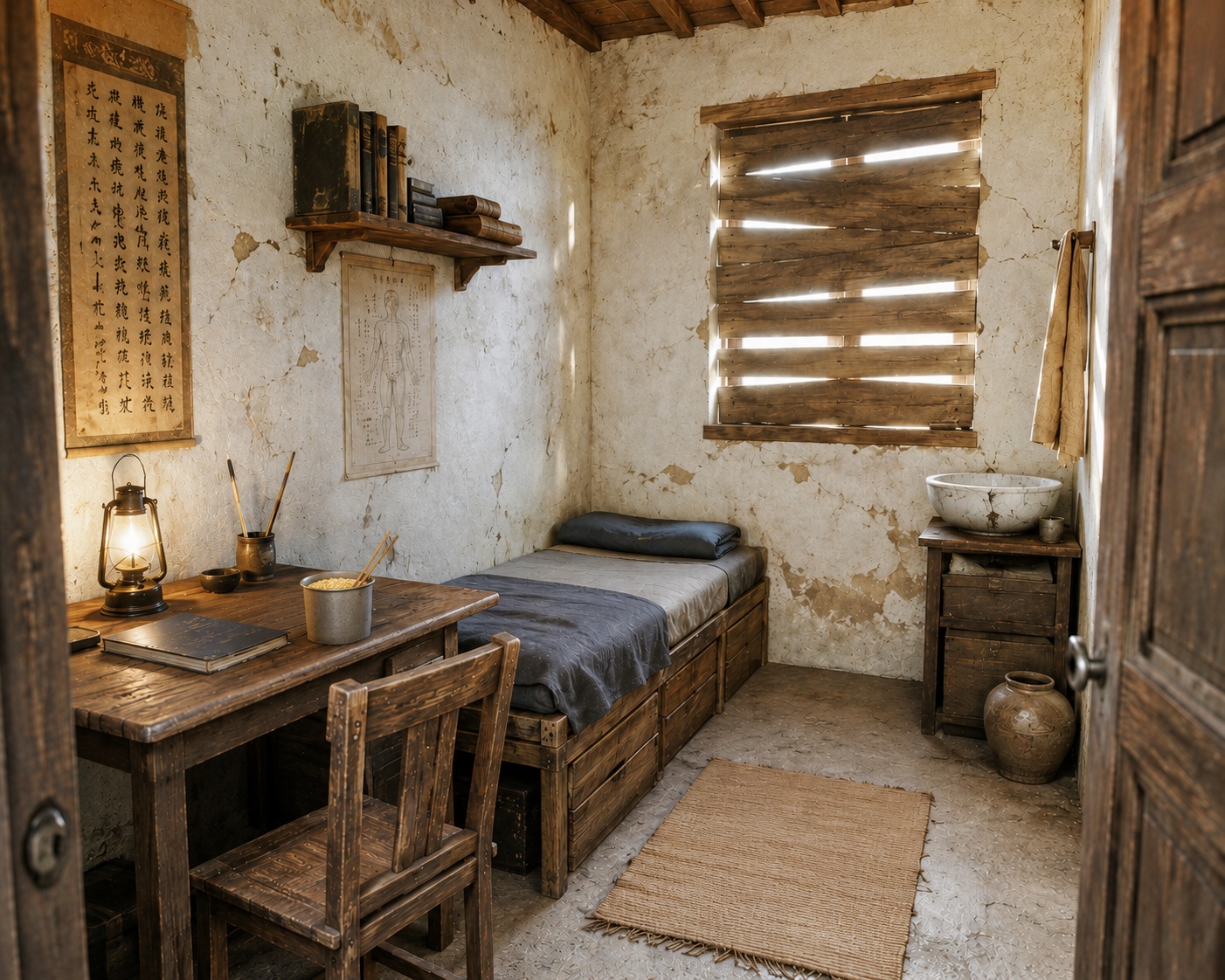
Every time a caravan returned to Deep Harbor, we were given several days off. With the money I was now making, I rented a permanent room above a noodle shop near the western canal district. It was a tiny room with a narrow bed, cracked wash basin and boarded up window that rattled in the wind. The chatter from the noodle shop came through the walls, vendors shouted in the street outside, and roaches scurried across the floor.
It was my home. I accepted this fact. I missed my past, I missed Haaris and Far Away, but this was my life now. New adventures opened before me. Still, there was a part of me that didn’t know what I was doing anymore, or why. I was lonely. I wrote this feeling off as fear of something new, and ignored it.
I bought sturdy boots. Better clothing. A winter cloak lined with wool. I repaired and sharpened my dao regularly, oiling the blade with almost religious care. Every now and then I returned to the bridge with donations of food and warm clothing. There, with my old riverside companions, I felt comfortable and whole, for a while.
Sometimes, when we were given leave, I followed my colleagues to see what their lives were like. One by one, I learned their secrets: Kuangren immediately vanished into gambling houses and brothels. Longwei visited teahouses and storytellers, and fought in amateur wrestling competitions for money. Meilin always ate enormous meals at restaurants, then went to stay with a woman who looked like her sister. Ahmed spent much of his free time at the masjid. As for Weili, she went to an archery range where she practiced shooting for hours, then to a little rooming house on the other side of town from my own. I wondered, did she not have a family? Was she an orphan too?
Having learned these things, I realized that the knowledge meant nothing and did not ease my loneliness. I stopped following them.
I was in my little room, eating noodles purchased from the shop downstairs, when a firm knock sounded at the door.
I felt a rush of excitement. Who could it be? Maybe one of my work mates had come to visit?
I opened the door and found Zihan Ma standing before me. He looked different. There was gray in his hair that had not been there before, and new lines creased his forehead. Either I had grown or he had shrunk, for I stood the same height as him now. He wore walking boots and a medical bag slung over one shoulder.
What I noticed most, however, was that his eyes were tired.
A Grievous Error
“Uncle!” I blurted out. “How did you find me?”
He took a slow, deep breath. “I have been looking for you, Darius. For many months I have looked.”
“You have?” I remembered, some months ago, seeing him standing in front of the masjid, watching the faces of the men as they entered. “But why?”
His eyes met mine. “I judged you wrongly. I committed a grievous error. I ask Allah’s forgiveness and yours. We miss you. We want you to come home.”
This speech, short as it was, carried such weight that I took a step backward, then another, until I found myself sitting in the only chair in the room, beside a small table.
“May I enter?” Zihan Ma asked.
I waved to him to enter.
“May I sit on the bed?”
I nodded dumbly.
“What…” I paused to gather my thoughts. “So you now do not believe that I stole the bracelets and the gifts?”
“I know you did not.”
“How do you know?”
He swallowed. “Your Nai Nai sent a letter by courier, only a week after you met her that day. Those bracelets had been locked in a secure chest. She confronted her husband, and he admitted that he ordered the servant to plant them in your pack. His justification was that you were a bad seed, and it would be better for the family to get rid of you.”
I tilted my head back and looked at the wooden ceiling rafters. “So now you know I’m not a bad seed, is that it?”
“I never thought that.”
“What if… What if Nai Nai had not written that letter?”
Zihan Ma sighed. “I made a mistake, Darius. Have you never made a mistake that you regret deeply, and that you are ashamed of?”
I gave him a blank look. “Not really.”
He winced at that. “Haaris misses you. You’re his brother. And he has to do all the farm work by himself again. It’s hard for him.”
That hurt me. “That’s not fair.”
“Your Lee Ayi talks about you every day.”
I stood suddenly. “I have a new life now. I have to go forward, not backward.”
Zihan Ma stood as well, pushing on his knees with his palms. “Our home is your home,” he said. “You can return anytime, to live or to visit. You don’t even have to knock. We love you. I… Well, I love you.”
This nearly made me break into tears but I held myself rigid. Zihan Ma turned to leave.
“Uncle. How is Far Away?”
He smiled. “He runs, climbs walls, suns himself atop the house. Bao Bao can’t keep up. He even jumps onto the donkey’s back sometimes. Alhamdulillah for all His mercies upon us. The world is built upon rahmah, Darius. Mercy. Nothing else. I forgot that for one moment. I am sorry.”
When he left, and the door was firmly closed, I fell onto my bed and wept.
* * *
Come back next week for Part 16 – Five Star Trading Company
Reader comments and constructive criticism are important to me, so please comment!
See the Story Index for Wael Abdelgawad’s other stories on this website.

Wael Abdelgawad’s novels – including Pieces of a Dream, The Repeaters and Zaid Karim Private Investigator – are available in ebook and print form on his author page at Amazon.com.
Related: