

Muslim Poet, Buddhist Statues | The Review of Religions
How Buddhist sacred sites were viewed by Muslims in the Medieval Period
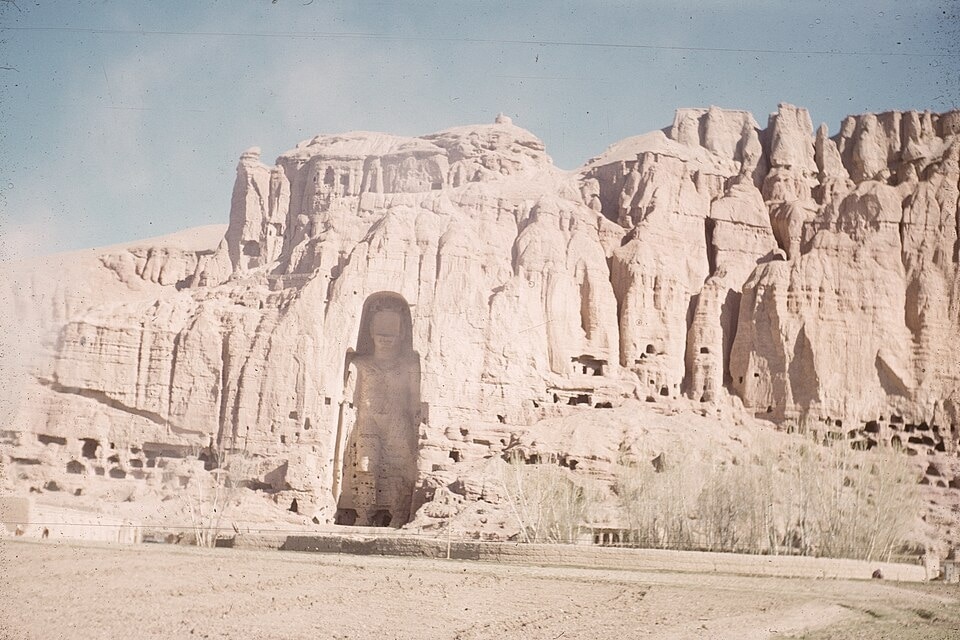
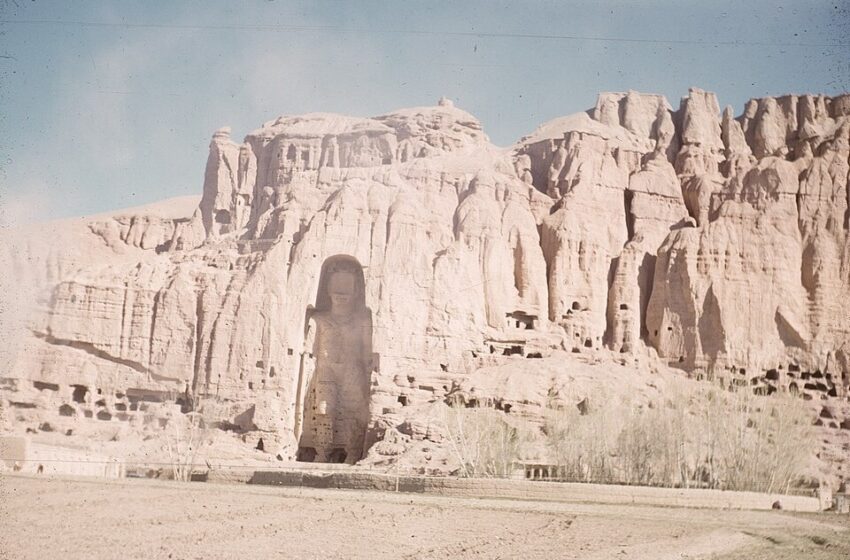
Buddhas of Bamyan (May 1961), photograph by František Řiháček, via Wikimedia Commons, licensed under CC BY-SA 3.0.
The countries of Iran and Afghanistan have, for a long time, been linked in Western media with Islamic terrorism. A key trigger for this occurred in 2001, when the Taliban destroyed an important piece of humanity’s shared heritage: the Bamiyan Buddhas, two towering sculptures that astonishingly adorned the sandstone cliffs on which they were carved out in the sixth century CE. Located at a pivotal node of the Silk Road, they were blessed with centuries of rich history, visited and wondered at by people from near and far, many of them being Buddhist monks from East Asia. But that rich history was abruptly wiped out. That destruction of these priceless treasures led to the conclusion in many minds that Islam is a fundamentally intolerant religion incapable of peacefully coexisting with other faiths. And that destruction’s one-sided worldwide media coverage also eclipsed the Soviet destruction of Buddhist archaeological heritage in Afghanistan, further cementing the idea that it is only Muslims who destroy. But in reality, nothing could be further from the truth.
First of all, shall I point out the obvious? Muslims took over that region over a thousand years ago, and for over a thousand years those statues stood unharmed. The fact that the Taliban had anything to destroy in the first place is itself proof that Islam can coexist with other faiths. After all, no Muslim is known to have ever laid even a finger on them despite having a myriad chances for that throughout the centuries. In fact, not only were these statues tolerated by Muslims for centuries and centuries, they were even celebrated.
One example that shall be discussed here was the Balkh-based poet Abu’l-Qāsem Ḥasan b. Aḥmad Unsuri Balkhi (961-1039), a paramount poet at the court of the powerful Ghaznavid king Mahmud of Ghazni. His literary prowess and eminent wordmanship found their best expressions in his panegyric (praise) poetry, his romantic epics, and his mathnawis (poem of a long chain of rhyming couplets that dive deep into didactic, spiritual, philosophical, or narrative contents), earning him the knighting of the title Malik-us Shu’ara (King of Poets).
Among his literary works is a Persian-language mathnawi called “Khing But u Surkh But” (“Moon‑White Idol and Red Idol”). Unfortunately, this poem is mostly lost, sharing its fate with the carved marvels it was based on. However, it was referenced in many other works sufficiently to retrieve its content: both sculptures are reimagined as star-crossed lovers entombed in stone, their likeness immortalised by these two towering colossi. The male was associated with the sun, hence called surkh but (red idol). The female was linked to the moon, hence called khing but (moon-white idol). This colour-coded binary of sun and moon for the lovers serenely bridges human craftsmanship with cosmic imagery, as if the sun and moon materialised in stone. Such an ingenious acknowledgment treated the massive Buddha sculptures as elegantly marvellous icons of wondrous presences rather than idols to be destroyed. These terms for the sculptures, however, were commonly used for them in their description entries in geographic encyclopaedias. Rethinking them as lovers separated by fate lasted longer in local folklore, especially Hazara traditions, all varying in narrative details, and some referring to them by the names Shahmama (for the smaller one) and Solsol (for the bigger one).
But, is such a reinvention not a scornful mockery due to the disregard of their original meaning? One could assume that. But a closer look at Bamiyan’s history unveils that Unsuri could never fathom that this was once a purely religious site. The erstwhile statues were only the tip of the iceberg of the Buddhist nature of Bamiyan. More on that is found inside the mountains they were carved into as they contain a huge number of caves dedicated for worship. Those caves date to various centuries, thus providing a timeline for the Buddhist religious activity at this site. The last cave carved for Buddhist worship is roughly dated to the ninth century. And the last Buddhist traveler to describe a pilgrimage and visit to Bamiyan was the Korean monk Hyech’o in the eighth century. Lacking evidence for any later religious activity at the site speaks for an abandonment or fading significance. Meaning, by the time of Unsuri, around two centuries later, there was most likely no practicing Buddhist left to educate people on the site’s original religious substance. One might allege that the decline of Buddhist activity at Bamiyan was forced by the arrival of Islam due to both events’ overlap in time. However, there is proof that Buddhists appear to have relinquished this site in particular and continued practicing their faith elsewhere in this region.
For instance, Buddhist practice outlived Islam’s advent and possibly even coexisted with it in the city of Balkh (northern Afghanistan in modern borders), in which there was the vast Buddhist monastery named Naw Bahar. Presumably found in the second century CE by Kushan emperor Kanishka I, it also flourished for many centuries as a beacon for Buddhism, likewise attracting students of the religion from far and wide. The most prominent among them was probably the Chinese monk, Xuanzang, from the first half of the seventh century. In the same century, the first Muslims reached the region under the Rashidun Caliphs, Hazrat Umar (ra) and Hazrat Uthman (ra). During the 8th century, Balkh was variously pulled by the Turk Shahis, the Tibetan Empire, and the Umayyad Empire, with the latter succeeding the conquest. While that put the region under Muslim rule, other faiths’ heritage was not wiped off the surface.
Among the earliest scholars of the Muslim faith to document the Naw Bahar monastery was Umar ibn al-Azraq al-Kermani, an Iranian scholar from the early eighth century, when the region had just come under Muslim-led Umayyad rule. His account on it was cited by scholars of subsequent centuries. Given the recent conquest, did he advocate for any annihilating seizure of the site? No! He not only left a minute description but also drew striking links to his own faith: he parallels the monastery’s stupa with the Kaaba, both being covered in cloths, situated centrally within their architectural contexts, and both circumambulated. What an exquisite way to connect faiths! After all, superficial differences in religious formality are not what matter but instead humankind’s common grounds.
Three centuries forward in the 10th -11th century, the Persian scholar and contemporary of Unsuri Balkhi, Abu Rayhan Muhammad ibn Ahmad al-Biruni (c. 973 – c. 1050), a giant in Indology and anthropology, documented it as a still operating monastery in his studies on Buddhism.
And this is where the picture of the 11th century becomes the most nuanced: while one Buddhist sacred site (Bamiyan) was abandoned, at least another one (Naw Bahar) was still used as such. Likewise, plenty of the people calling themselves Muslims were awed at them.
Furthermore, the region’s Buddhist heritage sparked the inventiveness of artisans and architects who would obtain design inspirations for mosques and madrasas from Buddhist temples and monasteries. The DNA of the Ghaznavid Empire truly was a crossroad where rich threads of Islamic credo, Buddhist heritage, and Persian literature formed together one gaudy tapestry, of which these examples of Persian literature and Persian scholarship provide compelling glimpses, inviting one to explore more.
Retained in memory. Reimagined in poetry. Revered in intellectual lore. To many Medieval Muslims, the Buddhist heritage was indeed symbols to ponder and wonder at, poems in stone, and a cultural continuum. Preserving heritage means not just drawing on monuments only, but also reclaiming multi-faith legacies of respect, deeply embodied by such voices. Voices that remind us that condemnation or destruction is never the only or natural response to difference. Voices that remind us that admiration, appreciation, and awe can and do transcend faith. By erasing the Bamiyan Buddhas, the Taliban radically ruptured this rich history. A rich history of Muslim-Buddhist interactions that goes back to the time of the Rightly Guided Caliphs (ra). What followed were centuries filled with peaceful coexistence and fruitful intellectual and legal protection for Buddhists under Muslim rule.
If only that mathnawi of Unsuri’s had survived, it would certainly be a hallmark of Persian literature that would blaze the trail, showing peace beyond boundaries amidst the draining darkness of depravity. But perhaps we should write our own odes of mutual respect?
About the Author: Rastagar Ahmad Ilyas Munir studied Asian Archaeology and Art History, Egyptology and East Asian Studies at the University of Vienna and Heidelberg University. He is currently working on his PhD.
Bibliography
Akasoy, Anna Ayse, Muslim–Buddhist Relations and Buddhism in Muslim Sources until the Mongol Period, in: Oxford Research Encyclopedia of Religion, Oxford, 2022.
Azad, Arezou / Kennedy, Hugh, The Coming of Islam to Balkh, in: Delattre, Alain / Legendre, Marie / Sijpesteijn, Petra M., Authority and Control in the Countryside. From Antiquity to Islam in the Mediterranean and Near East (Sixth–Tenth Century), 2018, https://doi.org/10.1163/9789004386549_010
Berzin, Alexander, Buddhist-Muslim Doctrinal Relations (https://studybuddhism.com/en/advanced-studies/history-culture/buddhism-islam-advanced/buddhist-muslim-doctrinal-relations)
Centlivres, Pierre, Les Bouddhas d’Afghanistan, Lausanne, 2001.
Flood, Finbarr Barry, Between Cult and Culture: Bamiyan, Islamic Iconoclasm, and the Museum, in: Art Bulletin Vol. LXXXIV No. 4, December 2002, pp. 641-659.
Klimburg-Salter, Deborah, Entangled Narrative Biographies of the Colossal Sculptures of Bāmiyān: Heroes of the Mythic History of the Conversion to Islam, in: Nagaoka, Masanori (ed.), The Future of the Bamiyan Buddha Statues. Heritage Reconstruction in Theory and Practice, Paris 2020, pp.215-237. DOI: https://doi.org/10.1007/978-3-030-51316-0_14.
Melikian-Chirvani, Assadullah Souren, L’evocation litteraire du Bouddhisme dans l’Iran musulman, in: Le Monde Iranien et l’Islam, no. 2, 1974, pp. 1-72.
Inaba, Inaba, KĀBUL AND THE REGIONAL CENTERS OF EASTERN AFGHANISTAN IN THEIR HISTORICAL PERSPECTIVE, in: Xinru Liu, The World of the Ancient Silk Road, 2022, pp.336-353.
Ramli, Ahmad / Awang, Jaffary / Rahman, Zaizul, Muslim scholar’s discourse on Buddhism: a literature on Buddha’s position. SHS Web of Conferences, 2018. DOI: https://doi.org/10.1051/shsconf/20185304001