


Friday Sermon Summary 10th July 2026: ‘The Kindness & Generosity of the Promised Messiah (as)’
Summary prepared by The Review of Religions
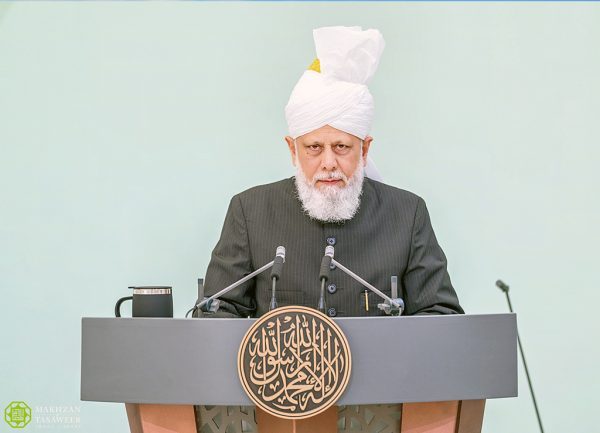
After reciting Tashahhud, Ta`awwuz and Surah al-Fatihah, His Holiness, Hazrat Mirza Masroor Ahmad (aba) continued presenting incidents from the life of the Promised Messiah (as), demonstrating his kindness and generosity.
Showing Kindness to One’s Opponents
His Holiness (aba) said that the Promised Messiah (as) would show kindness even to those who opposed him. For example, Mirza Imamuddin was a staunch opponent of Ahmadiyyat, and he opposed the family of the Promised Messiah (as). While the Promised Messiah (as) could not bear opposition in religious matters, he would overlook opposition in worldly matters. At various times, Mirza Imamuddin would require financial assistance, and the Promised Messiah (as) would not hesitate to help him. In fact, despite receiving this help from the Promised Messiah (as), Mirza Imamuddin would continue in his opposition. For example, once Mirza Imamuddin was having trouble selling his horse, the Promised Messiah (as) helped him by sending him to Hazrat Hakim Maulvi Nooruddin (ra), along with his own recommendation, to help him sell the horse.
His Holiness (aba) said that Mirza Muhammad Baig was another opponent of Ahmadiyyat and the family of the Promised Messiah (as). Yet, despite this opposition, when Mirza Muhammad Baig sought employment in Jammu, he approached the Promised Messiah (as) to request a letter of recommendation to Hazrat Hakim Maulvi Nooruddin (ra). The Promised Messiah (as) wrote a letter of recommendation, as a result of which Mirza Muhammad Baig secured a job.
His Holiness (aba) said that there was a well-known Hindu debater in Qadian who was an opponent of Ahmadiyyat. Towards the latter part of his life, this man found himself in financial difficulties, to the point that he could not afford even the basic necessities of life. Despite his opposition, he visited the Promised Messiah (as). He explained his circumstances, upon which the Promised Messiah (as), disregarding all his opposition, gave the man some money and told him he would give him even more later. Indeed, this man would return to the Promised Messiah (as) every few months to obtain money to sustain himself.
Giving Should Never Be for the Sake of Ostentation
His Holiness (aba) said that the wife of Hazrat Hamid Ali (ra) relates that the Promised Messiah (as) bore the expenses of her family. When the Promised Messiah (as) had a waistcoat made for himself, he had the same once made for Hazrat Hamid Ali (ra). Once, when the wife of Hazrat Hamid Ali (ra) was feeling cold, he told her she could wear the waistcoat the Promised Messiah (as) had given him, as it was made of warm fabric, and she did. The Promised Messiah (as) happened to come across her, and seeing as he had the same waistcoat, the Promised Messiah (as) asked in a lighthearted manner if she had taken his waistcoat. She replied that all the clothes and food they had were indeed the result of the kindness and generosity of the Promised Messiah (as).
His Holiness (aba) said that whenever the Promised Messiah (as) gave things to others, it was never for show; rather, it was to please God and out of his compassion for humanity. Thus, the Promised Messiah’s (as) generosity was often exercised in secret. There was an orphan in Qadian whose expenses and education were all funded by the Promised Messiah (as). He later became employed at the Badr newspaper in Qadian at a salary of 12 rupees. One day, the Promised Messiah (as) enquired about him and learned that his salary was 12 rupees. The Promised Messiah (as) thought this might not be enough to cover his expenses. Hence, the Promised Messiah (as) quietly walked past the man’s room and placed a packet of money inside it. The man had no idea where this packet had come from, and it was only much later that he would learn it had come from the Promised Messiah (as), who had quietly helped him cover all his expenses.
Helping Those in Need Even Before They Ask
His Holiness (aba) said not only did the Promised Messiah (as) never turn away anyone who had a need, the Promised Messiah (as) would also preemptively discern a need that may arise and fulfil it. For example, once during the winter, the Promised Messiah (as) gave a new migrant to Qadian some money to buy warm clothes. The man had not asked for anything at all, yet the Promised Messiah (as) perceived he may have a need and then fulfilled it.
His Holiness (aba) said that once, Mian Nizamuddin, who was a poor man, walked from Kapurthala to Qadian to visit the Promised Messiah (as). Upon arriving in Qadian, he presented two rupees as a gift to the Promised Messiah (as). A few days later, when Mian Nizamuddin was about to depart, the Promised Messiah (as) gave him seven or eight rupees as a gift upon his departure.
Looking After Those Who Help You
His Holiness (aba) said that the Promised Messiah (as) was very mindful about helping those who served him. Munshi Zafar (ra) says that once, on the occasion of Eid, the cloth for his turban was unclean. This was because he had come to Qadian only for a few days but had ended up staying longer, reusing the clothes he had brought for what was meant to be a short trip. Hence, when Eid came around, he thought to go to the market to buy a new cloth to tie as his turban. As he was walking to the market, the Promised Messiah (as) saw him and asked where he was going. Munshi Zafar explained that he was going to buy a piece of cloth to tie as a turban. Right then and there, the Promised Messiah (as) took off his turban and handed it to Munshi Zafar (ra), saying he would go and tie himself a different turban. This kindness and generosity left a profound impact on Munshi Zafar (ra).
Applying Wisdom When Giving
His Holiness (aba) said that the Promised Messiah (as) followed the perfect example of the Holy Prophet (sa), and in doing so, according to the dictates of wisdom, there were times when the Promised Messiah (as) would decide not to give someone what they were seeking. For example, once, someone went to the Promised Messiah (as) and said that his relative had passed away but he did not have enough money to make his funeral arrangements. Instead of giving the man what he asked for right away, the Promised Messiah (as) sent one of his companions to accompany the man and see to the funeral arrangements. A little while later, the companion returned smiling, saying the man was a deceiver. Along the way, the man tried to convince the companion not to go any further and just to give him some money. When the companion insisted that he would go along, the man admitted that he had lied and that he, in fact, did not have a family member who died; rather, this was his ploy to get some money. Thus, the Promised Messiah (as) very wisely had refrained from giving money right away.
Generosity to Children
His Holiness (aba) said that the Promised Messiah’s (as) generosity extended to children as well. Once, while the Promised Messiah (as) was eating breakfast, he heard a little girl crying and asked her mother what she wanted. The mother replied that she was asking for something to eat, and so the Promised Messiah (as) gave her something to eat; however, the small girl continued crying. The Promised Messiah (as) asked why she was still crying, to which the mother replied that the little girl was asking for the same food that the Promised Messiah (as) was eating. Upon this, the Promised Messiah (as) gave the little girl some of the same food he was eating.
The Importance of Repaying One’s Loans
His Holiness (aba) said that in his previous sermon, he related an incident in which the Promised Messiah (as) used his wife’s jewellery to cover the kitchen expenses. Upon this, someone asked His Holiness (aba) whether this means that a husband can use his wife’s jewellery to fulfil his expenses. His Holiness (aba) said that it should be clear that the Promised Messiah (as) would take this as a loan from his wife. It is similarly recorded that during a drought, the Promised Messiah (as) took a loan from his wife to cover household expenses and the expenses of the communal kitchen (Langar). Later, upon receiving some money, the Promised Messiah (as) repaid the loan to his wife.
His Holiness (aba) said that the Promised Messiah (as) would sometimes sit in an orchard with his friends. On these occasions, the Promised Messiah (as) would once again exhibit his generosity by distributing various fruits to all those sitting with him.
His Holiness (aba) said that these were a few narrations of the Promised Messiah’s (as) generosity, which he displayed in following his master, the Holy Prophet (sa). This generosity impacted Ahmadis and non-Ahmadis alike; indeed, it would leave a profound impact even on his opponents.