

The New Era of Muslim Political Power Is Already Here
What is the future of Muslim political power?
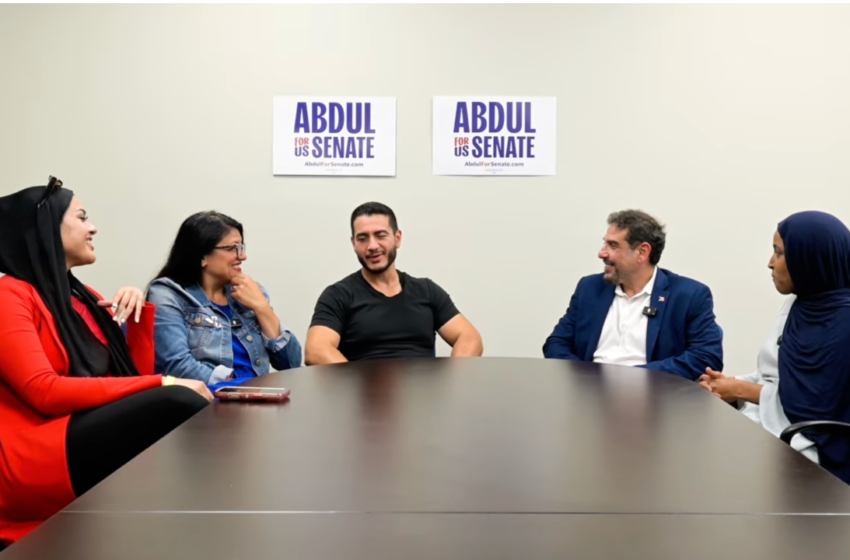
On the occasion of Michigan’s Democratic Primary, which saw Dr. Abdul El-Sayed win a historic victory against AIPAC-backed Haley Stevens, four American Muslim leaders sat down with Muslim Girl founder Amani Al-Khatahtbeh to discuss the very real stakes of the moment.
Michigan attracted national attention in the final days leading up to the primary. Rep. Ilhan Omar, Rep. Rashida Tlaib, and soon-to-be Rep. Adam Hamawy joined Abdul on the campaign trail for the primary that would choose Abdul to be the first Democratic nominee for U.S. Senate.
In their first roundtable together, the consequence of the convening brought on reflections of Muslim identity in U.S. power and their shared experiences of enduring anti-Muslim hate. The conversation naturally became a retrospective on our progress toward embracing identity and building a future where representation is no longer an exception, but a reflection of America itself.
“It’s not just the path that you widen for Muslim candidates. It’s the path that you widen for any candidate who’s told that they don’t quite belong because of an ethnic identity, or a faith identity, or a sexual orientation, or whatever it is. It’s that you’re normalizing the ability to represent and be fully and 100% American because America doesn’t look one way,” Abdul shared.
Rashida Tlaib, who has represented Michigan in the U.S. House since 2019 and won her fifth term on Primary Day, framed the growth in Muslim political representation as part of a larger movement.
“[This role] has given a lot of people strength to be unapologetically themselves. Growing up, I didn’t know when someone was Arab American until they showed up for our community and said they were,” Rashida said, emphasizing how Muslim children can now see people of their faith in government and imagine themselves there too.
Rashida continued to say that since she and Ilhan were elected in 2019, about 200 Muslims have been elected across the country.
Ilhan is Somali-American and has served as the U.S. representative for Minnesota’s 5th congressional district since 2019. She is a reminder of an earlier era in political representation when Muslim candidates were encouraged to be “less Muslim” or keep their faith less visible:
“It is not something that feels threatening for Muslim candidates anymore because they see us. They see that we withstand everything, and we’re still able to serve the people that elected us. That’s encouraging for future candidates to be like, okay, if they survived, you know, I got this,” she said.
Adam Hamawy, who won his primary for U.S. Congress in New Jersey’s 12th District, added onto the conversation around campaign spending to U.S. support for Israel and the war in Gaza, reflecting the criticism on the role of political spending in shaping policy across the country.
“Do we want politics where super PACs come in and buy the election?”
As the first Muslim woman elected to U.S. Congress, Rashida’s advice is particularly resonant: “Come home every week.”
“Every time somebody steps up and does this thing, America gets a little bit wider for everybody. And that’s a beautiful thing,” El-Sayed said.
And perhaps through it all, Muslim political representation was never just about getting a seat at the table, but about remembering whose voices are missing.