

What the Makkah Agreement is Missing
On August 7, 2026, Pakistan, Saudi Arabia, and Turkiye signed a defence pact termed as the Makkah Defence Alliance. This is primarily an agreement for collective security, quite similar to NATO (North Atlantic Treaty Organization)’s Article 5. The official announcement states: “Any armed aggression against any one of the three states shall be considered an aggression against them all.”
The Makkah Agreement has received significant attention in the Muslim world, where many have hinted at a coming Muslim NATO alliance. For many, this stands in contrast to the United Arab Emirates’ increasing military cooperation with Israel since the so-called Abraham Accords in 2020. The standing assumption is that these three Muslim countries will have more in common and will be likelier to come to each other’s support.
The agreement was tested immediately with the Houthis’ attack on the Saudi Jizan refinery, yet neither Pakistan nor Turkiye came to Riyadh’s aid to defend it. Ironically, when the UAE was bombed by Iran, Israel sent its Iron Dome battery over in secrecy. “Israel did the UAE a great favor during the war,” a US official told Middle East Eye on condition of anonymity.
Keep supporting MuslimMatters for the sake of Allah
Alhamdulillah, we’re at over 850 supporters. Help us get to 900 supporters this month. All it takes is a small gift from a reader like you to keep us going, for just $2 / month.
The Prophet (SAW) has taught us the best of deeds are those that done consistently, even if they are small.
Click here to support MuslimMatters with a monthly donation of $2 per month. Set it and collect blessings from Allah (swt) for the khayr you’re supporting without thinking about it.
This shows two contrasts between these two agreements. The Makkah Agreement was signed in Makkah after Pakistan’s prime minister Shehbaz Sharif and military commander Asim Munir performed Umrah. Turkiye’s Tayyip Erdogan arrived on the holy day of Jumaah, where the visiting leaders joined Saudi crown prince Mohammad bin Salman in prayer facing the Kaabah, the holiest site for Muslims, and finalizing the agreement. Meanwhile the agreements between the UAE and Israel are kept hidden and are not openly discussed, even though Israel in practice cooperated more with the UAE during the 2026 war than Turkiye and Pakistan did for Saudi Arabia.
This should bring us to an important point: where does the strength of the Makkah Agreement actually lie?
The Makkah Agreement brings with it a powerful symbolism of Muslim unity and promise of a better, more united future. There are reports that Bangladesh may join, and Turkiye has pushed for the inclusion of Egypt. This is one of the few initiatives that promises to connect the Muslim world. However, it is still an agreement to defend nation-states, and their interests, a defensive agreement and not necessarily one that promotes Islam and unity of Muslims above all else. It is sometimes difficult to distinguish between what promotes Islam and when Islamic symbolism is used to color what in reality is nation-state securing their interests.
Nevertheless, most would agree that this is a step in the right direction. But what would it take to develop this step further?
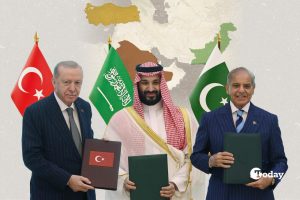
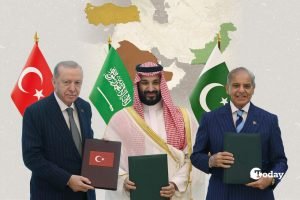
Turkish president Tayyip Erdogan, Saudi crown prince Mohammad bin Salman, and Pakistani prime minister Shehbaz Sharif mark the Makkah Accord (Photo: Turkiye Today).
All pacts and agreements between nations are ultimately operated by people. These people need to understand each other’s cultures, languages, and sensitivities. To promote this, we need first and foremost to promote studies across these countries.
The European Union, for instance, is held together by a number of initiatives, including the Erasmus+ program, which many university students know promotes exchanges for European student. The objective of the program is to provide transnational learning, cooperation and inclusions across European univerisities. This creates connections, cultural understanding, and love for the countries that aims to lead their future leaders toward strategic partnerships.
The Muslim world has been given the concept of the “Ummah” through the religion of Islam and this has created love and solidarity between average Muslims: in everyday conversations between Muslims we hear sympathy when they hear about issues in other Muslim countries, but little has been done to get to know one another across national borders. There were around 5000 Pakistani students in Turkiye in 2025, and most Pakistanis in Saudi Arabia were foreign workers, not students that engage intellectually with the culture, politics, and universities. By comparison, there were 48,000 in the United Kingdom and 10,000 in Germany alone. Meanwhile, Turkiye is actually the largest non-EU participant in the Erasmus+ program, and Saudi Arabia also sends many students to the United States, United Kingdom, and other Western countries.
When all these countries send their best minds to the West, what kind of cultural exchange is taking place between these countries? As somebody who has studied in Turkiye and Jordan, with a Pakistani background and a Norwegian upbringing, I can say that Norwegian people who have a large Pakistani community among them know more about Pakistan and its culture than many of the people I met in Jordan and Turkiye, even though the latter share the same faith and cultural closeness. Real interactions and exposure are needed in order to foster bonds.
To build on the soft power of the Makkah Agreement, person to person initiatives must first and foremost be established so as to create stronger bonds between different Muslim nations and cultures. One method could be increased educational mobility between member countries, so that culture, language, and other nuances are shared with those who will, in the future, be responsible for maintaining these agreements.
Related:
Exploring the Legacy of the Ummah: Why Turkiye is the Ideal Destination for a Family Vacation
Why Pakistan must not Side with the Saudi Bloc against Qatar