

Islamic Psychology in the Holy Qur’an
Blog Post 89
Rabi al-Thani 18, 1448 – September 30, 2026
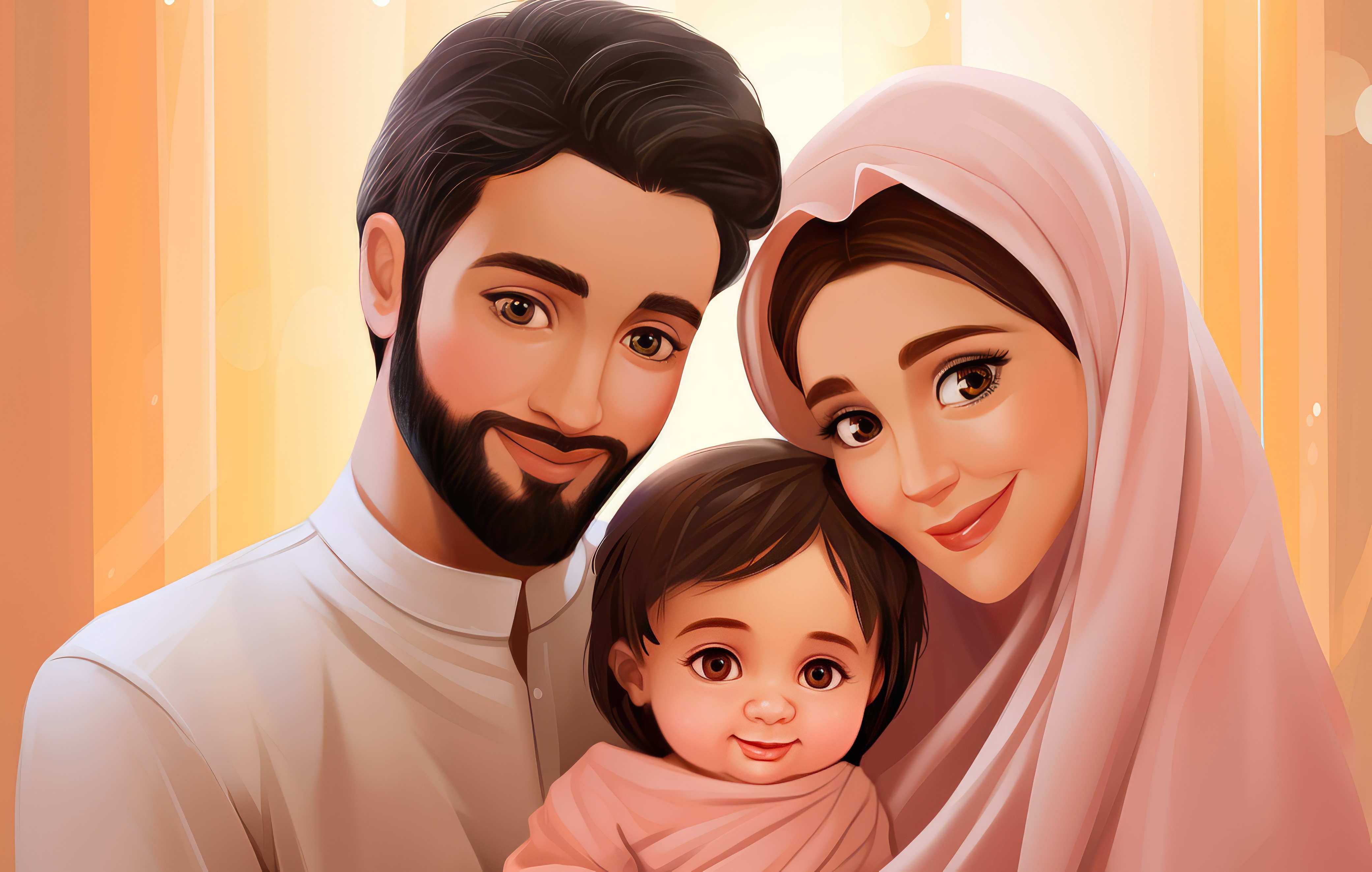
Part 1: Starting Before Conception
Recently, I’ve been doing a lot of thinking about a topic that has always been on my mind throughout my lifetime, even before I embraced Islam. It is such an important topic because it is all about our Creator, Allah Subhanahu wa ta’ala, and us, human beings which He created and knows all about. He knows what we’re made of, what we think and why and how we act and why. And thus, Allah knows what we need and what we don’t, what works for us and what doesn’t, how we should think and behave and how we shouldn’t.
So a study of the human being’s psychology using Allah’s Words in the Holy Qur’an and His teachings to the Prophet(s), the Ahl al-Bayt (peace be upon them all) and the scholars in Islam is a very worthy study. Inshallah, it will add to our knowledge and enable us to be the best human beings we can be and worthy worshippers of Allah Subhanahu wa ta’ala. It is expected that it will be in several parts. What follows is Part 1, inshallah.
Everyone should understand that we must adopt virtues (positive character traits) and control and remove vices (negative character traits), not one or the other. Abu Hamid Muhammad Al-Ghazali in his early 12th century book Ihya Ulum al-Din (The Revival of the Religious Sciences) wrote: “For, if one is satisfied simply with the removal of bad qualities, he is like a farmer who, after ploughing the field and cleaning it of weeds, sits down in expectation of the harvest, without having sown anything in the field at all. And if one only develops good character traits and does not weed out bad character traits, it is like planting a healthy seed in a diseased soil, thus thwarting or jeopardizing its growth altogether.” (Gillani, Uzma and Khan, Muhammad J. “Achieving our highest potential…” Frontiers in Psychology, 2025 Aug. 13)
To understand how and why people are mixtures of virtues and vices, we can start with the wisdom and insight of Imam Ruhullah Khomeini, may Allah be pleased with him. In his 1960 book Al-Talab wa al-Irada (Desire and Will or Seeking and Determination), he explains that “because the Essentially Necessary Being [Allah Subhanahu wa ta’ala] is necessary in every dimension, it is impossible to withhold grace from the receptacle of grace.” If Allah were to withhold grace from the receptacle that “enjoys complete receptivity or does not have any deficiency,” would mean that the Provider of grace is imperfect. Astagfir Allah. It “is similar to the essential impossibility of evil and oppression issuing from God…Therefore, there is no stinginess or favouritism from the All-Gracious. He bestows abundance of grace to every human being from the onset. The receptacles, however, are deficient, and thus limit or hamper the grace. The doors, however, are never closed. The temporal life of this world is an opportunity to change. The human being, from which ever land it starts developing, is in possession of an unsullied innate nature. It is the parents that blemish their attitudes and direct them to the path of spiritual destruction. Imam al-Sadiq (‘a) is reported to have said: ‘No baby is born save with the sound nature (fitra). Thereafter it is his parents that change him into a Jew, a Christian, or a Magian.’” (Khalfan, M.M., The Sacred Effusion…, 2009) In essence, each one of us are born as a Muslim, one who submits to Allah Subhanahu wa’tala, our Creator and Sustainer, with a pure fitrah that calls them back to Allah and obedience to Him.
This fitrah is our “innately ordained disposition toward goodness” which Allah Subhanahu wa ta’ala put within every human being. “This fitrah, even whilst confined to the realm of the corporeal world, continuously yearns and seeks goodness and is instinctively attracted and naturally inclined to honouring and respecting those instances of goodness it perceives, whether the acts are current and live, or have happened in the past and belong to legends of history, such as members of the Ahl al-Bayt (‘a)”, the Prophets of Allah and the piously righteous men and women of Allah’s Way. With the Holy Qur’an’s instruction and the Sunnah of Prophet Muhammad (s.a.w.) and the lives of the Ahl al-Bayt (a.s.) “and through the internal proof, the fitrah, the connection with” the Prophet(s) and “the Ahl al-Bayt (‘a) is a fundamental part of human existence and assists to fulfil an inherent metaphysical need within us of seeking closeness to Allah through noble characteristics perceived in extra-ordinary personalities.” (Khalfan)
Furthermore, “the human being has been described by Allah as being created in the best form, or created perfectly:” (Gillani and Khan)
Allah Subhanaha wa ta’ala says about Himself and the human being in the Holy Qur’an:
“And indeed, We created the human being from an extract of clay.
Then We placed him as a semen-drop in a firm resting place.
Then We created the semen-drop into a clinging substance.
Then We created the clinging substance into an embryonic lump.
Then We created the embryonic lump into bones.
Then We clothed the bones with flesh.
Then We produce it as another creation.
So blessed is Allah The Best of The Creators.” (23:12-14)
“Indeed, We created the human being in the best mould.” (95:4)
“The Work of Allah Who perfected all things.” (27:88)
“The One Who made good every thing He created
and He began the creation of the human being from clay.
Then He made his progeny from an extract of despised water.
Then He fashioned him and breathed into him from His spirit
and made for you the hearing and the sight
and the feelings; what little thanks you give.” (32:7-9)
“These ayaat do not speak only of the human being’s physical form. The perfection of man and woman includes the human spirit, the human will, the human emotional capacity, intellectual drive, innate curiosity, desire to excel, ability to love without bounds; and our yearning for Allah, even when we do not recognize it.” (Gillani and Khan)
“When Allah created humanity, He placed a portion of His spirit within us. The spirit of Allah…is the spirit created by Allah and owned by Allah, not part of the essence of Allah. Humanity is honored with this unique capacity, facilitated by the spirit, to connect with the Divine through worshiping Him and voluntarily submitting to His will.” Also, “it adds nobility…and indicates that humanity is a wondrous creation, that his prestige is appropriate enough to enter the presence of the Lord. For this reason, it is said: Whoever knows himself, knows his Lord.” (Elias, Abu Amina. “Whoever knows himself, knows his Lord,” 2020)
“The spirit of Allah within human beings is reflected in our motivation to reach Him, to uncover the mysteries of His creation, and to be vehicles through which the will of Allah is accomplished, manifested in His attributes of mercy, justice, and wisdom. It is in the essential nature (fitrah) of human beings to incline towards His worship and to aspire towards higher levels of consciousness in our journey towards Him.” (Elias)
“Inside every person is the potential to become a true servant of the Almighty Lord, to reflect His attributes off the mirror of their pure hearts into the world. For this reason, one who awakens the spirit of Allah within themselves will act under the guidance of Allah, as if it were Allah Himself acting through them.” (Elias)
“Whoever knows the mysteries of the spirit, knows himself. If he knows himself, he knows his Lord. If he knows himself and his Lord, he knows his matter is heavenly in his nature and his instinct, and that he is a stranger in the corporeal world, that his decent into it is not as a result of his nature in itself.” (Elias)
Dr. Thomas Veray, a Canadian psychiatrist and a “leading expert on the effects of prenatal and the early post-natal environment on personality development,” along with John Kelly in their 1982 book The Secret Life of the Unborn Child; “says: …a woman is her baby’s conduit to the world. Everything that affects her, affects him. And nothing affects her as deeply or hits with such lacerating impact as worries about her husband… Because of that, few things are more dangerous to a child, emotionally and physically, than a father who abuses or neglects his pregnant wife… An equally vital factor in the child’s emotional well-being is his father’s commitment to the marriage. Any number of things can influence a man’s ability to relate to his partner, from the way he feels about his wife or his own father to his job pressures or his own insecurities. (Ideally, of course, the time to work out these problems is before conceiving, not during a pregnancy.)” (Khalfan)
“(The mother’s) thoughts and feelings are the material out of which the unborn child fashions himself. When they are positive and nurturing, the child can … withstand shocks from almost any quarter. But the foetus cannot be misled either. If he is good at sensing what is on his mother’s mind generally, he is even better at sensing her attitude towards him…” (Khalfan)
“One of the very important secrets for the success of the future child is the perfection of the preparatory causes. If both the spouses enjoy a sound temperament and spiritual purity, and both consume the right foods before and after copulation, and both maintain an environment of serenity and Divine love, they would always serve as foundations of powerful generations to come. The Holy Qur’an cites a beautiful parable showing that Divine Grace is abundantly showered to all. The limitations of the receptacles, however, determine the nature of their bodies and spirits. The more deficient the receptacle, the more deficient the result.” (Khalfan)
Allah Subhanahu wa ta’ala says about Himself in the Holy Qur’an:
“He sends down water from the skies, and the channels flow,
each according to its measure…” (13:17)
Of course, we come from the lineages of our parents – our grandparents, our great-grandparents, etc. Faith, genetics, lifestyles, virtues and vices are all wrapped up within us. Imam Husayn (a.s.) in his Supplication of ‘Arafa [‘Arafah] says to Allah Subhanahu wa ta’ala: “You created me from clay, then established me in loins safe from the unpredictable turn of destiny and the difference of times; then I have been shifting from the loin to the womb along the course of the bygone days and the past centuries.” This is “a profound reality: the question of transfer of purity or impurity is not necessarily from the immediate parents. Generations are responsible.” (Khalfan)
Allah Subhanahu wa ta’ala says about Himself in the Holy Qur’an:
“He brings forth the living from the dead
and brings forth the dead from the living,
and gives life to the earth after its death,
and thus shall you be brought forth.” (30:19)
“Imam al-Sadiq (‘a) explaining the phrase ‘He brings forth the living from the dead and brings forth the dead’ in a tradition says: ‘The living is the believer whose clay comes out from the clay of a disbeliever, and the dead that comes out from the living is a disbeliever, who comes out from the clay of a believer.’” (Khalfan)
Thus, we should strive to rectify ourselves so we can pass on our love for Allah Subhanahu wa ta’ala and His Messenger(s), their lovers and virtues to our children and their descendants. As well we should strive to rectify ourselves so we can pass on our hatred of the enemies of Allah Subhanahu wa ta’ala and His Messenger(s) and vices to our children and their descendants. There is always time for change and revision and rectification. “If the parents purify themselves and make their foundations of belief and action firm, they would serve as origins of those human beings who truly personify La ilaha illa Allah.” (Khalfan)
“Therefore, if we firmly resolve to purify our beliefs and actions and unite with the spirit of tawhid, we can serve as the foundation of a powerful generation to come. This is where determining issues such as ‘the formation of the worldview of the youth,’ ‘spouse selection and its correct criteria,’ ‘etiquette of spousal interaction,’ ‘prenatal care in both the physical as well as spiritual dimensions,’ ‘child upbringing,’ ‘the importance of the temperament of the wetnurse during breastfeeding,’ etc. come into focus. [Islamic teachings, psychology and] science…[have] contributed in showing how…[such] factors determine the felicity and happiness of the child.” (Khalfan)
To be continued, inshallah…
Resources
Elias, Abu Amina. “Whoever knows himself, knows his Lord.” Abuaminaelias.com. February 11, 2020. Accessed from https://www.abuaminaelias.com/whoever-knows-himself-knows-his-lord/
Khalfan, Muhammad M. The Sacred Effusion: Reflections On Ziyarat ‘Ashura of Sayyid Al-Shuhada Al-Husayn B. ‘Ali (as) – Volume 1. United Kingdom: The World Federation of KSIMC – Khoja Shia Ithna-Asheri Muslim Communities, 2009. Accessed from https://al-islam.org/sacred-effusion-volume-1-muhammad-m-khalfan
Gillani, Uzma and Khan, Muhammad Jahanzeb. “Achieving our highest potential through character development (Husn-i-Akhlaaq): an Islamic perspective on holistic personality development, spiritual growth and human flourishing.” Frontiers in Psychology, 2025 Aug. 13: 1569393. doi: 10.3389/fpsyg.2025.1569393 Accessed from National Library of Medicine @ https://pmc.ncbi.nlm.nih.gov/articles/PMC12380808/