

Friday Sermon Summary 23rd October 2026: ‘The Holy Prophet’s (sa) Life of Contentment & Simplicity’
Summary prepared by The Review of Religions
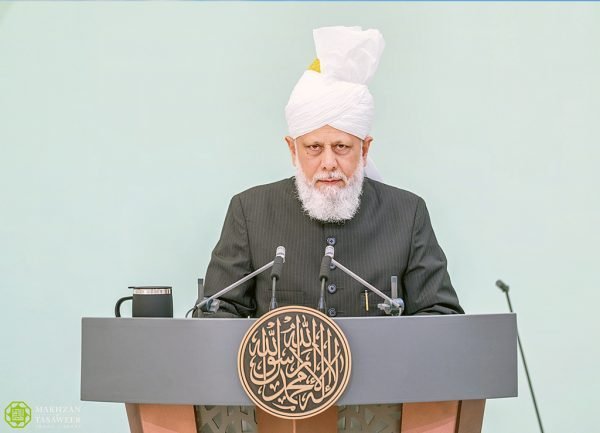
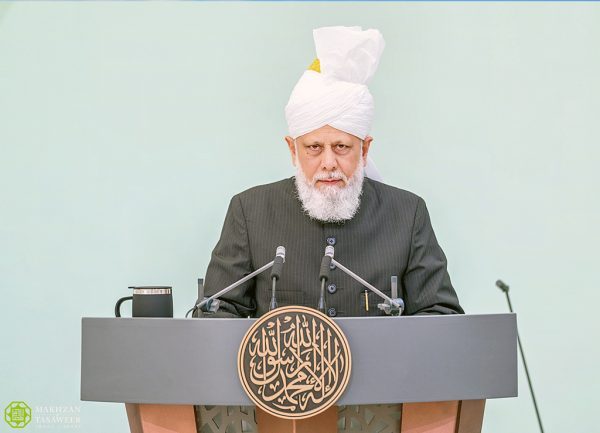
After reciting Tashahhud, Ta‘awwuz and Surah al-Fatihah, His Holiness, Hazrat Mirza Masroor Ahmad (aba), said that he would continue speaking about the example of simplicity established through the life of the Holy Prophet (sa).
The Importance of Carrying Out One’s Own Tasks
His Holiness (aba) said that it is recorded that the Holy Prophet (sa) would go to the market himself to purchase things that he needed. Once, the Holy Prophet (sa) went to the market to buy some clothes. At that time, clothes would be weighed to determine their price. When the clothes that the Holy Prophet (sa) had selected were being weighed, the Holy Prophet (sa) told the merchant to add a little more weight to the scale. The merchant was surprised to hear this, because people usually tell him to mind the scale and lighten it so they pay less. Seeing this simplicity and honesty, the merchant leapt forward to kiss the Holy Prophet’s (sa) hand. However, the Holy Prophet (sa) did not allow it, saying he was no king whose hand should be kissed; rather, he was a man just like them. Then the Holy Prophet (sa) purchased the clothes, and the companions with him moved forward to carry the Holy Prophet’s (sa) clothes for him. However, the Holy Prophet (sa) did not allow them to, saying a person should carry their own belongings, unless they are weak and unable, in which case a Muslim brother should help them.
His Holiness (aba) said that once, on the day of Eid, Hazrat A’ishah (ra) and her friends sang songs that contained lore from the Battle of Bu’ath, which took place in Makkah between the Aus and Khazraj tribes. Hearing this, Hazrat Abu Bakr (ra), who was also present, scolded them, saying they should not sing such things. The Holy Prophet (sa) told Hazrat Abu Bakr (ra) that it was no matter and that it was an informal environment; the songs which they were singing did not contain any element of associating partners with God, so there was no harm in their singing.
An Example in Displaying Patience with Those Who Come to You
His Holiness (aba) said that the Holy Prophet (sa) would always be the first to greet whomever he met with the greeting of peace. This applied to children as well, as the Holy Prophet (sa) would always be the first to greet them with peace. At times, the Holy Prophet (sa) would also place his hand on the children’s head and pray for them. This was the peaceful, simple environment the Holy Prophet (sa) created. Indeed, anyone who sat with the Holy Prophet (sa) and needed to express a need would find that the Holy Prophet (sa) patiently sat with them and listened to what they had to say until they themselves got up to leave. This conduct would encourage them to openly share what they needed. His Holiness (aba) said that office bearers must also emulate this example today.
The Holy Prophet’s (sa) Modesty in Attire
His Holiness (aba) said that a companion who sat in more than a hundred gatherings with the Holy Prophet (sa) described how, in these gatherings, the companions would share poetic couplets and stories from the times of ignorance. The Holy Prophet (sa) would sit in these gatherings and sometimes smile as well. In other words, these gatherings were informal and held in a comfortable environment. Similarly, it is recorded that the Holy Prophet (sa) would sit among his companions in these gatherings so that, if a foreigner walked by, he would not be able to distinguish the Holy Prophet (sa) among those seated.
His Holiness (aba) said that once during the migration from Makkah to Madinah, the Holy Prophet (sa) was sitting under a tree outside of Quba. Some people from Madinah ran out to greet him, but because they had not seen the Holy Prophet (sa), they did not recognise him and mistakenly took Hazrat Abu Bakr (ra) for the Holy Prophet (sa). Hence, they sat in a manner of reverence facing Hazrat Abu Bakr (ra), while the Holy Prophet (sa) did not say anything to correct them. Then Hazrat Abu Bakr (ra) got up and used his sheet to shade the Holy Prophet (sa) from the sun, saying, ‘O Messenger of Allah (sa)’, thus correcting the mistake made by the people of Madinah.
His Holiness (aba) said that the Holy Prophet (sa) would enjoin his companions to adopt simplicity as well. It is recorded that the Holy Prophet (sa) enjoined his companions to do certain things and cautioned them against others. The Holy Prophet (sa) cautioned against wearing gold rings, harir and diwar, or fine silk, brocade, a certain type of fabric from Egypt that contained silk, and silk cushions. Then, the Holy Prophet (sa) enjoined taking part in funeral processions, visiting the sick, and conveying the prayer and greeting of peace to everyone. One reason for prohibiting silk was that it represented arrogance and pride and was a hallmark of the disbelievers. Similarly, wearing gold for men symbolised showing off, displaying pride and haughtiness.
His Aversion to Being Given Preference over Others
His Holiness (aba) said that once, when a companion fell ill, the Holy Prophet (sa) walked to his home to visit him. When he arrived, the companion was unconscious. The Holy Prophet (sa) performed ablution and then used that same water to pour over the companion, upon which the companion woke up.
His Holiness (aba) said that during the Battle of Badr, three companions shared one camel, so they took turns riding it. When it was the Holy Prophet’s (sa) turn to walk, the two companions paired with him insisted that the Holy Prophet (sa) keep riding the camel and that they walk. The Holy Prophet (sa) replied that they were no stronger than he was, and that he, too, wanted the opportunity to earn God’s blessings. Thus, the Holy Prophet (sa) said that they would adhere to the agreed-upon rotation.
His Holiness (aba) recorded that when the Holy Prophet (sa) passed away, he left nothing behind except his mule, which he would ride, his armour, and a piece of land he had vowed for travellers. This reflected the simple manner in which the Holy Prophet (sa) lived his life. The Holy Prophet (sa) considered nothing beneath him. He would feed his own camels, he would do household chores, he would mend his own shoes and clothes, he would milk the goats, he would sit with his workers to eat, he would carry items purchased from the market and bring them home, he would shake hands with both the rich and the poor, he would convey the greeting of peace to everyone, if someone would invite him to their home only to eat dates the Holy Prophet (sa) would not think anything less of it, he would always continue smiling, he would not laugh excessively hard, he would remain fearful of God at all times, he was extremely generous. Still, he avoided extravagant expenditures; he never sought anything out of greed; he was always kind; and he did not eat excessively.
His Example When Receiving Gifts & Food Not to His Liking
His Holiness (aba) said that the Holy Prophet (sa) would accept even the smallest gifts, and the Holy Prophet (sa) would also give gifts. The Holy Prophet (sa) would pray for his children, asking God to grant them exactly what they needed, thus praying for their simple life as well.
Similarly, even if certain foods were not to his liking, the Holy Prophet (sa) would never express his dislike; he would simply avoid eating them. It is recorded that the Holy Prophet (sa) would not mind eating bread with dates. It is even recorded that several days would go by before the Holy Prophet (sa) had a hot and fresh meal to eat. The Holy Prophet (sa) never ate to his fill, unlike those who seem to have made eating the purpose of their lives. The Holy Prophet (sa) showed that it is a hallmark of the righteous to suffice with what is available. It was not uncommon for the Holy Prophet (sa) to have nothing available to eat, so he would suffice with mere dates and water. No matter what he had, the Holy Prophet (sa) would be grateful to God and consider it enough. In fact, the Holy Prophet (sa) adopted such simplicity that he even said he would not eat whilst reclining. This was because it was a habit of worldly people who exult their wealth to eat in this manner. Thus, the Holy Prophet (sa) said that he was an ordinary person and would eat like an ordinary person.
A Perfect Examples in Every Aspect of Life
His Holiness (aba) quoted the Promised Messiah (as) who wrote:
‘The Holy Prophet, peace and blessings of Allah be upon him, is a perfect example in every respect. Study his life and see how he treated women. In my view, an individual who stands up to contend against a woman is an unmanly coward. Study the pure life of the Holy Prophet, peace and blessings of Allah be upon him, so that you may see how kind he was. Even though the Holy Prophet (sa) was an awe-inspiring personality, if an old woman would stop him, he would stand there until the lady would permit him to leave. He would go to the market himself and bring his household items.
On one occasion, the Holy Prophet (sa) purchased something from the market and a companion submitted: ‘Your Holiness, allow me,’ but the Holy Prophet (sa) said: ‘A person ought to carry their own things.’ One should not conclude from this that the Holy Prophet (sa) would never allow others to do small tasks for him, such as bringing his firewood. Nonetheless, these instances demonstrate the simplicity and immense informality of the Holy Prophet (sa). The Holy Prophet (sa) would go from one place to another by foot without any distinction as to who was walking ahead of him or behind him. For it is observed in the case of those who are disposed to formality that they do not appreciate it when others walk ahead of them. In fact, the Holy Prophet (sa) was such a simple man that on certain occasions people could not even identify who the Messenger, peace and blessings of Allah be upon him, was in a group of people.
When the Holy Prophet, peace and blessings of Allah be upon him, arrived in Medina, Hazrat Abu Bakr, may Allah be pleased with him, had a white beard, and so the people thought that he was the Prophet of God, peace and blessings of Allah be upon him. However, Hazrat Abu Bakr (ra) did something to serve the Holy Prophet (sa) in order to show the people that the Holy Prophet sa was the Messenger of God, and it was then that everyone realised the truth.
On certain occasions, the Holy Prophet, peace and blessings of Allah be upon him, even had a race with Hazrat A’ishah, may Allah be pleased with her. On one occasion, the Holy Prophet (sa) outstripped her, and on another occasion, he went easy so that A’ishah, may Allah be pleased with her, could outstrip him, and so she overtook him. Similarly, it is also proven that on one occasion, a few Abyssinians came to show an entertaining spectacle. The Holy Prophet, peace and blessings of Allah be upon him, showed Hazrat A’ishah, may Allah be pleased with her, their demonstration. However, when Hazrat Umar, may Allah be pleased with him, arrived, the Abyssinians saw him and fled.
In short, when a person closely studies the life of the Holy Prophet, peace and blessings of Allah be upon him, they learn a great deal. However, there are certain foolish, benighted individuals who do not reflect over his life, but open their mouths to raise allegations against him – this is the state of the Christians and Arya Samajists.’ (Malfuzat, English Translation, Vol. 3, pp. 296-297)
His Holiness (aba) said that the Holy Prophet’s (sa) station was a lofty one, and his every action serves as an example for us.