


Friday Sermon Summary 6th November 2026: ‘Spending Out of That Which You Love’ – The True Philosophy of Sacrifice
Summary prepared by The Review of Religions
After reciting Tashahhud, Ta‘awwuz, and Surah al-Fatihah, His Holiness, Hazrat Mirza Masroor Ahmad (aba), said that Allah the Almighty says in the Holy Qur’an:
‘Never shall you attain to righteousness unless you spend out of that which you love’ (The Holy Qur’an, 3:93)
How the Companions Attained the Pleasure of God Almighty
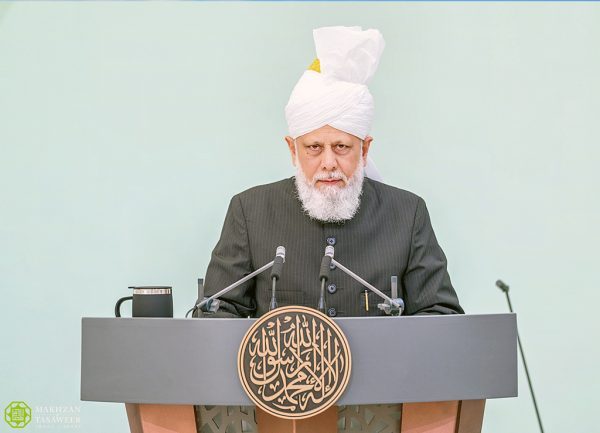
His Holiness (aba) said that it is recorded that when this verse was revealed, Hazrat Talhah (ra) presented his orchard called Bairuha, which he loved, to the Holy Prophet (sa) for the sake of Allah. We find numerous such examples of the companions making immense financial sacrifices. These shining stars remain examples for us to this day. Then, in accordance with the promises of God, came the revival of Islam with the era of the Promised Messiah (as), in whose time the companions made great financial sacrifices as well, because the Promised Messiah (as) taught them the true philosophy of sacrifice.
His Holiness (aba) quoted the Promised Messiah (as), who wrote that the door for righteousness is narrow, and one cannot enter through it simply by spending out of their useless and excess wealth alone. Rather, it is only by spending out of that which they love that they can enter through this door. The companions did not reach the ranks of attaining the pleasure of God by chance; rather, their immense sacrifices and the difficulties they bore for the sake of God led them to these ranks. After these temporary difficulties, a believer attains everlasting comfort and peace.
His Holiness (aba) said that this was the philosophy taught by the Promised Messiah (as) and taught to his companions. As a result, there were companions who had hardly anything to wear aside from the clothes on their backs, yet they still came forward to make whatever sacrifices they could.
The Spirit of Sacrifice Is More Important than the Total
His Holiness (aba) said that this degree of sincerity and loyalty did not end with them. Rather, with the passage of time, there have continued to be people within the Community of the Promised Messiah (as) who come forward to present immense sacrifices. This is all because the Promised Messiah (as) reminded the world in this era of the true and pristine teachings of the Holy Prophet (sa). These people proved that their love was not with their love but with the chosen faith of God. Oftentimes, the people who are at the forefront of financial sacrifice are those who do not even have much to begin with. Conversely, the wealthy often fall into overthinking about their wealth. Often, people who do not have much will put their personal needs aside so that they can sacrifice for the sake of God. These things cannot be comprehended by worldly people; how people who live far afield, who haven’t ever met the Khalifah of the time and may only have heard his voice are the ones who are at the forefront of presenting significant and immense financial sacrifices. These are the people who covet righteousness. These people have attached themselves with the true servant of the Holy Prophet (sa) and seek to understand every conceivable path of attaining righteousness and then seek to tread upon it.
Faith-Inspiring Incidents of Sacrifice
His Holiness (aba) said that he often presents such examples of financial sacrifice and he will do so again today.
His Holiness (aba) said that a new Ahmadi from Guadeloupe attended the Jalsa Salana (Annual Convention) of the Ahmadiyya Muslim Community. There, he came to learn of the financial system of the Community and how financial sacrifices have led to great progress and service to humanity all around the world. He realised how these financial sacrifices are spent only for the sake of God. The missionary had explained this concept to him, but seeing it for himself moved him to present financial sacrifices himself through Tahrik-e-Jadid. But that was not all; he had also conveyed this same concept to his son, who was six or seven years old. One day, as they were going to a park that had an entrance fee, the young boy spoke up on his own and said that after learning about the concept of financial sacrifice, he wished that rather than using the money to pay the park’s entrance fee, he wished to sacrifice that money for the sake of God and donate it to Tahrik-e-Jadid. Such zeal for sacrifice is truly astonishing.
His Holiness (aba) said that there is a man in Guinea-Conakary who makes a living by selling coal and is otherwise quite poor. He had pledged 30,000 Guinea francs for Tahrik-e-Jadid. His daughter was also getting married, for which he had saved some money. When he was reminded about paying his pledge for Tahrik-e-Jadid, he only had the 30,000 Guinea francs that he had saved for his daughter’s wedding. He thought to himself that true virtue is attained by spending out of that which one loves, so he sacrificed that amount for Tahrik-e-Jadid.
After doing so, he received a call from his son – the son who had gone abroad but had not been heard from for so long that his family thought he had passed away and they had even offered his funeral prayer. This son called and said that he had indeed reached France and said that he would be sending a large amount to his father. The man was elated that, as a result of making this financial sacrifice, he was able to find his lost son, and a sum larger than what he had sacrificed was returned to him.
His Holiness (aba) said that there are various incidents from Africa as well. This is despite the fact that the conditions in many African countries are quite precarious. Terrorism has become rampant, and there is a great deal of unrest and fear in many places. His Holiness (aba) urged that everyone should pray for the betterment of their conditions. It is difficult to live in such circumstances, and it is also difficult for these people to leave or go anywhere else. Yet, despite it all, these sincere people continue making financial sacrifices.
His Holiness (aba) said a missionary from Niger wrote that it was difficult for him to reach certain villages because of government restrictions. As a result, it seemed difficult to collect financial contributions. Yet, despite these restrictions, that village sent a message to the missionary saying they had gathered their financial contributions and would send them to the mission house as soon as a means opened up. Finally, when they were able to deliver the amount to the mission house, the missionary opened it and saw that it was greater than in previous years. This was despite the fact that the conditions were much worse. Such is the sincerity of these people that, in the face of grave danger and fear, they continue making immense sacrifices; rather, it is as though they remain waiting for opportunities to offer sacrifices.
His Holiness (aba) said that the first Ahmadi in Argentina was a renowned journalist. Later, due to illness, it became difficult for him to leave his home. His son is also unwell, so the family faces constant financial strain and gets by on his limited pension. It is often the case that they do not have enough money for treatment and medicine. His Holiness (aba) prayed that Allah may grant them healing. The missionary in Argentina felt hesitant to approach them regarding Tahrik-e-Jadid as he knew of their financial circumstances. He told them that only if they wished, they could give a very small amount for the sake of blessings.
A few days later, the man called the missionary and said that he had sent an amount to the Jama’at account as his financial contribution. When the missionary checked, he saw that it was $25 USD. Although it seems like a small amount, given their financial situation, this was a significant amount for him. He is the lone Ahmadi in his family, and he faces opposition from his family and pressure to leave the Community. Yet, he remains steadfast. His Holiness (aba) prayed that Allah may keep him firm in his faith.
His Holiness (aba) said that a man from Sweden pledged that, over payments throughout the year, he wished to ultimately donate an entire month’s salary towards Tahrik-e-Jadid. He began praying that his salary would increase so that he would have to increase his financial sacrifice as well. He began offering voluntary prayers so that Allah would enable him to fulfil his pledge. At one point, it seemed difficult that he would be able to fulfil his pledge; however, he unexpectedly received a dividend from his company that enabled him to do so. Another blessing of this financial sacrifice was that he received one month’s notice before being let go from his job. However, while others continue searching for work, he secured a new job before the month passed. He attributes all of this as being blessings of his financial sacrifice.
His Holiness (aba) said that many people write to him expressing that after making financial sacrifices, they see their affairs somehow being tended to, resolved, and their difficulties being removed. Even matters pertaining to their children and their moral upbringing become resolved in a positive manner.
His Holiness (aba) said that a woman from Canada heard His Holiness’ (aba) sermon from the previous year in which he gave the example of the Promised Messiah’s (as) wife who would submit her pledge at the beginning of the year and then fulfil it. So, this lady wished to follow this example and at the beginning of the year doubled her usual pledge for Tahrik-e-Jadid, equivalent to the amount of two months of her salary. As a result, she saw many blessings – the home they had been trying to sell for two years was finally sold, and they were able to buy a new home. She said many other pending affairs were finally resolved as a result of this sacrifice.
His Holiness (aba) said that a man from Germany received a letter stating that he and his wife owed 50,000 euros in taxes. They continued making financial sacrifices and also wrote to His Holiness (aba) for prayers. Some time later, they received a letter from the tax office stating that, after review, they found they had collected 5,000 euros in excess. Because they had not tried to hide anything, it became clear they owed less than they had initially thought. Then, after receiving that excess amount back, they decided that since everything they had was due to financial sacrifices, they would donate that amount as well. His Holiness (aba) said that those who attempt to evade taxes should try this, because in doing so they embarrass themselves, deceive the government, and incur the displeasure of God. From a worldly standpoint, their wealth becomes unblessed. It is better to be straightforward and pay one’s full taxes, so the government can never say that an Ahmadi has evaded taxes. If one pays their taxes and continues to make financial sacrifices, they will reap God’s blessings and have wealth returned to them manifold.
(These are just some examples of the various incidents shared by His Holiness (aba)).

Announcement of the 93rd year of Tahrik-e-Jadid
His Holiness (aba) said that November marks the beginning of a new year for Tahrik-e-Jadid. The 92nd year of Tahrik-e-Jadid came to an end on 31 October and the 93rd year commenced on 1 November. In the previous year, the worldwide Jama’at donated 20.8 million British pounds towards Tahrik-e-Jadid, an increase of 727,000 British pounds from the year prior. The number of participants or donors towards Tahrik-e-Jadid also increased by 46,616. This number does not include many African countries, which have been unable to report the number of participants. In terms of overall collection, the top ten countries in the world are:
- UK (They have achieved the top position for the first time)
- Germany
- USA
- Canada
- A Middle Eastern country
- India
- Australia
- Indonesia
- Ghana
- A Middle Eastern country
His Holiness (aba) said that contributions from wealthier countries are used to cover expenses for various countries worldwide. For example, this includes the upkeep of mosques and mission houses in Africa, which currently number 7,601. 123 new mosques were built in the past year. There are 2,400 mission houses, including 103 newly built ones. The expenses for all of these mosques and buildings are covered by grants from the central headquarters. There are also 489 missionaries in Africa and 2,274 local missionaries; their expenses and allowances are also covered by the central headquarters. Under the Nusrat Jahan scheme, there are 620 primary and middle schools in 13 African countries whose expenses are largely covered by the central headquarters. Similarly, there are 41 clinics in 14 African countries whose expenses are covered through grants from the central headquarters. There are various hospitals and clinics that are being revamped and renovated, and the expenses of their doctors are also covered. There are also many educational grants that are given. Majority of the funds from Tahrik-e-Jadid are spent on these things.
His Holiness (aba) said that many of the members of the Community are not wealthy but are of the middle class. Yet they continue making immense sacrifices. If we try to compare with the world, then these amounts may seem small, as in worldly affairs they speak of billions and trillions. Yet, there are so many projects that the Community is spending on, while in the worldly realm, a few projects have large amounts spent on them. When we compare results, worldly people are astonished at how the Community is running so many different projects on relatively less amounts. There are further projects like radio stations, MTA studios, There are also South America countries which are financially supported through grants from the central headquarters. There are large amounts spent in various countries and on numerous projects. Just in grants to poorer countries alone, the amount sent in grants is around 17 to 18 million, not including all the various other projects and countries. All of this work is being done and Allah the Almighty blesses the wealth of the Community.
His Holiness (aba) prayed that may Allah bless the wealth of all those who make these financial sacrifices. Majority of these people are of the middle or lower classes yet they continue on making sacrifices. It was thus that the Promised Messiah (as) said that he was astonished at the manner in which the people of his community offer sacrifices. His Holiness (aba) prayed that may Allah grant all those who make such sacrifices the best of rewards.