

Not So Easy at Suez: The Lustre and Limitations of an Anticolonial Watershed
Though few survivors now live to tell the tale, for most people in the Middle East, Southern Asia, or Africa, the first half of the twentieth century was one where the might and global influence of two major powers was taken almost for granted. These were not the United States and Soviet Union, whose rivalry in the Cold War would play so major a role in world history from 1950 to 1990, but the ancient empires of Britain and France. Yet in the aftermath of the Second World War both empires saw their territorial hold unravel, with a spree of decolonial movements leading to the formal independence, if not entire liberation, of most of would be known as the “Third World” or “Global South”. A major watershed in this process was the short but sharp Suez war of November 1956, where both empires joined with Israel to attack Egypt, only to suffer a dramatic geopolitical defeat that hastened their downfall and confirmed both the heyday of decolonization and the supremacy of two younger giants in the American-Soviet competition.
For three centuries the colonial empires of Britain and France, frequent rivals and occasional allies, had spread afar from Western Europe, first grappling over North America and the Indian subcontinent before setting up uneasy cooperation to carve up most of Africa, Southeast Asia, and the Middle East between them at the cost of countless principalities and, more often than not, many millions of people. British and French technological, civilizational, and even innate superiority was almost taken for granted as a fact of life, not simply by self-serving British aristocrats and arrogant French administrators but by many of the millions of Asians and Africans at whose expenses much of their fabulous wealth was built. It would take the bloodiest war in recorded history, during the 1940s, to break this mythos among subject populations, and slowly persuade the imperial elites that colonial empires were no longer feasible. Even so, the lesson was learnt slowly.
Egypt and its Suez Canal was a centrepiece of Anglo-French supremacy. France had first invaded this country under Napoleon Bonaparte at the end of the eighteenth century as part of an unsuccessful international war with Britain. As it broke away from an often neglectful Ottoman rule, Egypt’s militaristic modernization in the nineteenth century was built along the organizational lines and with the frequent aid of French and British military and technical advisors. The 1869 construction of the Suez Canal, connecting the Mediterranean and Red Seas, was without intended pun the highwater mark of this cooperation, and its strategic benefits were not lost on the colonial empires as it provided a shortcut between their European metropoles and their colonies in Asia.
For all its ambitious beginnings, Egypt’s monarchy had become increasingly indebted and reliant on foreign support; this provoked a revolt that was only put down with an Anglo-French invasion in 1882. Britain took control of Egypt and established a protectorate that, frequently over the next seventy years, including during and between the World Wars when governments and even sultans were dismissed under British pressure, made a parody of the once-prized Egyptian independence. At various points, major political protests as well as underground societies tried to challenge colonial rule, but these were quashed sooner or later in the face of British interests.
Keep supporting MuslimMatters for the sake of Allah
Alhamdulillah, we’re at over 850 supporters. Help us get to 900 supporters this month. All it takes is a small gift from a reader like you to keep us going, for just $2 / month.
The Prophet (SAW) has taught us the best of deeds are those that done consistently, even if they are small.
Click here to support MuslimMatters with a monthly donation of $2 per month. Set it and collect blessings from Allah (swt) for the khayr you’re supporting without thinking about it.
Although the costs of the Second World War forced Britain and, more reluctantly amid a series of major wars, France to relinquish many of their holdings, by 1950 both still held a huge swathe of Africa. Indirect, protectorate-style holdings and lopsided alliances as in Egypt were now Britain’s preferred method, but it retained colonies in much of East and South Africa, and France most of North and West Africa. This was hardly unchallenged, however: France fought wars against nationalists in the Indochina peninsula around Vietnam, while Britain faced major unrest especially with its role in establishing the ethnonationalist state of Israel over Palestine.

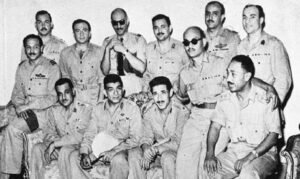
The Free Officers junta in Cairo set a trend of nationalist military coups but also internal repression in the Arab world. (Photo: Ahram)
Even the often cowed Cairo monarchy was inclined to reset its terms, but in summer 1952 fell prey to a military coup by more assertive “Free Officers”. Though the resultant junta embarked in a series of power struggles initially marked the resultant junta, all factions seemed to have agreed on the need for a serious reversal of colonial subjugation and it was on this that Gamal Nasser, a charismatic Free Officer who established himself as a populist dictator by autumn 1954, embarked.
Becoming a Colonial Target
Though Nasser cemented power with major repression – notably against the Ikhwan or Muslim Brethren, an early anti-British partner that he soon sidelined and brutally repressed with perhaps the Muslim world’s first modern police state – Nasser also tapped into the rising anticolonial mood and managed to leverage Egypt’s strategic potential. In Palestine he appropriated the Ikhwan’s earlier role of supporting resistance at Gaza, against Israeli colonization and brutal crackdowns, through an intelligence officer called Mostafa Hafez. In Jordan his attache Salaheddin Mostafa lobbied against longstanding British military commander Bagot Glubb, a paternalistic colonial veteran. He also dispatched navy commander Ezzat Soliman and an intelligence officer called Fathy Dib to Algeria, where they made contact with a major Muslim revolt against France’s century-long colony.
The mid-1950s had become a nightmare for French rule in North Africa, in what its former regional commander Alphonse Juin called Le Maghreb en Feu. France had foolishly deposed Moroccan sultan Mohammad V bin Yusuf but was forced by massive pressure and budding militancy to restore him two years later. In Tunisia France tried unsuccessfully to repress the Neo-Destour party. In both cases more militant Muslim opposition, including raids by what the French army scornfully called fellaghas or peasants, forced France to yield. This was partly influenced by its struggles with the biggest insurgency of the lot, the Front Liberation National in Algeria, where a bitter war had broken out at the same time as Nasser’s 1954 coup.
Cairo’s support for the Algerian insurgency was immensely exaggerated by a France unwilling to admit its lack of support among the long-oppressed Muslims, and an unstinting hostility toward Nasser prevailed. Similarly Israel, already neck-deep in undermining its neighbours, saw Cairo as its major rival. Finally Britain’s pompous prime minister Anthony Eden, who had long dealt in unequal British relations with Cairo, balked at having to bargain with an assertive Egyptian regime over such matters as the British colony in Sudan or the Suez Canal. He preferred to withdraw into comfortable myths and indulge in wildly fanciful comparisons of Nasser with Britain’s most recent dictatorial foe, Adolf Hitler.
Friction rose sharply in 1956. That winter rising anticolonial sentiment had precipitated Britain’s ouster from Sudan; that spring France was forced to give up Morocco and Tunisia even as its Algerian war escalated; Israel assassinated both Mostafas, Hafez at Gaza and Salaheddin at Amman; in fall Jordan’s only free election yielded a cabinet strongly in favour of Nasser, who by now also enjoyed the support of most Arabs, especially Muslims, in Syria, Iraq, and Lebanon. But most galling to the empires was Nasser’s nationalization of the Suez Canal in summer 1956. Acting on a codeword from the dictator’s speech, an Egyptian force led by Mahmoud Younis seized control of the canal from joint Anglo-French control and replaced its French director, Jacques Georges-Picot. By autumn 1956 Britain, France, and Israel were agreed on a Tripartite coalition. The decolonial snake, as they saw it, must lose its head; Egypt had to be cut down to size.
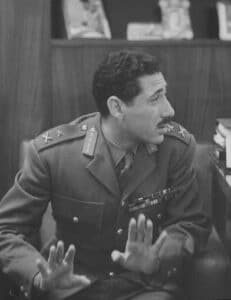
Abdel-Hakim Amer led the military for over a decade (Photo: Google Arts and Culture)
The Tripartite Assault
It was, as has often been the case in Middle Eastern imperial wars, Israel that triggered the war. Under the leadership, and despite the mutually sour relations, of the infamous one-eyed military supremo Moshe Dayan and his corps commander Asaf Simhoni, Israel’s military cast its net wide. At the end of October 1956, fearing Jordanian collusion with Cairo, Israel combed the Jordanian borderlands where Palestinian militants led by Saeed Sabaa and Mahmoud Ashwah had been operating. However, the Israelis contented themselves with a massacre of Arabs at the town of Kafr Qasim, before turning south to focus on Egypt.
Astonishingly, Nasser had ordered the military not to resist the Israeli invasion as he appealed abroad. His military commander Abdel-Hakim Amer indignantly refused and unsuccessfully tried to dismiss airforce commander Sidky Mahmoud, whose fleet had been effectively ground under Israeli fire. Navy commander Soliman, better known for his exploits in Algeria than his naval skills, dispatched a cursory flotilla to counterattack by sea, but this was easily routed; one ship, led by Rushdy Tamzin, tried to bombard Haifa but was sunk off the Palestinian coast.
Amer was caught off guard when Israeli paratroopers, led by future prime minister Arik Sharon, landed east of the Suez Canal in Sinai. The peninsula would be defected, in rather improvisational manner, by Amer’s lieutenant at Arish Anwar Qady, soon reinforced from the west by Talaat Aly. In addition minister Kamaleddin Hussein, a member of the junta with historic connections to the banned Ikhwan, assembled a paramilitary corps of volunteers to reinforce the army. Likewise Palestinians in the Gaza Strip mobilized to assist its defence.
The Egyptian defenders’ confusion was matched by the attackers’ impatience in the Sinai; on his own initiative Sharon, who was as notorious among Israelis for his impetuosity as he was among Arabs for his brutality, made a frontal rush against Talaat’s troops at the Hitan heights to Dayan’s irritation. Dayan was also annoyed at the heavy casualties that his army took in trying to capture the strategic town Abu Agilla, which connected the Sinai’s road network and lay in particularly rugged territory. With garrison commander Samy Boulos badly injured as the Israelis took the town, his replacement Saadeddin Motawally withdrew to the heights around the town and continued to resist repeated attacks until supplies ran out.
There was less Egyptian resistance in the Gaza Strip, where in November 1956 the main Israeli force rumbled southwest in a wave of massacres . In line with Cairo’s orders, governor-general Fouad Digwy surrendered to Simhoni within a fortnight. By that point Israel had already massacred Palestinians at Khan Yunus, where Youssef Agroudy had led the only notable Egyptian resistance, as well as Rafah, where Gafar Abed had surrendered. This viciousness, which served no military purpose, echoed the much larger ethnic cleansing during Israel’s 1948 foundation and, of course, the current genocide of the 2020s.
Meanwhile Britain and France, the colonial twins, had focused their efforts within the vicinity of the Suez Canal. The joint force was led by the British general Hugh Stockwell, who during the last days of the British colony had shown himself an unabashed partisan of Zionist militias against the Palestinians. His French deputy, Andre Beaufre, was a ruthless veteran of the Indochina and Algeria wars who believed in the concept of total war. As in the Israeli and Egyptian commands, the pair frequently squabbled, but both had hoped that, rather than focus on the Suez Canal, they should attack the northern port city Alexandria and push on Cairo, forcing Nasser’s capitulation.
Instead, the colonial coalition was tasked with focusing on the Suez Canal and launched their main attack around the Suez Canal’s northern tip, at Ports Saeed and Fouad. Against this daunting expedition the defenders were clearly outmatched, but their commander Salaheddin Moguy doggedly held out, playing for time while reinforcing his troops. And this paid off when, within days, Nasser’s gamble paid off with a diplomatic coup.
A Geopolitical Coup for Ommel-Dounia
Though they were not yet ready to admit it, both Britain and France had been eclipsed in the 1940s by the two giants of the Cold War, the Western United States and the Eastern Soviets. Despite their own record of empire, both these powers officially criticized colonialism and, in their mutual rivalry, sought to gain the support of the colonized “Third World” that had begun to shake off the colonial yoke. Both also had pressing issues closer to home than the Middle East: the Soviet Union had just invaded Hungary to install a client government, while American ruler Dwight Eisenhower was at the deep end of a reelection campaign. Neither wanted the rising “Third World”, a key battleground in the Cold War, to flip to the other side.
Because of closer American links with and leverage over the Tripartite coalition, Eisenhower’s influence proved key. He denounced the Tripartite invasion and called for the United Nations, still taken seriously at that early stage, to mediate. Canadian foreign minister Lester Pearson, a future prime minister, went further by setting up the first United Nations peacekeeping force.
Forced to comply, the Tripartite Powers were aghast: not only had their military gyrations and pyrotechnics proven useless, but they had been hung out to dry by a power that they assumed was their own. The Suez war was politically devastating for Eden, who resigned in disgrace, and his British empire, which was forced to accept its subservience to and eclipse by the United States. Having hedged its bets on both sides of the Cold War, from then on Israel increasingly focused, to considerable effect, on expanding its political and propaganda reach in the United States, so that several generations of American elites have since been bound hand in glove with the Zionist cause. And France sullenly returned to its internal convulsions and bloody Algerian war, which, like Suez, was a key watershed in the decolonial process.
For Egyptians, and most Muslims, Arabs, Africans, Asians, and indeed people of the “Third World”, this unexpected result had confirmed the country’s historical role as “Ommel-Dounya”, the World’s Mother. The land of the Nile and Sinai has indeed always been a key strategic power in the region if not the world, and this was never more evident than in the late 1950s. As pro-Nasser anticolonialism of various types drew succour and practical support from the outcome of the Suez Crisis, one country after another flung off colonial control; by 1960, most of Africa was formally independent. In the Middle East, Syria willingly joined Egypt in what would be an unhappy, but was certainly originally a thrilling, marriage; Iraq, Jordan, Lebanon, and even parts of Saudi Arabia and Yemen shared similar sentiments. Though colonial claims about Cairo’s control was wildly exaggerated, Egypt did thrust itself into one diplomatic adventure after another, revelling in its status as a leader of the Third World and a natural bridge between Africa, Asia, and the Arab world. To this extent, its win cannot but be celebrated as a major triumph.
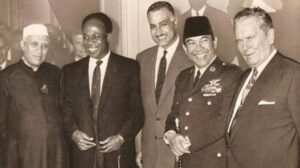
Nasser was a major leader in the decolonization period and in the Non-Aligned Movement, which formally shunned vassalage to either the American or Soviet blocs. Despite this, he had benefited from the American-Soviet rivalry in 1956 (Source: UnHerd)
The Cost of Wrong Lessons Learnt
But Nasser also learned the wrong lesson from his win. His gamble had paid off this time, and it enabled him to ignore or intensify the uglier underbelly of his regime. His Egypt was a dictatorship, setting a pattern of tightly controlled states through the region that preached revolution even as they indulged in internal repression. Beyond slogans, societal reform and justice were largely buzzwords: indeed only months earlier Nasser had set a trend by sidelining shariah and placing Islam, which he continually cited in public, in a position of subservience to the state. Similarly, revolutionary rhetoric did not disguise the fact that the country was under a tight elite that often made decisions on whims.
This Nasser thought he could overcome with skilful external diplomacy, riding the anticolonial wave and playing off the United States – who, it is often forgotten, had supported his initial takeover from the British-backed monarchy – and the Soviet Union but falling short of satisfying either. The Non-Aligned Movement in which he was a leader refused to join either the American West or Soviet East in a worthy stance; yet Nasser’s own strategy relied on both powers, which had fast displaced Britain and France as the major empires of the day.
By contrast, Israel had long enjoyed both American and Soviet support; 1956 had been but an exception to the rule, and the American connection was especially strengthened in subsequent years through restless lobbying and enormous propaganda; Nasser foolishly thought he could outbid the Israelis who presented themselves as a civilizational beacon of white civilization in a region of Muslim barbarism, a propagandistic point that no amount of Egyptian appeasement could outmatch in the long run.
Tellingly, over the next eight years Nasser refused to upgrade his military precisely because it might antagonize one of the two Cold War powers. The military, so key to a strategic power, was left entirely under political whims, so that it would be led for years afterward by the same strategic command that had, in purely military terms, failed in 1956. These shortcomings would be brutally laid bare during the six-day war of 1967, where Nasser’s gains were overwhelmed in an Israeli surge, now unequivocally backed by one of the two Cold War giants that Cairo had sought to pacify, which shattered the exhilarating prestige of 1956.
Keep supporting MuslimMatters for the sake of Allah
Alhamdulillah, we’re at over 850 supporters. Help us get to 900 supporters this month. All it takes is a small gift from a reader like you to keep us going, for just $2 / month.
The Prophet (SAW) has taught us the best of deeds are those that done consistently, even if they are small.
Click here to support MuslimMatters with a monthly donation of $2 per month. Set it and collect blessings from Allah (swt) for the khayr you’re supporting without thinking about it.