

Friday Sermon Summary 27th November 2026: ‘The Promised Messiah’s (as) Simplicity in Relation to Food’
Summary Prepared by The Review of Religions
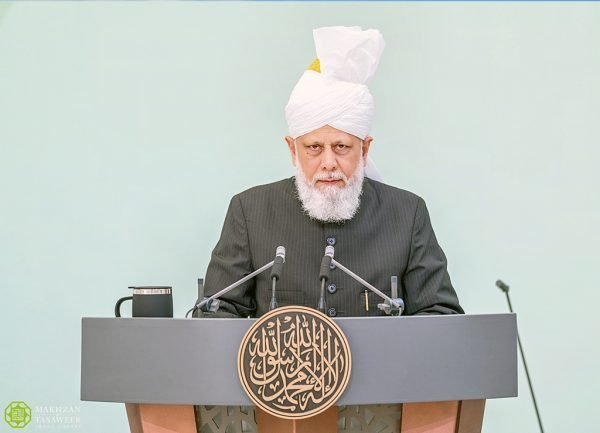
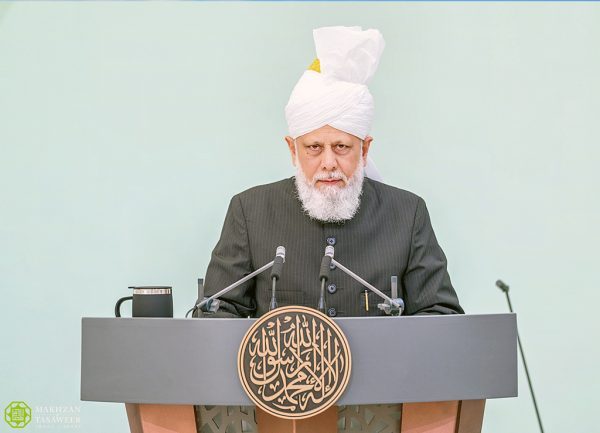
After reciting Tashahhud, Ta‘awwuz and Surah al-Fatihah, His Holiness, Hazrat Mirza Masroor Ahmad (aba), continued speaking about the simplicity with which the Promised Messiah (as) led his life.
His Holiness (aba) quoted Hazrat Mirza Bashiruddin Mahmud Ahmad (ra), the Second Caliph, who said that after the demise of the Promised Messiah’s (as) father, he left all his worldly work and dedicated his time to studying the faith and defending Islam against attacks by responding to them in newspapers and various publications. Typically, at such a time, people fight over money; however, the Promised Messiah (as) handed all of his property over to his brother. He took no part in the income of that property, nor did he do any work related to it. His food would be arranged by his brother, and often the Promised Messiah (as) would distribute the food among the poor.
The Promised Messiah’s (as) Ability to Suffice on Little Food
His Holiness (aba) quoted the Promised Messiah (as) who said:
‘Allah the Exalted knows well that I possess such tolerance as far as food is concerned that I can very easily eat twice a day on one paisa alone. Once, I was intrigued at heart to see the extent to which a human being can bear hunger. To test this, I ate nothing for six months – I would have a morsel or two every now and then. After six months, I estimated that I could extend this state of affairs to even six years. During this time, I continuously received my meals from home twice a day, but I desired to keep this state of mine a secret. The difficulty that I bore in order to keep this secret was a burden that perhaps others could not bear due to hunger; I would distribute those two meals to two or three people in need. In this state, I would offer my five daily prayers in the mosque, and none of the people who knew me could tell by any signs that I was eating nothing.’ (Malfuzat, English Translation, Vol. 2, p. 172)
His Holiness (aba) said that it is recorded that when the Promised Messiah (as) would have pita, he would break it into small pieces and eat certain pieces only. Some have said that the Promised Messiah (as) would say he searched among the pieces for those that praised God. Allah says in the Holy Qur’an, ‘Whatever is in the heavens and whatever is in the earth glorifies Allah.’ In other words, every single thing that has been created, in one way or another, praises God; it is a matter of us actually ‘listening’ to that praise and glorification. When one enjoys something that Allah has created and cannot help but say ‘Holy is Allah’, then that too is a form of that thing glorifying Allah.
His Holiness (aba) said that once, the Promised Messiah (as) said that he had not eaten meat for an entire year and instead sufficed primarily on pita and bread. Similarly, once, when someone observed the manner in which the Promised Messiah (as) ate, he observed that in reality, the Promised Messiah (as) would eat only a few morsels. Instead, as he sat to eat, the Promised Messiah (as) would encourage all those around him to eat and continue offering them food.
His Holiness (aba) said that once the Promised Messiah (as) was walking with some of his companions. Along the way, the Promised Messiah (as) asked for some water. When a glass of water was presented to him, the Promised Messiah (as) took a seat on the ground while he drank the water and then continued walking after he was done.
His Unassuming Nature When Sitting with Others
His Holiness (aba) said that once, the Promised Messiah (as) went to an orchard with his companions and suggested that they eat some fruit from the orchard. So, the Promised Messiah (as) took a seat on the grass along with some of his companions while some fruit was picked from the trees and they ate it. Hazrat Mirza Bashiruddin Mahmud Ahmad (ra) writes that some mystics may be of the opinion that one should not eat in this manner; however, the Promised Messiah (as) set this example for all others to show that there is no disgrace or embarrassment in sitting with others in this manner and eating with them.
An Example in Appreciating Your Wife’s Cooking
His Holiness (aba) said that the Promised Messiah’s (as) blessed wife narrated that she had come to know that the Promised Messiah (as) liked sweet rice, and so, with great care and excitement, she prepared sweet rice for the Promised Messiah (as). As she was making it, she put four times the amount of sugar that was required. That was all the food that had been prepared, and so she was very sad once she poured the rice out of the pot and realised that it had not been made right. When the Promised Messiah (as) saw the look on her face, he smiled and asked whether she was sad because she thought the rice had been ruined. The Promised Messiah (as) said that there was nothing wrong with the rice; in fact, they were made exactly as he liked it, and he happily ate it. All the while, he kept complimenting the rice until his blessed wife became quite happy and pleased.
His Holiness (aba) said that even today, there are many marital issues that arise on account of the wife not knowing how to cook or because she may not have cooked something exactly right. His Holiness (aba) said that such people must develop tenderness in their hearts and should not give rise to unnecessary quarrels, especially not on account of the manner in which food is cooked.
His Desire for Simple Food
His Holiness (aba) said that once, by the time the Promised Messiah (as) reached the kitchen to eat, the food that had been prepared was already finished. It was offered to the Promised Messiah (as) that fresh food would be prepared; however, the Promised Messiah (as) said that there was no need and he should simply be brought some bread and milk. However, there was no milk at the time either. The Promised Messiah (as) said that it was not an issue; he would dip the bread in water and eat it that way.
His Holiness (aba) said that often, when not occupied with literary work, the Promised Messiah (as) would not eat much. He would often eat once a day, and sometimes he would suffice only on milk. The Promised Messiah (as) would also eat good foods like meat; however, whenever he did, he would eat in very small quantities.
His Holiness (aba) said that the Promised Messiah (as) said that often, God would reveal to him even that which he would have to eat the next day, and it would come to pass that he would be presented with the food that he had been informed about through revelation.
His Holiness (aba) said that once, in a conversation with a new Muslim from Australia, the Promised Messiah (as) explained that he lived his life by the principle of simplicity and that he had not adopted the affectations that have become prevalent in Europe. He explained that he avoided any such practices that would only bring on further difficulties. He said that even when it came to food, he chose to adopt simplicity as his fundamental practice.
His Holiness (aba) said that it is recorded that the Promised Messiah (as) would often help with various tasks and chores around the home and was not at all averse to working with his own hands. Hazrat Mirza Bashiruddin Mahmud Ahmad (ra) once advised the Community to adopt the habit of doing work with their own hands and not considering it to be beneath them. He said that leaders and rulers will seldom, if ever, be seen doing any work with their own hands, let alone lifting anything. However, he cited the example of the Promised Messiah (as), whom he often saw working with his own hands, such as arranging pots and washing them himself. There are many examples and instances of when people observed the Promised Messiah (as) carrying things himself, or doing various tasks himself rather than having others do them for him.
His Holiness (aba) said that he has related just a few examples from the life of the Promised Messiah (as) exhibiting how he led a simple life. The Promised Messiah (as) wished for his Community to adopt the same standards of simplicity. His Holiness (aba) prayed that may Allah enable us to adopt these same principles in our lives.

Funeral Prayer
His Holiness (aba) said that he would lead the funeral prayer in absentia of the following:
Abdul Hayy Waqar
Abdul Hayy Waqar, who was a missionary serving Rabwah. He passed away at the age of 25 in an accident. He is survived by his parents and a younger sister. His father is also a life-devotee of the Community. Abdul Hayy Waqar graduated from Jamia Ahmadiyya Rabwah in 2024 and was specialising in refuting atheism. He possessed many virtuous qualities. He never complained about anyone at home. He lived a very simple life. He never sought anything from anyone, and he would suffice on his minimal allowance. His father says that he came to learn of many of his son’s virtuous qualities after he passed away, showing that he often did things quietly and not to be seen by others. He always remained mindful of his duty as a life-devotee, and this is a quality that every life-devotee should adopt. He set an example of how to honour relationships with others. His mother says that he lived his life very humbly. He was very obedient, bright and kind. He also would help his mother in her work. His sister says that he would often work late at the office. If ever she complained about someone, he would conversely try to tell her about their good qualities. No matter how late he came home, he would ensure to offer two units of voluntary prayer before going to sleep. He was loyal to the Community and he would say that he did not require any office or position to serve the Community rather he was happy to silently offer as much service as he possibly could. Whenever he had time, he would remain engaged in the remembrance of Allah, especially between his classes. His Holiness (aba) said that this is an example for every life-devotee; that whenever there is time they should spend it in praying and remaining engaged in the remembrance of God, as doing so will bless their work, rather than remaining occupied on various technologies. His Holiness (aba) prayed that may Allah grant the deceased forgiveness and mercy.