

Friday Sermon Summary 7th August 2026: ‘The Holy Prophet’s (sa) Teachings & Practical Example of Expressing Gratitude’
Summary prepared by The Review of Religions
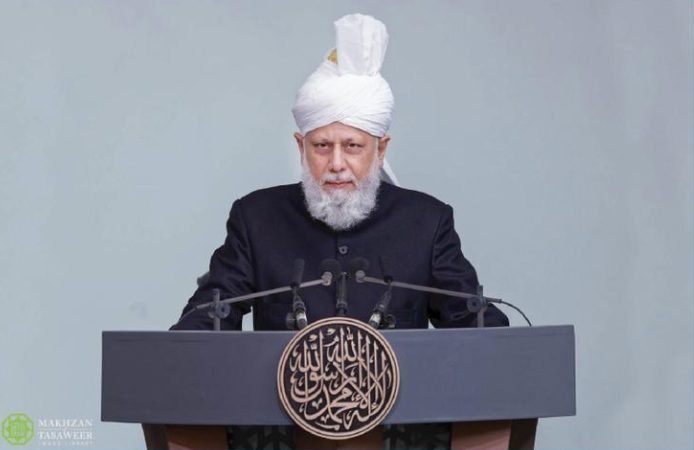
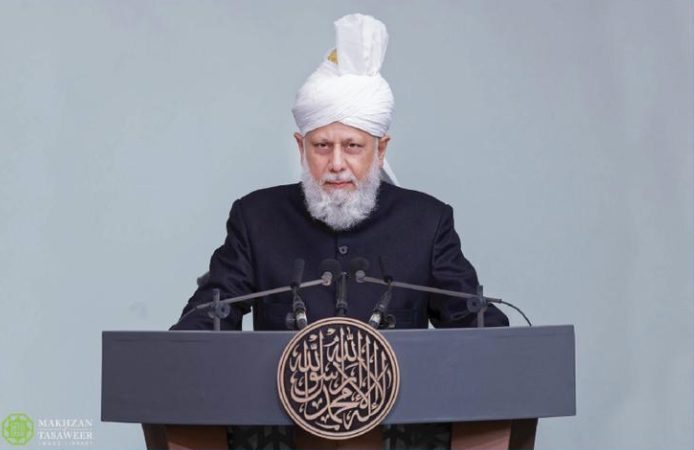
After reciting Tashahhud, Ta‘awwuz, and Surah al-Fatihah, His Holiness, Hazrat Mirza Masroor Ahmad (aba), said that he would continue to mention the standards of the Holy Prophet’s (sa) gratitude, along with his actions and teachings in this regard.
Gratitude in Even Small Matters
His Holiness (aba) said that the Holy Prophet (sa) enjoined gratitude for even the smallest of matters. The Holy Prophet (sa) said that it pleases God whenever a person expresses gratitude for every morsel they eat and every sip they drink. Similarly, once, the Holy Prophet (sa) entered his home and saw a piece of bread that had been sitting out. The Holy Prophet (sa) cleaned it and ate it. Thereafter, he said to Hazrat A’ishah (ra) that one should honour that which is honourable. When God deprives a people of provisions, then they are never able to receive them again. Thus, the Holy Prophet (sa) showed gratitude for everything, no matter how small it was. Therefore, if a person wishes for their provisions and wealth to become blessed, then they should show gratitude for everything they have.
His Holiness (aba) said that on the day of the Conquest of Makkah, the Holy Prophet (sa) went to his cousin Umm Hani’s home. He was hungry and asked if she had anything to eat. She replied that she had nothing but dried bread, but expressed her embarrassment at presenting that before the Holy Prophet (sa). However, the Holy Prophet (sa) said that she should bring the stale bread, which he dipped in water and ate.
Then, the Holy Prophet (sa) asked Umm Hani if she had any curry or stew. She replied that she had nothing but vinegar. The Holy Prophet (sa) asked for that to be brought, and poured it over the bread. The Holy Prophet (sa) then said that vinegar is an excellent meal, and a home that possesses vinegar can never be poor.
Such was the standard of the Holy Prophet’s (sa) gratitude. Despite living in developed countries, many are ungrateful and expressing ingratitude over the smallest matters, rather than being truly grateful for all the blessings that God has bestowed.
The Spirit of Gratitude We Must All Adopt
His Holiness (aba) quoted Hazrat Mirza Bashiruddin Mahmud Ahmad (ra), the Second Caliph of the Ahmadiyya Muslim Community, who said that today, people cannot bring themselves to wear torn clothes, yet if the Holy Prophet’s (sa) companions received even torn clothes, their heads would bow in gratitude. Similarly, today, whenever some food is presented, people often wish that they had something else that they would have liked to eat. Yet, if the companions of the Holy Prophet (sa) received even stale bread to eat, they would continuously express their gratitude to God.
The greatest example of this gratitude was exhibited by the Holy Prophet (sa), as is evidenced from the incident at the Conquest of Makkah when he visited his cousin’s home where there was only stale bread and vinegar to eat, upon which the Holy Prophet (sa) expressed gratitude. Gratitude develops great strength within a person, whereas experiencing the bounties of God and not expressing gratitude for them does not strengthen a person’s character in the slightest. Gratitude can turn even the smallest amount of food into that which is sufficient.
His Holiness (aba) said that this spirit of gratitude is something which everyone should adopt, and in particular those who are life devotees. They should be grateful for whatever little means they may have, and they should adopt and elevate the standards of their own gratitude as well as their wives and children. They have dedicated their lives for a grand purpose, and to achieve that purpose they must establish grand examples and strive to act upon them.
His Holiness (aba) said that the Holy Prophet (sa) would not only express gratitude for the service of his companions but also grant them many prayers. Once during a journey, the Holy Prophet (sa) fell asleep on his mount, causing him to slide down on one side. Without saying anything, a companion went over to that side to support the Holy Prophet (sa) so that he would remain balanced on his mount. This happened a second and then a third time. When this happened a third time, the Holy Prophet (sa) asked him how long he had been walking alongside and supporting him in that manner. The companion replied that he had been doing so throughout the night. The Holy Prophet (sa) prayed that Allah may protect him, the same way he protected Allah’s Prophet. This was the esteemed manner in which the Holy Prophet (sa) expressed his gratitude.
His Holiness (aba) said that once, the Holy Prophet (sa) said that Allah asked him if he wished the entire city of Makkah to be turned into gold for him. The Holy Prophet (sa) replied that instead of this, he wished to remain hungry one day and then eat to his fill the next day, so that he may express gratitude to God upon eating to his fill, and he may beseech God when he is in a state of hunger.
His Holiness (aba) said that the Holy Prophet (sa) would drink water in three breaths – that is, the Holy Prophet (sa) would not drink water in one big gulp, and instead would calmly drink water taking three breaths in between. Every time he would break to take a breath, he would express gratitude to God.
The Importance of Returning a Favour
His Holiness (aba) said that the Holy Prophet (sa) once said that if a person received a favour from someone, they should try to return that favour. If they are unable to return the favour, then they should recount the favour they received in the presence of others, because a person who recounts a favour expresses gratitude for that favour. A person who falsely attributes greatness to themselves is like a person who is shrouded in two clothes of falsehood. In other words, such a person is a liar from head to toe.
His Holiness (aba) said that the Holy Prophet (sa) always remembered those who had done any favour for him and would recount them. For example, there was Hazrat Khadijah (ra), who stood by and supported the Holy Prophet (sa) at every step. She was one of the wealthier women in Makkah, and after her marriage to the Holy Prophet (sa), she presented all of her wealth to the Holy Prophet (sa) for him to use however he pleased. Then, after his claim to prophethood, Hazrat Khadijah (ra) stood by her husband through every trial and difficulty. She did so until she passed away in the tenth year of the Holy Prophet’s (sa) ministry.
For the rest of his life, the Holy Prophet (sa) would recount all the favours and kindnesses that Hazrat Khadijah (ra) had done for him. He did so to the extent that the Holy Prophet’s (sa) other wives would become envious. Once, Hazrat A’ishah (ra) asked the Holy Prophet (sa) why he continued speaking of the favours of his old wife when he had now been granted other wives. The Holy Prophet (sa) said that he had no better wife than Hazrat Khadijah (ra) because she accepted him when others rejected him, and when others rejected him, she spoke in his favour, and when others deprived him of their wealth, she gave him her wealth, and God granted him progeny through her, something which he did not have from any other wife. Thus, the Holy Prophet (sa) showed gratitude for Hazrat Khadijah (ra) throughout his life.
His Holiness (aba) said that once, the Holy Prophet (sa) said that Allah gave a man the choice between preferring the world or the blessings that reside with Him, and that man chose the blessings that reside with Allah. Upon hearing this, Hazrat Abu Bakr (ra) began crying, which surprised the other companions. Hazrat Abu Bakr (ra) had understood that the man the Holy Prophet (sa) was referring to was indeed himself. Upon this, the Holy Prophet (sa) said that through his companionship and his wealth, no one had done more favours for him than Hazrat Abu Bakr (ra). The Holy Prophet (sa) said that if he were to have any close friend other than Allah, then it would be Hazrat Abu Bakr (ra).
His Holiness (aba) said that when the Muslims were facing grave persecution in Makkah, some of them migrated to Abyssinia, where the king granted them refuge. The Holy Prophet (sa) always remembered this favour done by King Negus and expressed gratitude for it whenever he could. Once, when Negus’ delegation came to visit him, the Holy Prophet (sa) stood to greet them. The companions said that they could receive the delegation; however, the Holy Prophet (sa) said that Negus had done a great favour upon the Muslims, and he wished to personally return this favour. It was out of this same spirit of gratitude that the Holy Prophet (sa) also offered his funeral prayer in absentia at the time of his passing.
The Holy Prophet (sa) as a Grateful Servant of God
His Holiness (aba) said that prior to his migration, the Holy Prophet (sa) accepted the pledge of allegiance from 70 people who had come to see him from Madinah. One of those people expressed to the Holy Prophet (sa) his desire for him not to return to Makkah even after God had granted him victory. Upon this, the Holy Prophet (sa) said that this would never be the case. The Holy Prophet (sa) said that their blood would be his blood, their friends would be his friends, and their enemies would be his enemies.
His Holiness (aba) said that once during a journey, the Holy Prophet (sa) got married to Hazrat Safiyyah (ra). That night, a companion stood guard outside the Holy Prophet’s (sa) tent. The next morning, the Holy Prophet (sa) asked him what he was doing. The companion replied that he feared lest his wife may cause any harm on account of the fact that her father and brothers had been killed in the Battle of Khaibar and she was only a new convert to Islam. Seeing his sincerity, the Holy Prophet (sa) prayed that Allah may protect this companion the same way in which he protected him throughout the night.
His Holiness (aba) said that once the Holy Prophet (sa) requested some water to drink. A companion brought him some water in a vessel. There was a hair in the vessel, which the companion took out before presenting the water to the Holy Prophet (sa). Even upon this small act, the Holy Prophet (sa) prayed that Allah may grant this man beauty. The Holy Prophet (sa) spared no opportunity to express gratitude. It is recorded that this companion lived a long life, and not a single hair on his head or in his beard became white as a result of the Holy Prophet’s (sa) prayer for him.
His Holiness (aba) said that the Holy Prophet (sa) once said that if someone received a gift, then they should try to give a gift in return. If they are unable to give a gift in return, then they should speak to others about the gift they received. One who recounts a gift they received expresses gratitude, while one who conceals it is ungrateful.
His Holiness (aba) said that the Holy Prophet (sa) would stand at night in prayer for so long that his feet would become swollen. Seeing this, Hazrat A’ishah (ra) asked him why he did this when Allah had already protected him from all past and future sins. The Holy Prophet (sa) replied, saying that should he not be a grateful servant? Thus, the Holy Prophet (sa) reached the heights in becoming a grateful servant and in doing so enjoined us to do the same. In other words, to become truly grateful to God requires true effort and progress in our worship to HIm.
His Holiness (aba) prayed that may Allah enable everyone to become truly grateful, to become true servants of God and those who always receive the blessings of God.