

What Love Asks of Us
Blog post brought to you by Laila Katie Helms
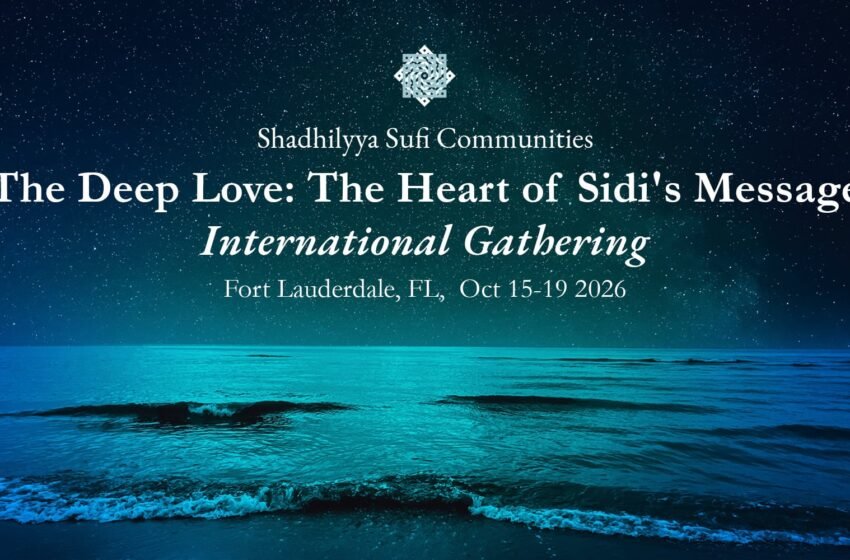
There’s a passage in Music of the Soul that undoes a common assumption: that we come to love God by first coming to know Him. It’s a passage worth sitting with on the page and in our writings. It’s the kind of teaching that asks to be practiced with other people, rather than only read alone. That’s a lot of what this October is for.
Love before knowledge
“From love comes the desire to know, and then the longing for the beauty of the essence” (p.392, MoS). Love isn’t the reward at the end of understanding. It’s the beginning of it. Love is not predicated on knowledge, knowledge is what lover goes looking for when they want more.
A love that asks something back
Once love is present, it doesn’t leave us where it found us. “He has made obedience to Him the source of His love, and obedience to His love a condition for loving Him” (p.392). Read it slowly, maybe copy it into a notebook so it can fully sink in. That’s not one requirement — it’s a loop. Obedience opens the door to love. Love, once it’s in you, asks for obedience in return. Neither one finishes the other. They keep circling, deepening each other, the same way this year’s gathering theme reminds us that this Love never lets us stop anywhere.
Trusting in what remains
What does that circling actually rest on? Trust — total trust, of a particular kind. The text describes it as: “trusting in His isolation with the attributes of perfection, for all else is non-existent, because all things return to Him in the complete commitment to Him and in the complete trust in Him” (p.393).
Not trust as a comforting feeling, but trust as a recognition: that everything we might otherwise rely on eventually returns to the One thing that doesn’t end. Everything else is passing through. Everything else must be a path straight to the Unity. It takes trust to walk that path and that kind of trust is hard to build alone, in the middle of an ordinary week. We create Sufi gatherings to be surrounded by people practicing the same surrender, the same walking.
What it feels like to be caught up in it
If all of that sounds abstract, Sidi gets remarkably concrete about what it actually feels like to be caught up in this love. He names real, specific states: “friendliness, expansion and contraction of the heart, witnessing, manifestation, annihilation (al-fana), subsistence (al-baqa)” (p.393). Read together, it’s less a checklist and more an invitation — an invitation to become a lover of the Unity, willing to move through whatever state that love brings, whether it feels expansive or contracted, whether you’re witnessing something or seemingly losing yourself entirely. These aren’t abstractions at a gathering. They’re what a strong hadra, a real sohbet, a held dhikr circle can actually open in you – not guaranteed, but far more possible together than alone.
Held past what we can hold
There’s an honesty in this passage about what that losing-of-self actually costs the mind. The lover, it says, “is forgetful because he cannot contain all of its truth” (p.393). Not forgetful as a flaw — forgetful because the truth being encountered is simply too vast for memory to hold onto in it’s wholeness. Some things aren’t meant to be retained. They’re meant to be returned to, again and again – which is part of why a single visit, a single class, rarely does what a sustained gathering can do.
Beyond words
This is perhaps why the passage goes on to say: “the intoxication of the love is a condition of the essence, so that the one who reaches it does not awaken to be able to talk about the reality of it” (p.394). There’s something almost merciful in that. We’re not meant to fully explain this. We’re meant to taste it — and however inadequate our words are afterward, however forgetful we become, that’s not a failure of the practice. It might be a feature.
Why gather?
In challenging seasons, this teaching on obedience, trust, and release isn’t abstract. It’s the medicine the moment calls for. A blog post can point at that medicine but it cannot administer it. That is more likely to happen in community, in dhikr and sohbet, with sustained presence over many days. What’s practiced there isn’t meant to end when the gathering does. The trust, the surrender, the willingness to be forgetful and undone by something larger than us – that’s meant to travel home, into the ordinary week after, when the room isn’t there to hold us anymore.
Come, let’s take a drink — of a love that asks everything of us, and gives us, in return, more than we could ever hold onto or explain with words.